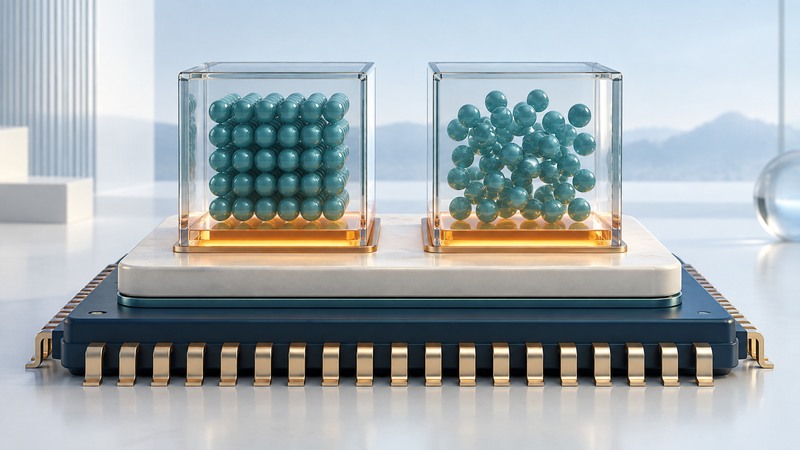
Phase-change memory stores information in a material’s physical state and reads it through an electrical property. Understanding that mechanism makes it easier to evaluate claims about speed, endurance and data retention—and to distinguish an interesting device experiment from a complete memory system.
How a phase-change cell stores information
In electrical PCM, a crystalline state generally conducts more readily than an amorphous, disordered state. Electrical pulses produce localized heating to change that state. A lower-energy read measures resistance without intentionally reprogramming the cell. IBM’s 2018 account of single-element phase-change research describes the conductivity contrast and thermally driven transition.
The common SET operation promotes crystallization, producing a lower-resistance state. RESET melts a small region and quenches it rapidly into a higher-resistance amorphous state. IBM researchers illustrate these distinct thermal histories in their 2009 storage-class-memory tutorial, slides C-3 through C-6. The names describe device operations; the assignment of logical zero and one belongs to the memory’s encoding.
Nonvolatile storage retains its state without continuous power, within the device’s specified conditions. Retention still has a time, temperature and error criterion. Write energy, read energy and idle-system power answer different questions and should be compared separately.
Ask for conditions behind each result
On narrow screens, focus the table and use the arrow keys or swipe to see every column.
| Reported property | Conditions to look for | Why the conditions matter |
|---|---|---|
| Switching time | SET or RESET; pulse shape; verification steps. | A short material transition does not include every system operation. |
| Retention | Temperature, elapsed time, state levels and acceptable errors. | A result is meaningful for the tested storage requirement. |
| Endurance | Cycles, failure criterion, sample count and programming conditions. | A best-performing cell gives limited evidence about an entire array. |
| Energy | Per pulse, per bit or complete operation; peripheral circuits included. | Array and controller work can change the system total. |
| Density | Cell footprint, access device, array overhead and usable capacity. | Material dimensions alone leave out supporting circuitry. |
The 2016 PCM technology survey discusses retention, switching, endurance, 3D integration and multiple bits per cell as connected design challenges. A change that improves one measured property must be evaluated against the others under the intended workload.
Endurance is also a physical reliability question. A 2019 review of PCM cycling endurance relates stuck-state failures to material movement, including segregation and void formation. Use device-specific qualification evidence when deciding how frequently a memory may be rewritten.
Why multiple levels make reading harder
A cell can represent more information if its read circuit reliably distinguishes several resistance ranges. The 2016 survey identifies resistance drift during relaxation of the amorphous material as a challenge for multilevel operation. The engineering task is to preserve enough separation between the distributions, including variation among devices and changes over time.
Encoding example: two distinguishable states can represent one bit. Four states can represent two bits because 2² = 4; sixteen states can represent four bits because 2⁴ = 16. This arithmetic says how many labels are possible. It establishes neither a usable noise margin nor a particular product’s retention. To assess a four-state experiment, ask for the four measured distributions after the specified time and temperature, plus the observed error rate.
A useful comparison keeps the readout method, error correction and programming verification visible. If one experiment reports raw cell errors while another reports corrected output, preserve that distinction in the comparison.
Recognize the level of evidence
- A material experiment establishes behavior in a particular composition and structure. Record its scale and test conditions.
- A device or array demonstration adds evidence about addressing, programming and reading multiple cells. Look for variation and the number of devices tested.
- A computing demonstration adds an application and a method for interpreting imperfect physical signals. Evaluate application accuracy and the complete measured energy boundary.
- A product decision requires the exact part’s interface, qualification, operating limits, availability and support documentation. A research paper alone leaves those questions open.
The distinction has practical consequences. IBM’s 2018 antimony study described an amorphous state stable for thousands of seconds at room temperature and identified improving retention as further work. That is a scoped research result; it is insufficient evidence for a long-term archive. The same report explored memory and in-memory-computing uses where requirements can differ.
Phase-change materials also appear in optical storage, where light writes or reads the medium; see the UDO archive guide. Electrical PCM, MRAM and 3D memory integration describe different mechanisms or architectural choices. Compare them by a defined task and measured conditions, keeping their categories clear.