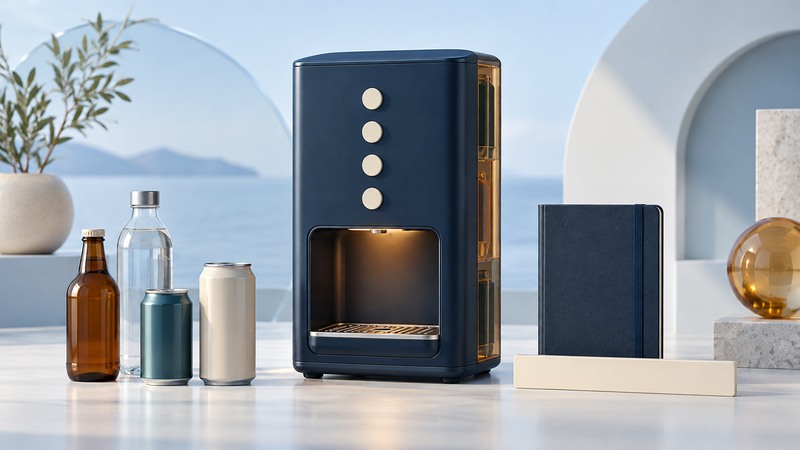
A personal beverage vending machine offers cold drinks through selection buttons, with a loading mechanism that must fit the containers you buy. For a used Maytag SkyBox, evaluate three things separately: refrigeration, reliable dispensing and the availability of the parts needed to keep both working.
Establish which SkyBox you have
Read the rating label before relying on a seller’s title. Maytag’s MBV1976AAB parts document distinguishes the beverage center from its MBS1976AAB stand and lists use-and-care document W10124423. A parts diagram identifies components; a current supplier quotation establishes whether a replacement is actually obtainable.
Start with Maytag’s manual lookup using the complete model. An archived Maytag SkyBox MBV1976AA manual hosted by ManualsLib describes four beverage bins and a nominal capacity of 64 twelve-ounce cans or 32 twelve-ounce bottles. Its loading and maintenance sections address container shape, orientation and jams. Match the document to the actual unit before applying its instructions; capacity is conditional on compatible containers and loading.
Save a copy of the applicable manual with the serial number, seller’s photographs and parts quotations. Confirm the electrical supply, clearances and installation conditions from that manual. Measure the intended location with the door open and include room to restock and service the machine.
Inspect a used unit in two stages
Begin with an unplugged visual inspection: cabinet condition, door and seal, cord, accessible bins and delivery opening. Missing bins or broken mechanism pieces can matter more than faded graphics. Have damage assessed before powering the appliance. Follow the manual for transport and installation; arrange help appropriate to its weight.
Then ask for an operating demonstration after the unit has been set up according to its instructions. A briefly running compressor establishes little about sustained cooling. Record the elapsed operating time, room conditions, temperature setting and a measured interior temperature after stabilization. Use the manual’s expectations to interpret the result.
On narrow screens, scroll the table sideways. Keyboard: focus the table and use the arrow keys.
| Check | What to record | Why it matters |
|---|---|---|
| Refrigeration | Setup conditions, elapsed time and measured temperature | Separates a cooling demonstration from a light or fan merely turning on |
| Each selection | Exact container, loading arrangement and repeated deliveries | Reveals a problem isolated to one bin or selection |
| Door and cabinet | Seal condition, closure and visible damage | Helps scope repair needs |
| Parts | Part number, supplier response, price and return terms | Turns a repair assumption into an estimate |
| Placement | Footprint, access and manual-required ventilation | Shows whether the intended room can accommodate it |
Test the can or bottle format you expect to use, within the manual’s allowed dimensions and materials. Similar volume does not guarantee similar geometry. If a selection fails, follow the user-level loading and troubleshooting checks with power precautions observed. Stop before dismantling electrical or refrigeration assemblies; those faults need qualified service.
Compare it with a beverage refrigerator
Choose around the experience you want. A vendor can make a few compatible drinks easy to select and can be enjoyable as a display piece. Its delivery mechanism introduces an additional system to inspect and maintain. A shelf-based refrigerator may suit a changing collection of container shapes, provided its own dimensions and storage instructions fit them.
For either option, compare usable capacity with your actual assortment. Count the drinks you can store in the intended arrangement, not just a headline maximum. Also consider restocking access, noise in the intended room and the effort required to clean spills.
Calculate ownership cost with real inputs
Fictional example: a $180 machine, $40 transport charge and $60 estimated part total $280 before labor and electricity. If diagnosis later reveals an unavailable component, the initial price has not captured the true decision. Obtain a repair estimate while the purchase is still optional.
For electricity, use a suitable plug-in energy meter only within its ratings and the appliance instructions. Measure over representative use, including restocking and door openings. Annual energy cost is measured daily kilowatt-hours × 365 × your tariff per kilowatt-hour. A hypothetical 0.8 kWh/day at $0.18/kWh equals $52.56/year; this is arithmetic, not a SkyBox energy rating.
Use the used beverage vendor inspection record to compare observations and costs. Check the CPSC recall database for the exact manufacturer, model and affected serial range before purchase. A satisfactory decision combines documented identity, repeatable operation, a suitable installation location and a credible service budget.