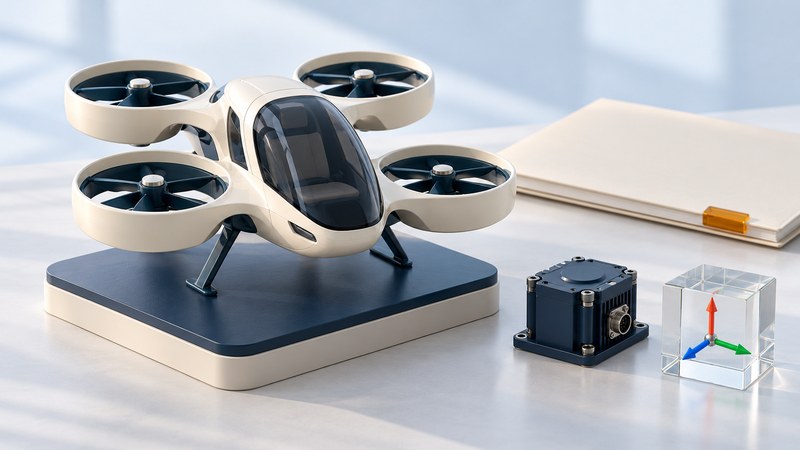
“Personal air vehicle” describes an intended use, not a single aircraft category. It can refer to a recreational vehicle, an experimental prototype or a proposed transport system. Before assessing convenience or performance, identify the exact design, its development stage and the jurisdiction in which someone intends to fly it.
What an inertial sensor contributes
An inertial measurement unit combines sensors that measure motion. Gyroscopes measure angular rate; accelerometers measure specific force. A controller or navigation system uses those measurements with its algorithms and, where applicable, other inputs to estimate motion and orientation. NASA’s guidance, navigation and control overview describes the common three-axis gyro and accelerometer arrangement in the context of spacecraft.
The sensor is one part of a larger system. To assess a flight-control claim, ask what supplies the measurements, how the software uses them, what drives the control surfaces or motors, and how the complete system is verified. A component specification by itself leaves the vehicle-level behavior unresolved.
The 2005 Springtail and GlobalFlyer examples previously discussed at this URL illustrated uses of sensing equipment. Those historical examples should not be treated as evidence that a different personal aircraft is ready for general use.
Read a flight video as one piece of evidence
On small screens, focus this table and use the arrow keys to scroll.
| Material shown | What it can establish | What to ask next |
|---|---|---|
| Rendering or mock-up | A proposed form or cabin arrangement | Has a representative vehicle been built? |
| Ground test | Behavior of the tested equipment under stated conditions | How does the setup compare with the flight configuration? |
| Tethered or limited flight | A demonstrated maneuver within a restricted test | What load, duration, environment and constraints applied? |
| Untethered flight program | Documented performance over its tested envelope | Which findings and approvals cover the proposed use? |
| Operating service | An identified operator offering a defined operation | What aircraft, pilot, site and operating authority apply? |
Record what is visible and what the developer reports separately. A short hover can be an important milestone while leaving range, weather tolerance, noise, reliability and recovery behavior to further evidence. Ask for dated documentation and test conditions instead of filling those gaps from the video.
Identify the applicable U.S. framework
For a U.S. proposal, ask the developer to identify the regulatory basis and the evidence supporting it. The FAA’s ultralight guidance explains the specific definition behind Part 103. Small size or one seat alone does not establish that a vehicle qualifies. Obtain a competent assessment of all applicable criteria and operating restrictions.
The FAA’s powered-lift questions and answers describes a separate framework addressing pilot certification and operations for that aircraft category. Its existence does not approve every proposed eVTOL. An aircraft design, a pilot’s qualifications and authority for the intended operation each require their own evidence. For another country, start with that country’s aviation authority.
Ask about the proposed use before paying
- Name the exact aircraft version, intended user and location.
- Request the documents establishing the development or approval status being claimed.
- Ask what training, maintenance, inspections and operating restrictions apply.
- Check the proposed takeoff and landing sites, local permissions and practical ground access.
- Identify which performance figures have been demonstrated with a representative load and which remain targets.
- Read the delivery, deposit and support terms with suitable professional advice for the transaction.
Use the personal-air-vehicle evidence record to keep each claim beside its source, date and unanswered question. An empty field is useful: it identifies information still needed.
Turn a claim into a bounded conclusion
This method supports careful interpretation without requiring the reader to design or operate an aircraft. The next useful step is a better documented question, not a homemade flight test.