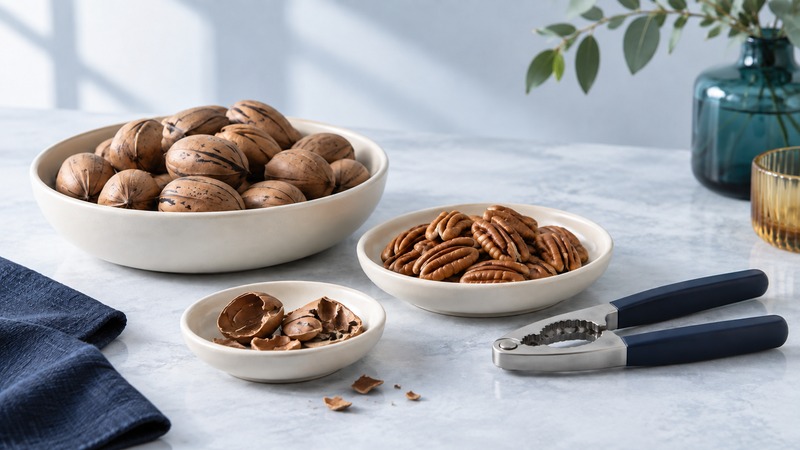
Choose a pecan cracker for controlled pressure, a secure fit and comfortable repeated use. Then test a small batch before shelling everything. The useful result is clean edible kernel weight; intact halves are an additional advantage when presentation matters.
Compare the mechanism
Focus the table and use the arrow keys to scroll sideways.
| Mechanism | What to inspect | Useful trial |
|---|---|---|
| Handheld hinged jaws | Jaw opening, grip texture and where the nut sits | Can you crack a pecan gradually without the handles pinching? |
| Screw press | Nut-size adjustment, stable base and release method | Can you stop as soon as the shell opens? |
| Lever tool | Supported nut sizes, secure footing and shell collection | Can you load and empty it comfortably for several repetitions? |
| Enclosed chamber | Capacity and access for cleaning | Does it contain fragments and release the kernel easily? |
These are buying criteria, not force ratings or accessibility certifications. Follow the exact tool’s instructions, including nut orientation. If possible, try it with the pecans you intend to buy; shell thickness and nut size vary. A seller’s return policy matters when hand comfort is uncertain.
Run a ten-nut trial
Start with a clean tray, three bowls for halves, pieces and shells, and a tool rated for pecans. Inspect each nut and discard visibly moldy or damaged examples. Keep hands clear of moving joints and apply pressure in small increments.
As one manufacturer-specific example, Drosselmeyer’s enclosed cracker instructions place the nut in the cone, cover the opening with the palm and press the lever. Apply that procedure only to that design; an open-jaw tool has a different hand position.
- Crack just enough to open the shell, then release pressure.
- Remove shell sections and the papery partitions. Use a nut pick gently if needed.
- Spread kernels on a light-colored tray and inspect for hard fragments before moving them into the food bowl.
- Record time, comfortable repetitions and intact halves after ten nuts. Adjust technique before continuing.
More force after the shell has opened often crushes useful kernels. If halves keep breaking, try a smaller movement or another supported orientation from the tool’s instructions.
Calculate cost from what you can use
Fictional batch: 1 kg of in-shell pecans costs $8. After shelling and inspection, you retain 250 g halves plus 200 g pieces: 450 g usable kernels. Usable yield is 450 ÷ 1,000 × 100 = 45%. Kernel cost is $8 ÷ 0.450 kg = $17.78/kg, before labor and tool cost.
Halves alone are 25% of the starting weight; the 200 g of pieces still have value for baking. Compare the total usable-kernel cost with shelled nuts of similar quality. Measure your own batch instead of treating this example as an expected yield for every cultivar or harvest.
Store kernels after inspection
Seal the finished kernels in clean containers, label the date and protect them from moisture and odors. University of Georgia Extension’s pecan-storage guidance explains why cooler storage slows quality loss and why in-shell nuts keep differently from shelled kernels. Refrigerate or freeze portions intended for longer storage, following any supplier instructions.
Keep the shelling tray separate from finished food, clean the tool as its maker directs and dry it before putting it away. Use broken kernels in a recipe where shape matters less; save halves for a visible topping. Pecans are tree nuts, so plan shared dishes around the diners’ allergy needs.