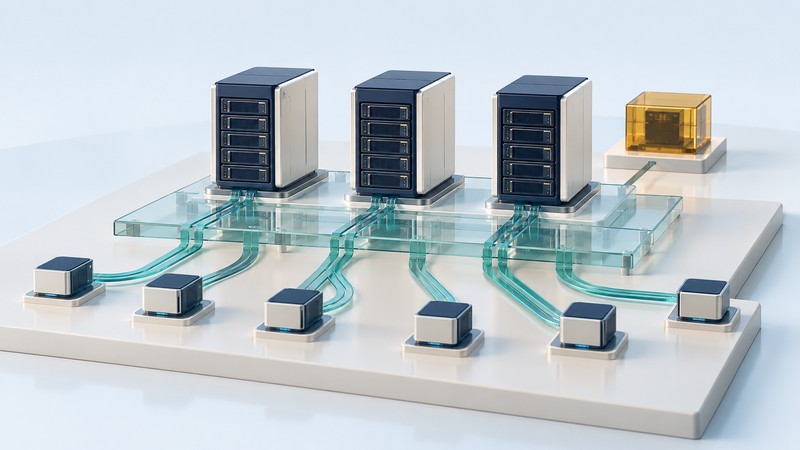
Parallel file storage lets multiple clients move file data through multiple storage paths while sharing a coordinated namespace. A hybrid implementation combines storage media, such as flash and hard drives, to serve a workload. Start an evaluation with the files, users, and recovery requirements the system must support.
Follow a request through the system
- The application asks for a file. A client uses file names, directories, and permissions in a shared namespace.
- Metadata services coordinate access. Depending on the design, these services describe file layout, maintain directory information, and coordinate changes.
- The client transfers data. A parallel layout can let the client access multiple storage servers. The network, client implementation, and storage layout determine the available paths.
- The system preserves consistency and protection. Redundancy, recovery, locking, and failure handling are part of the architecture that must be evaluated.
The IETF's pNFS flexible-file-layout specification, RFC 8435, describes an arrangement in which metadata and data access can be separated. It is one standardized design; product-specific parallel clients can use other mechanisms. Assess the supported protocol and client combination rather than assuming every NFS or SMB deployment has the same data path.
Three meanings of hybrid
A hybrid drive combines media within a device. A hybrid storage system can distribute different media across a cluster, using cache or placement policies defined by that system. Hybrid cloud concerns deployment across environments. Ask where the files actually reside, how movement is controlled, and what happens when a component or connection fails.
Draw the proposed path from application to client, network, metadata service, and storage nodes. Mark gateways, supported client versions, and backup destinations. This simple diagram often exposes requirements hidden by a headline bandwidth figure.
Match the architecture to the workload
On a narrow screen, focus the table region and scroll horizontally to read every column.
| Workload | Measure | Question for the evaluation |
|---|---|---|
| Many small files | Create, open, stat, and delete operations; latency | Can metadata work complete within the job window? |
| Large sequential datasets | Sustained throughput at realistic concurrency | Can every worker keep receiving data? |
| Checkpoints or bursts | Write duration, contention, and recovery | What happens when clients write together? |
| Mixed users and jobs | Per-client latency and job completion | Which task slows when backup or background work runs? |
| Growing retained datasets | Usable capacity, growth, and restore time | Can the team expand and recover within its constraints? |
A small team exchanging ordinary documents may value straightforward administration and standard client access more than a specialized parallel client. A compute cluster processing shared datasets may justify the additional networking, client management, and testing. Establish those needs before choosing the architecture.
Worked example: budget the simultaneous demand
Then ask a second question: how many files must each worker open to obtain those bytes? The same 2 GB/s can involve a few large files or a huge number of tiny ones. Record file operations and completion times alongside throughput. Check the result with the team's actual processing pipeline, including computation and output writes.
Run an evaluation with declared conditions
- Write acceptance criteria first. Specify concurrent clients, required task-completion time, throughput, latency measure, growth, and recovery objectives. Include the longest acceptable interruption and amount of data loss.
- Build representative test data. Use realistic file sizes, directory layout, access patterns, and read/write mix. Use approved disposable data on a test environment with agreed capacity limits.
- Record the whole configuration. Include client OS and driver, storage software, protocols, media, protection overhead, network links, and usable capacity. Separate raw capacity from capacity remaining after protection and operational reserves.
- Control cache effects. Declare cold or warm conditions and explain how they were established. Repeat runs, retain variation, and avoid presenting a cache-only result as storage-media throughput.
- Test concurrency and contention. Add clients gradually, then combine foreground work with backup or background activity. Record both aggregate results and the slowest clients or tail latency.
- Assess recovery and operation. Use vendor-approved test procedures to examine degraded service, rebuild load, restore steps, permissions, observability, and growth. Never induce failures on production storage just to obtain a benchmark.
The IOR/mdtest project provides tools for data-transfer and metadata testing. Its IOR tutorial explains how page cache and placement can distort results. Choose the tool configuration to match the question, and retain commands, versions, and logs with the report.
Redundant media protects against certain failures; independent backup and a demonstrated restore address a broader recovery need. Evaluate both. Include software subscriptions, network upgrades, client administration, spare capacity, support, and recovery work when comparing operating cost.
How Panasas fits the story
Panasas ActiveStor is a historical example of parallel hybrid storage. Its 2017 generation separated director and storage roles and combined flash with hard drives. This is useful context for asking which resources can grow independently, rather than treating a historical capacity or performance claim as a current guarantee.
Panasas adopted the VDURA brand in May 2024. The vendor's PanFS 10 architecture description explains DirectFlow client access to storage nodes and the role of director nodes. Treat that document as a version-specific example; confirm current supported clients, protocols, and recovery behavior for any proposed system.
Turn the questions into an evaluation brief
Download the storage workload and evaluation worksheet (plain text). Fill in the workload and acceptance criteria before a demonstration, then record measured results and unresolved questions. It includes the fictional bandwidth example above and fields for cache conditions, usable capacity, restore results, and costs.
If management software will recommend placement or capacity changes, use the AI-assisted storage management guide to consider verification and human review. Establish the baseline workload and recovery process first.