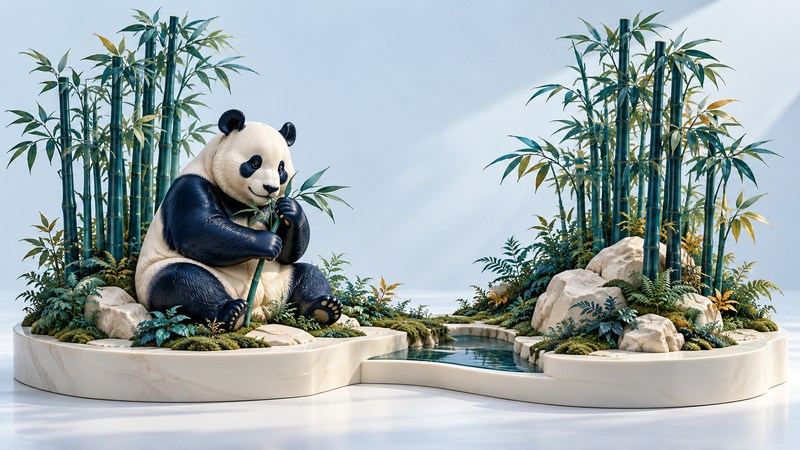
Giant pandas make more sense when you connect their daily behaviour with the mountain forests and bamboo on which they depend. Feeding, resting, movement and breeding are parts of one ecological picture. Conservation requires attention to those needs across a landscape as well as skilled care for individual animals.
Follow the bamboo
Giant pandas, Ailuropoda melanoleuca, are bears whose diet consists overwhelmingly of bamboo. Their digestive system retains features of a carnivore's, so processing enough relatively low-energy food occupies much of the day. A panda sitting and stripping stems is carrying out an important part of its energy budget.
A Smithsonian account of bamboo provision describes the work of selecting, harvesting and delivering suitable material. It also distinguishes the amount offered from what a panda actually eats. Those quantities should stay separate when comparing a zoo feeding report with a wild-diet estimate.
Watch which part of a stem the animal selects and how it handles the food. A brief webcam interval may show chewing, selection or rest, while leaving most of the day's feeding unseen. Avoid treating one quiet viewing period as evidence about appetite or health.
Think beyond a patch of green
The Smithsonian's species account places wild pandas in mountain forests of central China and explains the consequences of habitat fragmentation. Forest patches need to provide suitable food and conditions, while connections between them can allow movement and access to mates.
A map showing forest cover asks one question; a map showing usable panda habitat asks a more specific one. Elevation, bamboo, human activity and the connections between areas can change the meaning of an apparently green landscape. A narrow strip labelled a corridor deserves questions about its location, condition and evidence of use.
For a conservation project, look for its stated objective and measurements. These might concern habitat condition, reduced disturbance, connectivity or population monitoring. Distinguish land designated for protection from evidence that conditions or animal movements have improved.
Observe an individual in context
Pandas spend substantial time alone as adults, while mothers and dependent young have a different relationship. Separate enclosures at a zoo can support individual needs. Sharing a species name does not mean two animals should share every space.
The National Zoo's panda FAQs describe its care, feeding and breeding programme. Keep that managed setting distinct from a wild population. Veterinary monitoring, controlled diets and planned introductions allow some questions to be studied closely, but the forest presents different conditions.
Separate zoo milestones from population outcomes
A birth, a new enclosure and a habitat-restoration project are different achievements. Ask what each contributes: animal care, research, skills, funding or conditions in the native range. Then look for evidence that matches that contribution.
The Smithsonian's panda history documents successive animals, breeding milestones and research partnerships. It helps place earlier National Zoo habitat projects in time. A facility's history explains how its work developed; population recovery must be evaluated using field evidence and dated conservation assessments.
When a report gives a wild population estimate, record the survey year, area covered, method and uncertainty. The year an article was posted may be much later than the census it quotes. Use the same discipline for a threat category: it is an assessment with a scope and date, rather than a live animal count.
Use current official information for a visit
As checked in September 2026, the National Zoo's official panda pages feature Bao Li and Qing Bao. Use Meet the Pandas for current animal and visit information, and check entry requirements directly before travelling.
The official Panda Cam offers another way to observe. Check whether you are seeing a live feed or a replay before recording times. For a broader introduction to interpreting animal behaviour, compare the evidence questions in our chimpanzee guide.