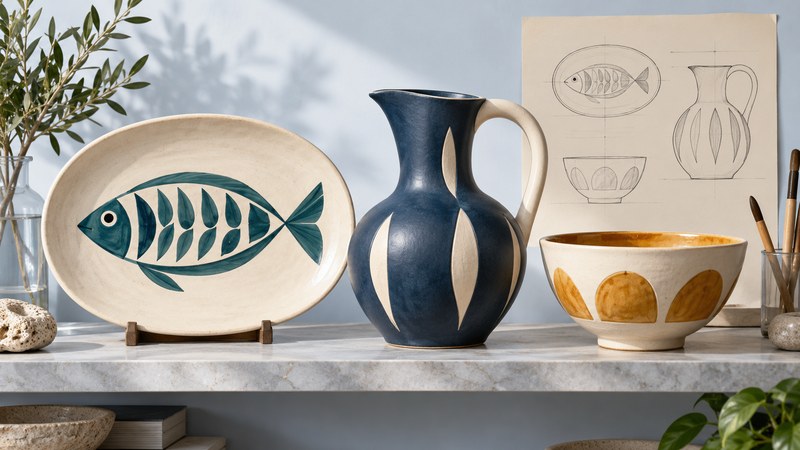
A plate offers a curved surface, a rim and a familiar use. Picasso’s ceramics turn those features into artistic possibilities. Look first at the object’s physical shape, then at the image on it: the interest often lies in how the two cooperate.
Begin with the workshop
Pablo Picasso (1881–1973) is widely associated with painting, yet ceramics became an important part of his later work. His work at Madoura in Vallauris depended on a pottery workshop’s materials, firing knowledge and collaboration. The Museu Picasso’s account of earth, water and fire identifies Suzanne and Georges Ramié and explains the workshop’s role in producing editions of his designs.
That context changes how to read an object. Ask who conceived the design, how the form was made, how its surface was decorated and what the record says about production. “By Picasso” can begin the inquiry, while the catalogue’s fuller description explains the particular work.
Use the museum images linked below as your examples. The ceramics in the illustration above are newly generated conceptual designs.
Read Two Fish as both image and object
Find Two Fish, dated May 19, 1956, in the museum’s illustrated pottery article. Its inventory number is MPB112.437. The caption identifies white earthenware and describes slips, glaze and patina.
- Trace the outside shape. Compare its proportions with those of the fish.
- Locate the rim and shallow interior. Ask how these physical boundaries frame the image.
- Compare light and dark. Look for marks that define a fish and areas where the ground contributes to the design.
- Read the material caption again. Which effects might involve the clay’s surface, an applied coating or a fired finish?
Slip is a liquid clay mixture used in ceramic processes, including surface decoration. Glaze produces a glassy surface through firing. A museum caption may also identify oxides, incising or patina. Keep those terms tied to the recorded object: similar-looking surfaces can have different material histories.
Look around and underneath
The same museum article shows Bullfight and Fish, whose reverse is identified as Faces, dated April 16, 1957, MPB112.446. Its detailed caption records applied fish and different treatments on the two sides. This is a useful reminder that a ceramic work can offer more than one viewing surface.
With the museum photographs, compare the center, rim, profile and reverse wherever they are shown. A front photograph compresses the object into a flat rectangle. A side view may reveal thickness, curvature or relief that changes how you understand the decoration.
At a museum, use the permitted viewing positions around the case. If the reverse is hidden, consult the catalogue or ask about available photographs. A missing view is a specific limit you can record.
Read the record for the particular ceramic
The Museu Picasso’s account of Jacqueline’s ceramics gift discusses unique pieces, workshop processes and Picasso’s use of familiar forms. It provides a route into the variety of the work rather than a single production formula.
A unique piece is described as an individual work. An edition involves a defined group produced from a design or model. Read the object’s own entry for the method, workshop and edition information. A date may concern the design or production of the particular example; preserve any distinction the catalogue makes.
Record the title, date, material, dimensions, inventory number and the exact edition wording. If you see a fraction-like number in a catalogue, check how that source explains it. Marks and numbers are evidence to investigate, with supporting records; this introductory looking method does not establish authenticity or market value.
Try a shape-and-decoration exercise
On paper, draw the outline of a plate and a pitcher. These are your own design studies. Put the same simple motif—a leaf, bird or fish—into each outline. Let a rim frame the motif in one; let a handle or spout change its silhouette in the other.
Compare the results using three questions: Where does the object help the image? Where does the image obscure the object? What would become visible only from a different angle? This exercise makes the relationship between a support and its decoration concrete without requiring pottery equipment.
Use the looking worksheet to compare a museum object with your observations. Continue to Dalí’s transformation of familiar objects for a different approach to everyday forms.
Explore all seven artist guides · Browse the broader art library