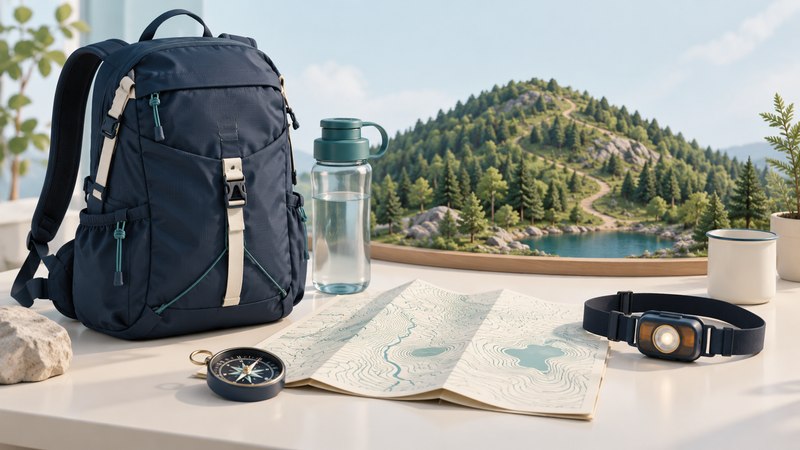
A good first day hike is one you can prepare for, enjoy and finish with time to spare. Choose the route before buying more equipment: its terrain, weather, access and length determine what you need to carry and how much time to allow.
This guide is for an ordinary day hike on an established trail. Snow travel, technical scrambling, remote crossings and overnight trips require additional skills and planning. For a first outing, choose a place with clear official information and an easy way to shorten the walk.
Choose a route you can explain
Write down the trailhead, named trails, intended destination and route back. If you cannot trace the entire outing on a current map, keep researching or choose a simpler route. A scenic photograph tells you little about the climb or the return journey.
The National Park Service trip-planning guide recommends matching an activity to your skills and fitness, checking conditions and preparing a backup. Apply that approach to the least experienced member of your group.
- Read distance carefully. Confirm whether the number is one-way, round-trip or the length of a loop. Include the approach from the parking area.
- Look beyond mileage. Climbing, rocky footing, exposed terrain and frequent junctions add effort or decisions. Check the elevation profile and the manager's difficulty description.
- Check the practical access. Look up opening hours, entry requirements, parking arrangements and trail closures on the land manager's site.
- Choose a fallback. Identify a shorter permitted route or another activity before a full parking lot or changing weather forces a decision.
For specific planning resources, explore the Catoctin Trail or Appalachian Trail day-hike guide. Both require attention to the particular section you intend to walk.
Work backward from a comfortable finish
Use your own recent walking experience on similar ground to estimate moving time. Add breaks, navigation pauses and a margin for delays. An optimistic app estimate is a weak basis for a first outing. Set a turnaround time that leaves enough time to retrace the route and return before the relevant closing time and darkness.
Check the forecast for the actual hiking area, including elevation where relevant, through the National Weather Service. Revisit the forecast and the land manager's alerts shortly before departure.
Pack by purpose
The NPS organizes its Ten Essentials around navigation, sun protection, extra clothing, illumination, first aid, fire, repairs, food, water and emergency shelter. Treat these as systems to adapt to the outing and learn to use. Carrying unfamiliar equipment provides little help when you need it.
- Find your way: a current map, an appropriate backup and navigation skills. Download digital maps before leaving connectivity and verify that the needed area opens offline.
- Manage exposure and delays: suitable clothing, weather protection, a working headlamp, food, water and emergency shelter appropriate to the conditions.
- Handle small problems: first-aid supplies, personal medication and basic repair items. Check local restrictions before using fire or carrying restricted tools.
Make the load usable: put items you expect to need within reach and protect spare clothing and sensitive contents from rain. Our pack-protection guide explains liners, covers and waterproof claims. The illustration above shows a few planning items, not a complete packing list.
Water needs vary with conditions and the person. Start with a plan for carrying enough water and for any verified resupply; a stream shown on a map does not establish current flow or drinking-water safety. Ask the land manager about the route's water situation.
Leave a trip plan someone can act on
Give a trusted person who is staying behind your route, party details, vehicle and trailhead, expected return and an agreed time to contact authorities if you have not checked in. Include the appropriate emergency contact for the area. Make sure that person understands the plan and tell them when you return. This follows the NPS approach to sharing a trip plan.
Download the editable day-hike trip plan (.txt). Open it in a text editor, fill every relevant field and share it privately with your trusted contact. It includes space for the map source, route distance and units, turnaround time, contingencies and return confirmation.
At the trailhead, confirm the plan still fits
Read current signs and check any new alerts. Confirm the group has the required equipment and feels ready. If access is closed, weather has changed or an essential item is missing, use the fallback. Update your trusted contact before taking a different route.
On the walk, keep the group together, use designated trails and reassess time and energy before committing to the next section. Afterward, record actual moving time, breaks and any equipment problem. That short record gives your next plan a firmer basis than a generic pace estimate.