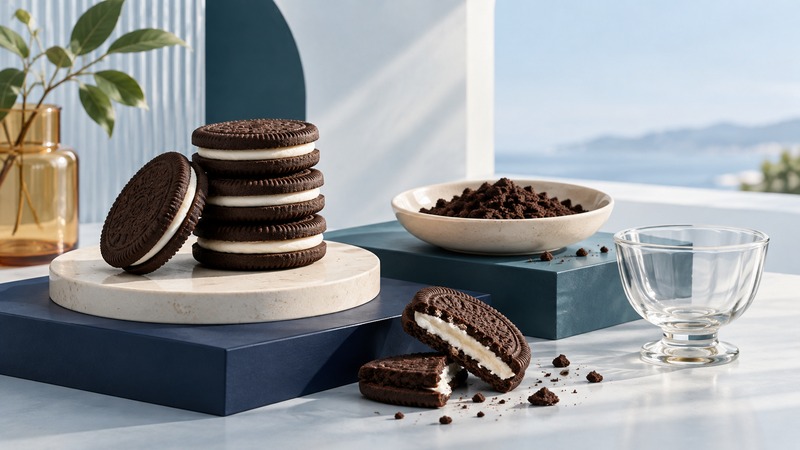
Decide what the Oreo cookie should do in your dessert before crushing it. Whole cookies give a recognizable garnish, coarse pieces stay distinct in a spoonful, and fine crumbs spread through a layer or form a recipe’s crust.
Choose a form that suits the dessert
Use the official Oreo product page to identify a product, then confirm the exact package you have. Original, Thins, Double Stuf and specialty varieties change the cookie-to-filling balance. A count-based substitution can therefore change both weight and texture.
| Form | Useful for | What to control |
|---|---|---|
| Whole or halved | A garnish or individually layered dessert | Reserve pieces before crushing the rest. |
| Coarse chunks | Pudding layers and ice-cream toppings | Crush briefly in a sealed food bag with a rolling pin; stop while pieces remain. |
| Fine crumbs | An even coating or a tested crumb crust | Use the recipe’s specified cookie weight and filling instructions. |
| Creme and wafers separated | A recipe that explicitly calls for separate components | Weigh the required component; whole-cookie weight includes both. |
For a pressed crust, follow a tested recipe’s pan size, butter amount and baking or chilling instructions. Extra filling and a different crumb texture can change how the crust holds together. A garnish is a more forgiving place to try a different variety.
A small dessert you can measure
Independent assembly idea for four small cups: use 400 g of ready-to-eat chilled pudding and 40 g of coarsely crushed sandwich cookies, filling included. Put 100 g pudding and 5 g crumbs in each cup; hold back the remaining 20 g crumbs and add 5 g to each cup immediately before serving. Total cookies: 4 × (5 + 5) = 40 g.
This creates a softer middle layer and a crisp final topping. Use pudding prepared and stored according to its package, and adjust cup size to hold the portion. The quantities are a serving plan, not a branded recipe or nutrition claim.
For a complete manufacturer-developed alternative, Snackworks’ Black & White Oreo Parfaits uses two pudding flavors and reserves cookie pieces for serving. Follow the full method, including its refrigeration step. The page’s zero-minute summary fields conflict with the method’s chilling time, so plan from the instructions.
Use weight when switching packages
Put an empty bowl on a kitchen scale, zero it and add the amount of whole cookies required before crushing. When a tested recipe specifies a cookie count, use its stated variety. If it also supplies a weight, record both. That makes a future package-size change easier to spot.
To estimate the cookies’ nutrition contribution, multiply each label value by cookie grams used divided by label serving grams. Divide a batch total by the number of equal servings. Add pudding, milk, cream or other ingredients separately. Use the package’s values rather than assuming all Oreo varieties share the same serving size.
Keep texture and ingredient information clear
Store reserved crumbs dry in a covered container. Add them near serving time for crunch; stir them in earlier when you want a softer cookies-and-cream texture. If a mixture looks uniformly gray, the pieces were likely too fine or mixed too long for a distinct-cookie result.
Read the exact cookie and dessert-base labels for allergens. A gluten-free cookie changes one ingredient choice; the whole dessert and preparation area still need review. The FDA’s allergen guidance explains why ingredient declarations and cross-contact are separate checks.
Keep pudding desserts refrigerated until serving and follow their package instructions. See the sundae portion plan for another use of a dry cookie topping, or the Oreo peppermint shake guide for a blended dessert.