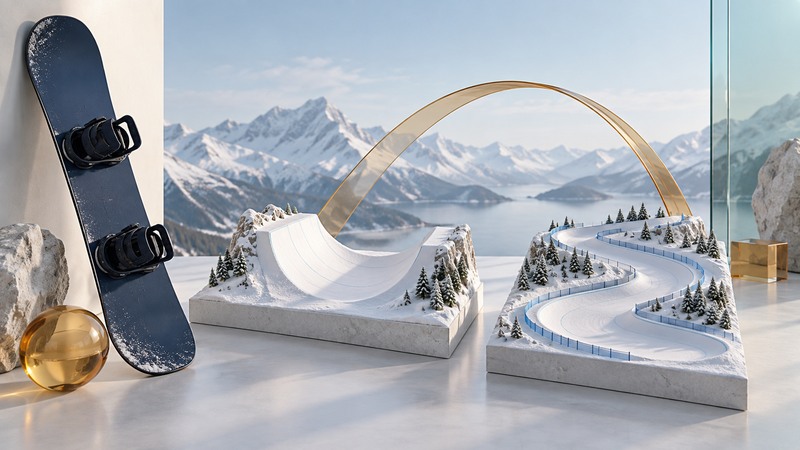
First identify whether the snowboard event is a race or a judged performance. In racing, position and advancement organize the story. In park and pipe events, the result depends on the evaluated performance and the rule for combining attempts. That first distinction makes the scoreboard much easier to read.
Identify the kind of contest
| Discipline | What you see | What decides progress or placing |
|---|---|---|
| Halfpipe | A sequence of tricks on the walls of a snow halfpipe. | Judged runs and the stated best-run format. |
| Slopestyle | A course combining rail features and jumps. | A judged run across the course. |
| Big air | One large jump and a trick on each attempt. | Scores combined under the event’s trick and counting requirements. |
| Snowboard cross | Several riders race through turns, rollers and jumps. | Finishing order within a heat, subject to official decisions. |
| Parallel giant slalom | Two riders negotiate neighboring gated courses. | Qualification times followed by head-to-head elimination rounds. |
Swipe the table sideways, or focus it and use the arrow keys.
The FIS snowboard, freestyle and freeski documents index provides the International Competition Rules and judging resources. Find the event name and season first. Snowboard rules share a publication with several ski disciplines, so check that a section actually applies to the contest you are watching.
A team designation adds another format layer. Read that event’s start procedure and advancement rule rather than applying an individual-race bracket automatically. The official start list and bracket show the competition you need to follow.
Watch the whole judged performance
The FIS park and pipe judges handbook linked from its document index identifies execution, difficulty, amplitude, variety and progression as judging criteria. That gives a viewer several questions: Was the landing controlled? How demanding was the trick? How much height or distance was achieved? How varied and innovative was the performance? The published handbook is the spring 2022 version linked by FIS when checked September 11, 2026.
A rotation count describes only part of a trick. Takeoff and landing direction, grabs, the feature used and the quality of completion also matter. In a sequence, the relationship among tricks matters too. Use the criteria to understand a score; a home tally of rotations is too narrow to reproduce judging.
For a real example, the FIS report of the 2026 Olympic slopestyle finals describes Su Yiming winning with 82.41 on his first of three runs. A strong early score can remain the counting result after later attempts.
Check which big-air attempts can combine
Big air calls for special attention to the counting rule. The FIS Milano Cortina 2026 preview explains the combination of two different spin directions. Two high scores alone are insufficient context: the attempts must satisfy the event’s required difference.
Write the counting marks beside the attempts when reading a result sheet. This shows both the successful scores and why another attempt may have been discarded. Qualification and finals can use different procedures, so keep the round heading visible.
Read a race as a bracket
In snowboard cross, a heat determines who reaches the next round under its advancement rule. In parallel giant slalom, follow the paired opponents through the elimination bracket. The FIS Bansko 2026 event record is a dated example providing qualification and final results; use the Olympic event’s own bracket for Olympic placing.
- Identify the round and the number of advancing places.
- Follow the officially confirmed finish after any review.
- Locate the athlete in the next-round bracket or start list.
- Read the final classification to distinguish a heat result from overall placing.
For any discipline, save the full event name, round, counting rule and official result source together. Once those four details are clear, the broadcast’s scores, times and colored markers become much easier to interpret.