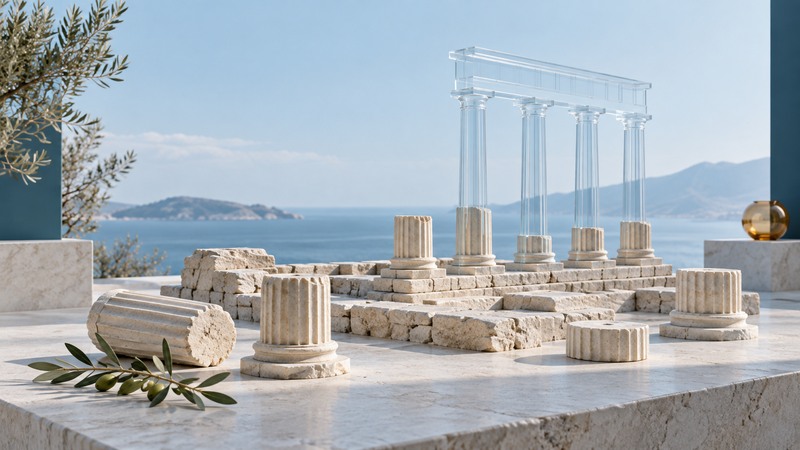
Read ancient Olympia in layers: the sacred enclosure, the places for training and competition, and the buildings that supported visitors and officials. A site plan establishes where those places are. A reconstruction proposes how they looked during a chosen period.
Start with the sanctuary and its edges
Olympia lies in the western Peloponnese. Its sacred enclosure, the Altis, included the temples of Zeus and Hera. Sporting and supporting buildings developed around it. UNESCO’s Archaeological Site of Olympia entry provides the World Heritage overview; the Greek Ministry of Culture’s site description identifies the principal monuments and their relationships.
| Area or building | Role | What to look for |
|---|---|---|
| Altis: temples of Zeus and Hera | Sacred buildings within the sanctuary. | Their separate footprints, columns and relationship to the enclosure. |
| Stadium, east of the sanctuary | A principal competition space. | The track, embankments and approach from the sanctuary. |
| Gymnasium and palaestra, to the west | Training spaces associated with athletics. | Courtyards, colonnades and how movement could work within them. |
| Leonidaion and other supporting structures | Accommodation and the operation of the gathering. | Evidence that the festival required facilities beyond the contest itself. |
Swipe the table sideways, or focus it and use the arrow keys.
Begin with the north arrow and scale, then find one large landmark such as the Temple of Zeus. Trace the route to the stadium and back to the training areas. This is an orientation exercise: visitor entrances, barriers and accessible routes must come from the current site information.
Read ruins as a sequence of changes
A plan can combine remains from different centuries. A complete-looking model usually selects a particular moment or synthesizes several forms of evidence. Ask which date or phase is represented before comparing the two. Otherwise, a later addition can appear to be missing from an earlier reconstruction even when both are internally consistent.
Separate three layers in your notes: surviving ancient material, conservation or modern reassembly, and digitally completed architecture. A photograph may include the first two; a virtual scene can add roofs, colors, furnishings and people. Each layer has a useful purpose when it is identified.
Useful reconstruction documentation names the archaeological measurements, comparable buildings or written descriptions used for an addition. If several forms remain possible, record that uncertainty in a caption instead of choosing the most photorealistic version as the most certain.
Use a digital tour for a specific question
The Foundation of the Hellenic World describes its Tour of Ancient Olympia as a reconstruction of the sanctuary in the second century BCE. Its overview identifies temples, training buildings, the stadium and civic structures. That stated date is essential context for interpreting what appears in the scene.
The project also links to a Greek-language 360-degree tour. Use the building labels and overview plan to keep your location clear as the viewpoint changes. The immersive production at Hellenic Cosmos in Athens and the archaeological site at Olympia are different destinations; consult the linked institution for its current programme before planning a visit.
- Choose a spatial question: How far is a training area from the stadium? What surrounds a temple?
- Record the reconstruction’s date, producer and named building.
- Compare its footprint with the site plan and its surviving parts with a photograph.
- List reconstructed details that need supporting documentation.
- Return to the overview so a close-up does not lose its place in the wider sanctuary.
A tour is particularly helpful for sightlines, relative scale and movement between buildings. Questions about an exact ancient ceremony, roof color or crowd size require evidence beyond the ability to navigate the scene.
Make a useful study or visit sheet
Give each chosen monument a small record: name, location on the plan, proposed ancient function, visible remains, reconstructed additions and the source you used. Add one question you still want to resolve. Three carefully compared buildings will often teach more than an unlabeled collection of screenshots.
For an on-site visit, check current opening arrangements, tickets and access information through Hellenic Heritage’s official Olympia visitor page. For remote study, begin with the official site description and then open the reconstruction. This order anchors the imagined space to the physical evidence.
Use the ancient Olympics history guide for the festival’s contests and participation. Keeping a site question separate from a history question helps you choose the right source: a measured plan can locate a building, while a text or inscription may explain the activity associated with it.