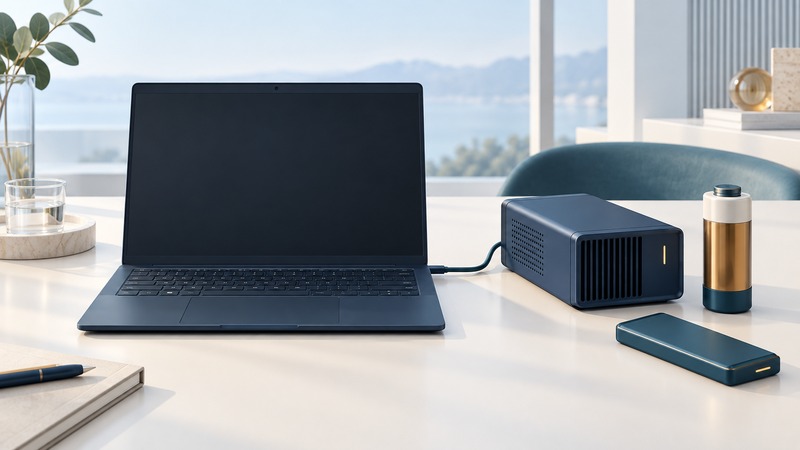
A notebook fuel cell converts fuel into electricity while a battery can bridge startup and short peaks. To assess the idea, ask how much usable energy reaches the laptop, whether the source supports its peak demand and whether the exact hardware and fuel are supported. An hours-per-cartridge claim needs all three.
What the 2005 ThinkPad demonstration established
The April 11, 2005 IBM/Sanyo announcement preserved by Lenovo described a prototype micro direct-methanol system and an up-to-eight-hour cartridge claim. It also described an Ultrabay Slim Battery bay for supplementing peak power and charging a battery. Its compatibility discussion concerned ThinkPad models of that period.
This is useful historical evidence of a proposed hybrid architecture. Applying it to a present-day purchase requires a reproducible test for the chosen laptop, current product documentation, supported fuel availability and service information for the exact system.
Separate energy, sustained power and brief peaks
On a narrow screen, scroll the table horizontally. Keyboard users can focus the table and use the arrow keys.
| Quantity | Unit | Useful evidence |
|---|---|---|
| Typical operating load | W | Measured average for the intended applications, display and radios |
| Short peak demand | W and duration | Startup and workload transitions the source or battery must support |
| Usable delivered energy | Wh | Energy available at the laptop input under stated test conditions |
| Compatibility | Model-specific ratings | Supported input voltage, connector or negotiated power mode |
| Support burden | Mass, time and supply | Module, fuel, spare battery, startup and replenishment requirements |
Measure or obtain a documented load profile for a representative work session. A laptop editing video, charging its internal battery and driving peripherals can present a different load from one reading a document. The adapter’s maximum rating indicates a capability; it is not a measurement of the laptop’s average use.
Draw the system boundary at the laptop input. If energy is quoted for the fuel rather than at the output, conversion losses and the fuel-cell system’s own consumption must be included before estimating runtime. The direct-methanol guide develops that wider system comparison.
Reproduce a runtime claim
Fictional delivered-energy example: suppose a tested cartridge and module deliver 240 Wh at the laptop input. At a steady 30 W load, the energy-only estimate is 240 ÷ 30 = 8 hours. At 45 W it becomes 240 ÷ 45 ≈ 5.3 hours.
If the same source supplies at most 35 W continuously, a sustained 45 W workload also draws at least 10 W from the battery buffer. A hypothetical 40 Wh usable buffer would cover that deficit for at most four hours before other losses or operating limits, even if fuel remained.
The two checks answer different questions. Enough cartridge energy does not settle whether the load can be supported throughout the session. Short peaks need a documented buffer response; sustained deficits drain the buffer. Include startup and the reserve needed to save work and shut down.
Turn a demonstration into a reviewable brief
Record the exact laptop, workload, initial battery charge, output measurement point, ambient conditions, startup time and stopping condition. A test that begins with a full laptop battery may draw on both stored battery energy and fuel. Record the final battery charge as well, so the cartridge’s contribution can be interpreted.
For field use, obtain the manufacturer’s operating, ventilation, fuel-storage and transport instructions for the exact system. Fuel-cell chemistry and packaging differ; a battery accessory’s permissions do not establish permissions for a fuel cartridge. Confirm the requirements with the carrier for any planned journey.
Conclude the brief with what was demonstrated, what remains unmeasured and what support must exist before deployment. For a different mobile load, the camera fuel-cell guide applies the same energy accounting to a production session.
Use the evidence record
Download the laptop power and runtime record (plain text). Save a copy, replace the blank fields with dated evidence and keep the fictional example separate from your own figures.
Explore more energy guides and case studies.