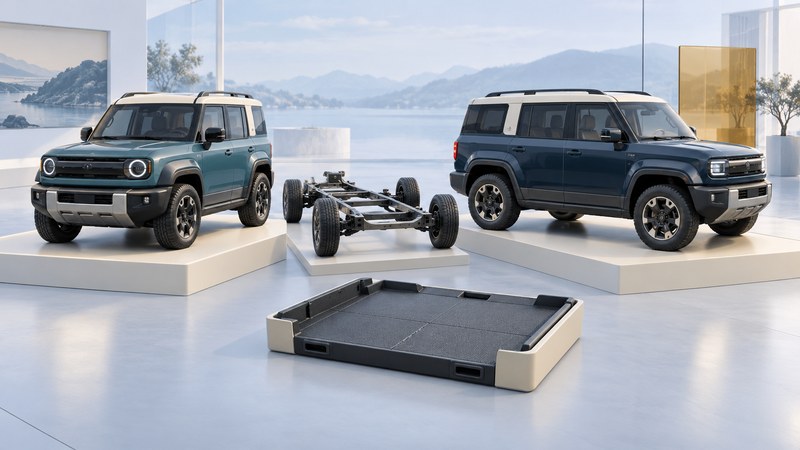
The 2005 Xterra is a useful case study in changing a vehicle underneath a familiar idea. Its upright SUV format continued, while its frame, powertrain and interior packaging changed substantially. Read the redesign in three layers: the vehicle architecture, the space available within it, and the equipment fitted to a particular version.
A new generation, with a dated production milestone
Nissan announced the first 2005 Xterra off the Smyrna, Tennessee, assembly line on January 7, 2005. Its announcement described a modified F-Alpha platform and a fully boxed steel ladder frame, with double-wishbone front suspension and a leaf-sprung rigid rear axle. The 4.0-liter V6 was built in Decherd, Tennessee. See the period Nissan production announcement reproduced by Rockcrawler.
Keep that calendar date separate from the model year. A production milestone tells you when a manufacturing event occurred; it does not identify every vehicle sold during that calendar year. For an individual Xterra, record the model year and build date separately before selecting literature or parts.
The shared platform name describes an engineering relationship. It is not a parts-interchange list. A frame layout can belong to a wider vehicle family while dimensions, mounting points and component specifications differ. Match any component question to the exact vehicle and part documentation rather than treating another F-Alpha model as a donor by default.
More wheelbase without much more overall length
Nissan's 2005 Xterra press kit compares the redesign with its predecessor: wheelbase increased by 2.0 inches, overall length by only 0.2 inch, width from 70.4 to 72.8 inches and height from 74.4 to 74.9 inches. It also describes a shorter front overhang. Those are the manufacturer's period comparison figures.
On a narrow screen, scroll the table sideways. Keyboard users can focus the table region and use the arrow keys.
| Measure | Reported change | What to investigate |
|---|---|---|
| Wheelbase | +2.0 in | Where the wheels sit relative to the cabin; this is not a direct measure of rear legroom. |
| Overall length | +0.2 in | The body envelope changed much less than the axle spacing. |
| Width | +2.4 in, calculated from 72.8 − 70.4 | Compare cabin clearances separately from exterior width. |
| Height | +0.5 in, calculated from 74.9 − 74.4 | Check measurement conventions, tires and roof equipment before using a figure for clearance. |
The useful lesson is redistribution. A two-inch wheelbase increase does not require a two-inch increase in total length when overhangs also change. Neither figure alone proves that a particular object will fit in the cargo bay. For a practical comparison, measure the opening, the floor and the available height with the seats in the position you intend to use.
Keep launch ratings attached to their source
The launch announcement rated the 4.0-liter V6 at 265 horsepower and 284 lb-ft of torque. The 2005 press kit describes six-speed manual and five-speed automatic transmissions. These are period launch specifications, not measurements of a surviving vehicle's output or a claim that every trim offered every combination.
When another reference gives a different number, record its model year, market, units and publication date before deciding that the engine changed. Do not average conflicting figures. Preserve both references until their scope or rating basis can be reconciled. Torque belongs in lb-ft here; it should not be labelled as power.
Separate the cargo design from fitted equipment
The press kit describes an Easy Clean cargo surface and adjustable floor channels for securing accessories. That makes the cargo floor part of the redesign story, but a description of the system is not a load rating or evidence that every fitting remains present on a particular vehicle.
Photograph the floor with loose liners removed, identify tracks and anchors, and compare their location with the appropriate manual. Record missing or aftermarket pieces separately. Evaluate a folded-seat load space in its actual configuration; an accessory tray, raised floor or seat position can matter more to your object than a headline volume figure.
Make a comparison you can revisit
Use the 2005 Xterra redesign record to keep published dimensions, your own measurements and unresolved differences in separate fields. For example, a hypothetical comparison of two listings should begin with two confirmed model years, not two similar-looking photographs. Add the exact brochure page beside each specification so another reader can reproduce the comparison.
For condition, maintenance evidence and modifications on a vehicle you may own, continue with the Xterra ownership and inspection guide. This redesign record supplies historical context; it does not replace that vehicle-specific work.
Explore Autos: vehicle guides, technology and design · Cars: buying, maintenance and ownership