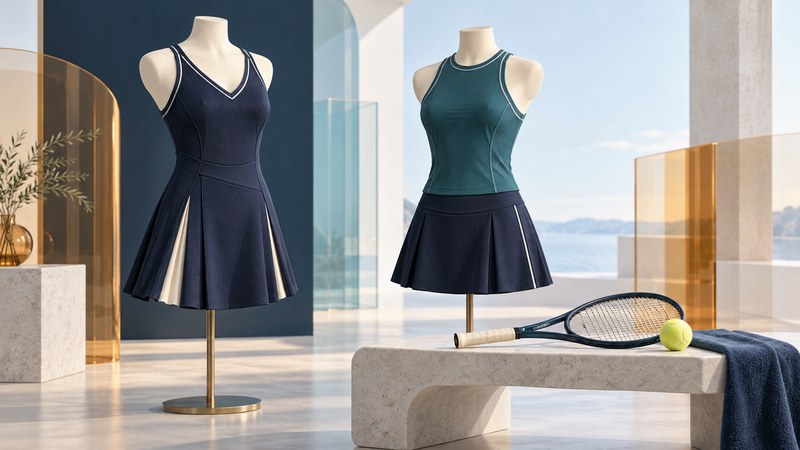
Maria Sharapova’s Nike wardrobe offers a useful way to study the meeting of sportswear and fashion. Follow the specific event and garment: the dance-inspired separates announced for Miami in March 2006, the dresses created for the US Open later that year, and the ceremonial reinterpretation in 2025 served different settings.
Miami, March 2006: adapting separates
The contemporary Nike announcement carried by Fibre2Fashion described two pieces adapted from the brand’s fitness-dance collection: a pearl-and-black Speed Corset and a black Shimmer Mix Skirt. The release emphasized front and back ventilation in the top and an adjustable rolled waistband on the skirt.
Read “corset” here as Nike’s name for an athletic fashion silhouette. The source describes custom tennis apparel and the player’s response to it, rather than supplying a construction pattern or measured cooling result. The useful design question is how the designers retained a distinctive look while accommodating court movement and the player’s preferences.
New York, August 2006: clothing within a campaign
In its August 17, 2006 campaign release, Nike described Sharapova’s first solo television advertisement for the brand. The commercial used “I Feel Pretty” before shifting attention to her forceful play. Nike also distinguished the performance dress shown in the advertisement from a separate custom evening-match dress planned for New York.
That distinction matters when captioning photographs. A year and an athlete’s name are insufficient identifiers when several outfits were made for different sessions and promotional uses. Record the tournament, date, day or evening context, and the source’s description before assigning a garment name.
A black dress revisited in 2025
Nike’s August 25, 2025 retrospective identifies Martin Lotti as designer of the 2006 US Open black dress. It describes a new version for Sharapova’s International Tennis Hall of Fame induction, with a longer hem and pleated skirt. A recognizable silhouette became formal occasion wear.
The retrospective includes both the designer’s recollections and Sharapova’s account of wearing the original. Those perspectives illuminate design intention and the wearer’s experience. Treat broad claims about changing tennis fashion as the brand’s interpretation, while the documented garment changes provide a concrete comparison.
| Context | Documented design focus | Question for the reader |
|---|---|---|
| Miami, March 2006 | Dance-derived top and separate skirt | How were an existing silhouette and fit details adapted for tennis? |
| US Open, 2006 | Distinct day and evening dress presentation | How did the match setting and advertising frame the garment? |
| Hall of Fame, 2025 | Longer formal reinterpretation of the black dress | Which visual cues survived a change in purpose? |
Read an outfit as a designed object
Use a photograph together with its caption and a dated design account. Start with silhouette: a one-piece dress and separates distribute seams, waist shaping and visual emphasis differently. Then inspect details such as neckline, hem, panels and closures. Finally, ask what the source actually tells you about material and movement.
Keep observations separate from conclusions. “The photograph shows a contrasting panel” is an observation. “The panel provides superior cooling” requires material and test evidence. Likewise, a player’s positive experience is meaningful testimony about that wearer, without establishing how the garment would perform for everyone.
When using this history as inspiration for your own clothing, translate a feature into a personal try-on question: can you move comfortably, does the waistband stay where you want it, and is the care routine workable? Historical custom apparel supplies ideas; an actual purchase needs its own fit and material checks.