Nicole Richie’s fashion work provides a useful way to separate three credits that are often blurred: appearing in an advertisement, collaborating on products and directing a label. Read each project according to its documented role. Then judge a garment or piece of jewelry by its actual design and materials rather than transferring a celebrity’s entire reputation to it.
Bongo: a documented spokesperson role
Iconix’s annual report for 2005, filed with the SEC identifies Richie among Bongo’s spokespeople. The company describes a licensing business in which brands and marketing worked alongside manufacturing and distribution partners. That record supports a campaign role; it does not identify her as Bongo’s founder or the designer of every advertised product.
A July 2005 Iconix announcement carried by Fibre2Fashion describes her continuing into Bongo’s fall campaign. Read it as a dated statement of the advertiser’s plans. It is useful evidence for how the brand presented the relationship at that time.
This distinction matters when describing an old advertisement or selling a vintage garment. “From the period of a Nicole Richie campaign” and “designed by Nicole Richie” require different evidence. A photograph of her wearing a label is not a design credit.
House of Harlow: follow the label’s own account
House of Harlow’s About page identifies Richie as its founder and creative force, describes an origin in costume jewelry and subsequent expansion, and says she reclaimed full creative control in fall 2024. Those are the label’s statements about its history and direction, accessed in October 2026.
“Creative control” describes the role asserted by the brand. It should not be expanded into an unsupported claim about the legal ownership of every company, trademark or license associated with earlier collections. Likewise, today’s assortment is not a complete catalog of everything sold under the name.
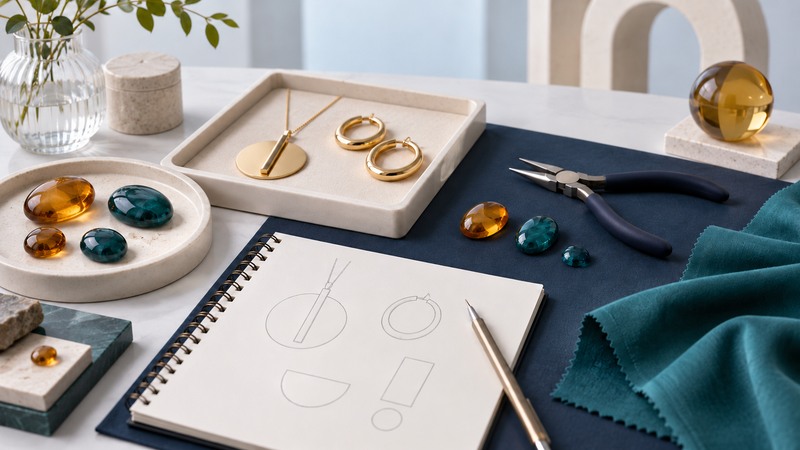
For a retrospective, organize examples by dated collection or product record. Compare the shapes, scale, colors and surface treatments you can see. If a seller uses a broad style word such as “bohemian,” translate it into visible features: an oversized pendant, a long chain, a geometric motif or a contrasting stone-like insert.
Read the credit before the aesthetic
On small screens, scroll horizontally. Keyboard users can focus the table area and use the arrow keys.
| Credit | Evidence to seek | What it does not establish |
|---|---|---|
| Campaign spokesperson | Dated advertiser announcement or campaign credits. | Authorship of the product. |
| Design collaborator | A collection announcement explaining the contribution. | Responsibility for every item the company sells. |
| Founder or creative director | Brand history and dated role descriptions. | The material quality or condition of an individual object. |
A clear caption can combine role and date without a sweeping biography: identify the campaign, its season and the named participant. A product description needs additional information about the object. Keep those two records connected but separate.
Evaluate the jewelry you would actually wear
Start with the exact item description. Record dimensions, closure type and the stated material of the base, finish and inserts. “Gold-tone” describes appearance; it does not establish solid gold. If the listing is vague, ask for the maker’s specification rather than inferring composition from color or price.
For a necklace, compare the stated length with a necklace you already wear and check where the pendant sits against the intended neckline. For earrings, look for dimensions and weight if supplied, closure photographs and return conditions. Comfort and scale are personal; a close-up advertisement gives neither a dependable size reference nor a wear test.
Follow the exact item’s care instructions. With secondhand pieces, inspect plating wear, missing inserts, bent fittings and disclosed repairs. Use celebrity association to locate a collection, then let the object’s documented details determine whether it suits you.