Nanotwins are extremely small mirror-like boundaries inside a crystal. On one side of the boundary, atoms line up in one orientation; on the other, the same crystal structure continues as a mirrored twin. That small change in orientation can have a large effect on how a metal bends, stretches, hardens, and eventually fails.
The idea is counterintuitive at first because a twin boundary is a kind of defect. In metals, however, not every defect is a weakness. Some defects interrupt the motion of other defects, especially dislocations, which are the line-like disturbances that let metal atoms shift under stress. A carefully placed boundary can make dislocations harder to move, and that can make a metal stronger without simply making it brittle.
Key Concepts
Nanotwins
Nanotwins are nanoscale twin boundaries within a metal's atomic lattice. The crystal structure on one side of the boundary mirrors the structure on the other side.

Atomic Lattice
An atomic lattice is the organized repeating arrangement of atoms in a crystal. The lattice gives a crystalline metal much of its mechanical behavior.

Gradient Material
A gradient material has a property or structure that changes gradually through the material rather than remaining uniform from one side to the other.

Work Hardening
Work hardening is the strengthening that occurs as a metal is plastically deformed by stretching, bending, pressing, rolling, or hammering.
Dislocations
Dislocations are line defects in a crystal lattice. Their movement allows metals to deform, while obstacles to that movement can raise strength.

Nanotwinned Copper
Nanotwinned copper is copper engineered with many twin boundaries. It is an important test material because copper is useful, well studied, and sensitive to changes in nanoscale structure.
Boundary Spacing
Boundary spacing is the distance between neighboring twin boundaries. Changing that spacing changes how dislocations move, pile up, and interact.

Why Twin Boundaries Matter
Metals are often strengthened by making it harder for dislocations to travel. Alloying, grain refinement, precipitation hardening, cold working, and surface treatments all rely in part on controlling dislocation motion. Nanotwins add another tool: a boundary that can block, guide, or reshape dislocation activity while preserving a coherent relationship across the crystal.
That coherence matters. A poorly matched boundary can become a site for damage, cracking, or corrosion. A coherent twin boundary can be a more orderly obstacle, which is why nanotwinned metals have drawn attention for applications that need strength, fatigue resistance, and, in some cases, conductivity.
The Gradient-Spaced Discovery
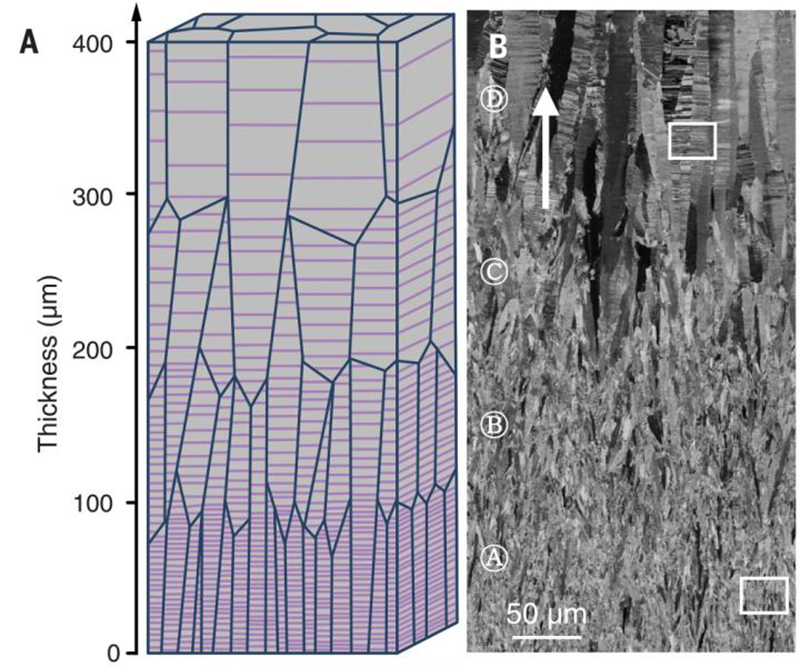
The 2018 work by researchers from Brown University and the Institute of Metals Research at the Chinese Academy of Sciences focused on gradient nanotwinned copper. Instead of making a copper sample with one uniform nanotwin spacing, the team assembled samples from four components with different twin-boundary spacings, from about 29 nanometers to 72 nanometers.
The order of those components mattered. Samples with a gradient in nanotwin spacing were stronger than the average of their components, and one arrangement was reported as stronger than even the strongest individual component. The result showed that the architecture of the structure could add strength beyond what any single uniform spacing provided.
Stronger Than the Components
A useful way to think about the result is that the metal was not only a mixture of strong and less-strong layers. The changing twin spacing altered how the whole structure deformed. Under strain, dislocations did not simply move independently within each region. They interacted across the gradient, producing dense, organized dislocation structures that helped resist further deformation.
That is why work hardening is central to the story. A material that starts strong but cannot harden may localize strain quickly, neck down, or fail suddenly. A material that continues to harden as it deforms can spread strain more effectively and may tolerate more demanding mechanical loading.
What Happens Inside the Metal
At the atomic scale, deformation is not smooth. Dislocations nucleate, move, pile up, and interact with grain boundaries, twin boundaries, and other obstacles. In gradient nanotwinned copper, simulations and follow-up analysis point to unusually concentrated dislocation bundles as part of the strengthening mechanism.
Those bundles are important because they connect nanoscale structure to bulk behavior. The metal is stronger not merely because the twin boundaries are small, but because the changing spacing creates a strain gradient that encourages a different internal dislocation pattern.
Why Copper Is a Good Test Case
Copper is widely used and scientifically convenient: it is conductive, ductile, relatively easy to process, and extensively studied. That makes it a strong platform for testing how nanoscale structure changes mechanical behavior. Nanotwinned copper is also attractive because many applications cannot simply trade away conductivity for strength.
The same design idea may not transfer automatically to every metal. Different crystal structures, alloy chemistries, processing routes, temperatures, and service environments will change the behavior. Still, the copper work provides a template for investigating other metals where strength, fatigue resistance, ductility, and functional properties must be balanced.
Manufacturing Challenges
Engineering nanotwins in a laboratory sample is not the same as producing reliable parts at scale. Manufacturers need control over twin spacing, gradient direction, thickness, grain structure, impurities, residual stress, and thermal stability. The structure must also survive forming, joining, machining, cycling, and exposure to service temperatures.
Characterization is another challenge. When the key feature is tens of nanometers wide, quality control requires microscopy, diffraction, mechanical testing, and models that connect small-scale observations to part-level performance. The promise is real, but the route from elegant microstructure to routine production is demanding.
Possible Applications
Nanotwinned and gradient-structured metals could matter wherever designers need more performance from familiar materials. Potential areas include conductive components in electronics, interconnects, flexible devices, high-cycle fatigue parts, lightweight structures, precision springs, heat-spreading components, and wear-resistant surfaces.
The strongest near-term opportunities are likely to be specialized uses where the extra processing is justified by a difficult combination of requirements. A stronger conductive copper component, for example, can be more valuable than a generic stronger metal if it also retains the electrical or thermal properties that made copper useful in the first place.
What Nanotwins Teach
Nanotwins show that material strength is not only a matter of chemistry. Composition still matters, but so does architecture: the arrangement of boundaries, defects, grains, and gradients across length scales. In that sense, gradient nanotwinned metals are part of a broader movement in materials science toward designing the internal structure of matter as deliberately as engineers design the outer shape of a part.