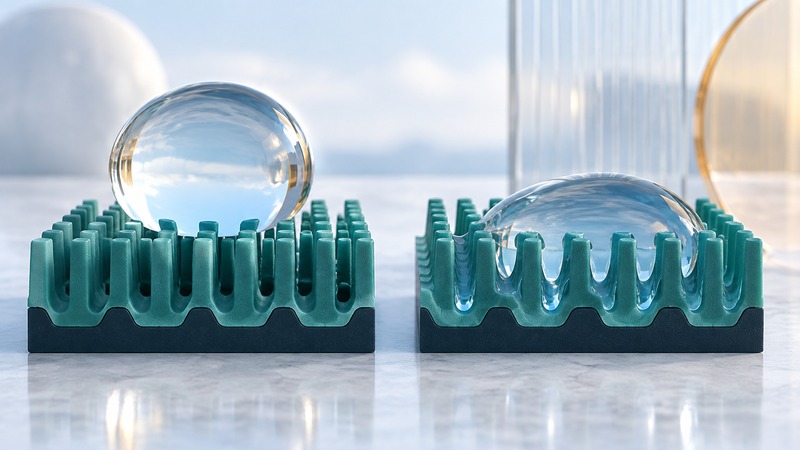
Nanograss is a description for dense, upright surface structures whose small features help change how a liquid contacts a solid. A droplet may rest partly on trapped air or enter the spaces between structures. Surface chemistry, texture and the liquid together determine the behavior.
For a reader comparing water-repellent materials, the useful questions are how the droplet sits, how readily it moves, and whether that behavior survives the intended conditions. A photograph of a rounded drop answers only part of that task.
Read the contact angle and the contact state
The apparent contact angle is measured through the liquid where the visible droplet boundary meets the surface. It describes the macroscopic drop shape on a textured sample. In a suspended, Cassie-type state, liquid contacts both solid features and trapped gas. In a fully wetted, Wenzel-type state, it follows the texture. Real surfaces can also have mixed or intermediate states.
A 2024 study of electrowetting and contact-angle hysteresis examines how texture, contact-line pinning and wetting state affect droplet behavior. Its modeled surfaces have defined geometries; use that context when comparing them with irregular coatings or damaged samples.
For a useful image comparison, request the liquid identity, drop volume, viewing method, surface preparation and scale. Record whether the surface was dry before the drop arrived and whether pressure or motion changed its contact state.
Separate a rounded shape from easy movement
The advancing angle describes a contact line moving onto previously unwetted surface; the receding angle describes its retreat. Their difference is contact-angle hysteresis. Pinning can allow a droplet to change shape before its contact line moves, so one static angle provides an incomplete account of mobility.
Understand electrical control as a system
In 2004, Krupenkin and colleagues reported electrical control of wetting on nanostructured surfaces, spanning highly water-repellent behavior to nearly complete wetting. The original study's abstract connects the accessible states to applied voltage and liquid surface tension.
Electrowetting concerns how an electrical arrangement changes interfacial behavior. To interpret a switching demonstration, identify its substrate, texture, coating, liquid, electrical configuration and starting state. A successful change in one direction establishes that transition; repeatable switching needs evidence for the return path and multiple cycles.
For a device claim, look for measurements of switching time, repeatability and the liquid's final location. Conditions that change droplet shape can affect transport differently. A demonstrated surface response and a complete fluid-handling device are separate milestones.
Match the test to the intended job
On a narrow screen, focus this table and use the arrow keys to scroll.
| Intended behavior | Useful measurement | Conditions to retain |
|---|---|---|
| Repel a resting drop | Contact angle and evidence of contact state. | Liquid, volume, preparation and observation time. |
| Shed droplets | Advancing/receding angles and a motion or tilt test. | Drop size, direction, surface uniformity and repeats. |
| Switch wetting state | Before/after state and return-cycle measurements. | Electrical setup, timing, liquid and cycle count. |
| Retain performance | The same wetting tests after relevant exposure. | Wear, contamination and other actual use conditions. |
Choose an acceptance criterion before comparing samples: for example, a specified fraction of matched droplets leaving a test area under a defined tilt. Preserve failed trials as well as attractive images. This makes the comparison about the needed behavior and gives a future repeat something precise to reproduce.
Related science guides
- Connect surface structure to growth conditions
- Explore how surrounding liquids change drop breakup
- Define comparisons and acceptance criteria
Explore all science guides. Sources reviewed September 11, 2026.