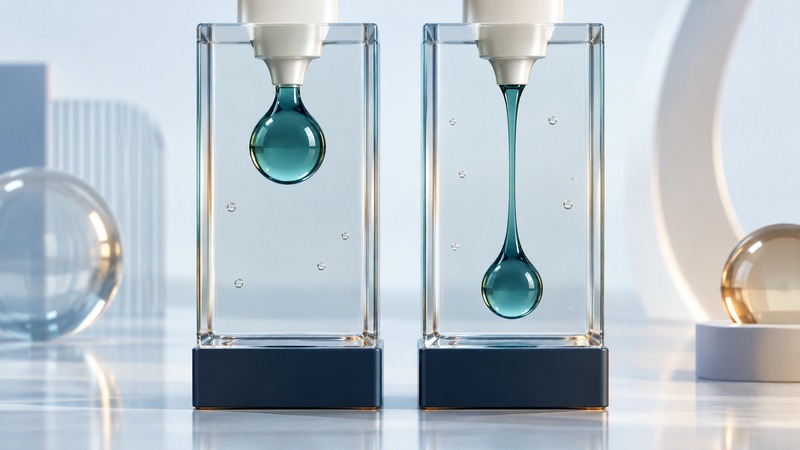
A falling drop can leave a thin liquid connection before it separates. The way that connection narrows depends on the liquid inside, the fluid outside and their interface. Under some conditions, the surrounding fluid helps a long, slender thread develop.
That observation is relevant to the idea of making fine fibers. To assess the idea, distinguish three outcomes: a transient liquid shape, a stabilized solid filament and a filament that performs a useful job. This guide explains what a breakup experiment can establish and how to read its images.
Include the fluid outside the drop
Surface tension acts at the interface, while viscosity describes resistance to flow within each fluid. A drop separating in air and one separating in a much more viscous liquid can follow different dynamics.
In the 2003 study “Persistence of Memory in Drop Breakup: The Breakdown of Universality” (PDF), Doshi and colleagues combined experiments, simulations and theory for a low-viscosity drop surrounded by a viscous fluid. They found a regime in which the shrinking profile retained information about its initial and boundary conditions. As the inner fluid's viscosity became important, a long thin thread could form.
The result explains a particular route to thin liquid structures. The paper discussed solidification as a possible application. Demonstrating a durable nanofiber requires additional evidence about solidification, dimensions and properties.
Read a viscosity ratio as a comparison
A common way to describe the two-fluid contrast is the inner dynamic viscosity divided by the outer dynamic viscosity. Both must use the same units and refer to the relevant conditions.
The 2003 paper also identifies a boundary of its continuous-fluid description as dimensions approach atomic scales. Extrapolating an equation into that range calls for different physical assumptions. A mathematical limiting value and a measured, recoverable object represent different kinds of evidence.
Read a breakup sequence consistently
On a narrow screen, focus this table and use the arrow keys to scroll.
| Record | Why it matters |
|---|---|
| Time for each frame | Shows whether apparent changes happened slowly or rapidly. |
| Scale and viewing direction | Connects the image to physical dimensions and projection. |
| Minimum radius or diameter | Defines the same quantity throughout the sequence. |
| Position of the narrowest region | Reveals movement or more than one narrowing location. |
| Fluids and imposed conditions | Makes comparisons between trials interpretable. |
Start with the earliest frame that clearly resolves the neck, and preserve the sequence through separation. For each frame, measure the same defined dimension using the scale bar. Mark frames where the neck becomes too small to resolve; a measurement limit belongs in the record.
If two minima appear, track each location separately. Identify each minimum consistently so that the trajectory follows a defined location. Retain the raw images and explain edge detection, smoothing and any excluded frames.
Follow the evidence from thread to fiber
For a proposed fabrication method, ask how the liquid structure is preserved before breakup, how the resulting object is recovered, and how its size distribution is measured. A solid filament then needs characterization appropriate to its intended role, such as continuity and mechanical or electrical properties.
Compare repeated production attempts, including broken or irregular products. Report yield using a defined denominator and state the dimensions actually measured. A selected image can show feasibility; repeatable output and performance establish a usable process.
A concise reading conclusion might say: “The experiment produced a transient thin thread under these two-fluid conditions; solidification and end-use testing remain the next steps.” That identifies both the demonstrated result and a concrete route toward the application.
Related science guides
- Understand liquid contact with textured solids
- Measure microscopic features using scale bars
- Separate discovery from product development
Explore all science guides. Sources reviewed September 11, 2026.