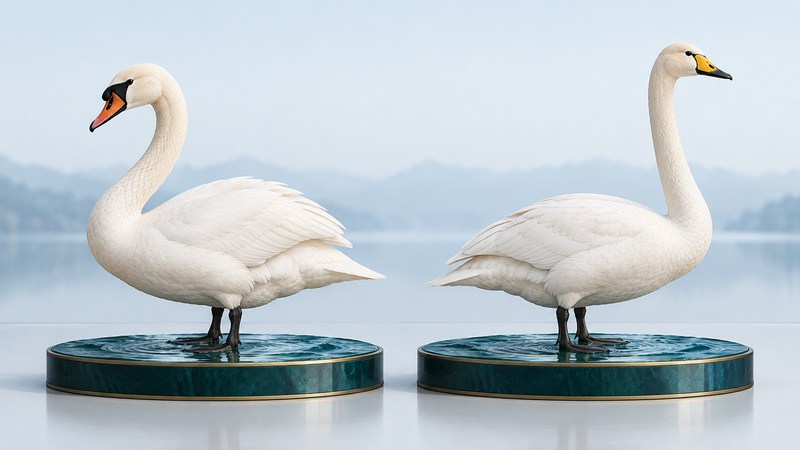
Begin a swan identification with the bill, then check age, body shape, voice, location and season. Adult Mute and Whooper Swans have useful differences, but young birds and other white swan species need closer comparison. Once you have an identification, investigate the local ecological and legal context separately.
Compare several visible features
| Feature | Mute Swan, Cygnus olor | Whooper Swan, Cygnus cygnus |
|---|---|---|
| Bill | Orange with black at the base and a black forehead knob | Black toward the tip, with a large yellow wedge extending beyond the nostril |
| Neck carriage | Often curved; posture changes with activity | Often held more upright, with a long, relatively straight appearance |
| Sound | Can hiss and make muted calls; the name does not imply silence | Conspicuous trumpeting calls can support identification |
| Main caution | Young birds have different bill colours and less-developed adult features | Compare carefully with Bewick's/Tundra Swans and other local species |
Scroll the comparison horizontally on a small screen.
Use actual reference photographs alongside your observation. The Missouri Department of Conservation's Mute Swan account illustrates the orange bill and basal knob. The RSPB Whooper Swan guide shows the larger yellow bill patch and explains juvenile differences. The conceptual illustration above introduces the comparison; it is not a photographic identification record.
Do not decide from neck curvature alone. A feeding, preening or alert bird changes its posture. Distance, glare and an overexposed photograph can hide bill colour. A second view often contributes more than a confident guess from one silhouette.
Keep the local alternatives in the comparison
In Britain and parts of Europe, compare a yellow-and-black bill with Bewick's Swan: Whoopers typically have more yellow, extending forward as a pointed wedge. In North America, consider native Trumpeter and Tundra Swans as well as introduced Mute Swans. Identify the age class before applying an adult bill rule.
Record the date, broad location, number of birds, bill details, posture and any calls. Take photographs from an existing public path with sufficient distance. A side view of the head and a whole-body view are especially useful. Save the unedited originals so another observer can assess colour and context.
If features remain unclear, report an unidentified swan and explain what was visible. That preserves useful evidence without forcing it into the wrong species record. Our bird-sound identification guide explains how a recording can add a second line of evidence.
Read range and status by place
The British Trust for Ornithology's Whooper Swan account describes the species primarily as a winter visitor to the UK, with a small breeding presence. That account concerns a particular region and population; it is not a worldwide seasonal rule.
Mute Swans have a native Eurasian range and introduced populations elsewhere. A bird's attractiveness and its ecological effects answer different questions. In an introduced population, management may consider aquatic vegetation, competition with native wildlife and conflicts around nesting areas. Keep evidence from one wetland separate from assumptions about another.
Evaluate a management proposal on its evidence
Start with the relevant wildlife agency's current documents. For a U.S. example, Indiana DNR's Mute Swan questions and answers explains the state's ecological concerns and management framework. Its requirements should be checked in Indiana; other jurisdictions can differ.
- Which species and local population are involved?
- What impact has been measured, over what period and by what method?
- What objective would count as improvement?
- Which alternatives were evaluated, including welfare consequences and feasibility?
- Who has authority to act, and how will results be monitored?
These questions allow ecological outcomes and animal welfare to be considered together. Obtain current advice from the responsible authority before any intervention. Avoid attempting to capture, move, feed or manage birds based on a general article.
Leave room for the birds
Observe from a distance, keep dogs under control and leave a clear route between birds and the water. Move away if a swan approaches defensively. For an injured or entangled bird, give the location and observations to the local wildlife authority or an authorised rehabilitator. A useful report helps professionals act without adding disturbance.