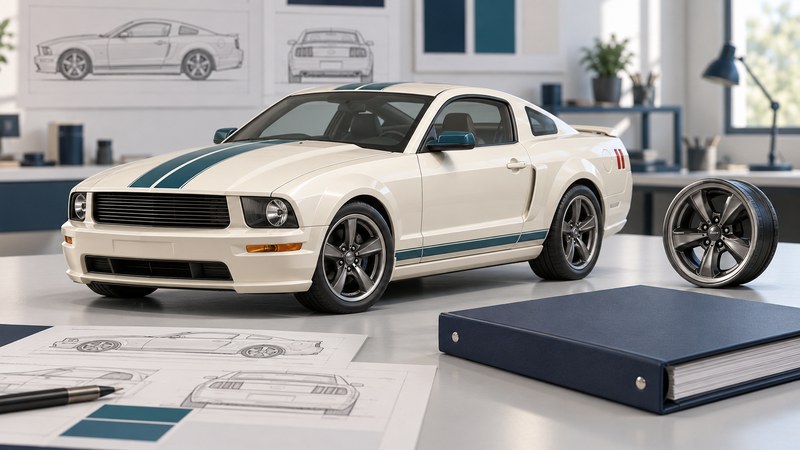
The Foose Stallion combined Chip Foose's design work with a program for modifying contemporary Ford Mustangs. Its history becomes clearer when the program's announcements, the builder's role and the records for an individual car are considered together.
Designer, builder and base vehicle
A February 2006 announcement identified Unique Performance Concepts as the joint venture between Unique Performance and Tecstar behind the Stallion. It described a preproduction car sold at auction in January and production planned for that summer. Source: the February 6, 2006 program announcement.
A January 2007 release credited Chip Foose with the design and Unique Performance Concepts with the builds. It reported that first deliveries had begun in June 2006 and announced an additional base version with broader dealer distribution. Source: Unique Performance's January 10, 2007 release.
Read each milestone in its own time
On a narrow screen, scroll the table sideways. Keyboard users can focus the table region and use the arrow keys.
| Report date | Milestone | How to use it |
|---|---|---|
| February 2006 | A January preproduction auction and planned summer production. | Establishes an early example and the announced schedule. |
| January 2007 | The issuer reported deliveries beginning in June 2006. | Provides a later account of the program reaching customers. |
| January 2007 | A new base version was announced; a supercharged edition was described as forthcoming. | Keep versions and announcement dates attached to equipment claims. |
These releases describe a program over time. They provide context for an individual car, while its own paperwork establishes which work was performed and when.
Build the history around one VIN
Start with the Ford vehicle identity and original specification. Then attach the conversion record: a build sheet, invoice or other dated document that connects the package to that car. Add delivery paperwork and later service or modification records in chronological order.
A wheel, badge or signed trim piece is worth photographing, but a coherent history connects visible components to dated records. Ask who supplied each document, whether it identifies the same vehicle and what part of the story it actually supports.
A useful way to resolve a mismatch
Imagine a car advertised with a particular wheel package while an early photograph shows different wheels. Record both observations. Look for an invoice or later photograph that dates the change, and ask whether the earlier parts were retained. The result may be a documented later alteration, an unresolved gap or a correction to the description.
Keep condition as its own subject. A well-documented conversion can still need maintenance, and a tidy appearance tells little about hidden work. A specialist's inspection should describe the car as it exists today, with findings linked to the relevant components.
Keep a usable build record
Download the Stallion build-history record (plain text). It includes vehicle identity, package evidence, a component timeline, unresolved differences and follow-up actions. Keep original documents alongside it and redact personal details before sharing copies.
For broader context, read the 2005 Mustang coupe and modification guide and custom-car build planning.
Explore Autos: vehicle guides, technology and design · Cars: buying, maintenance and ownership