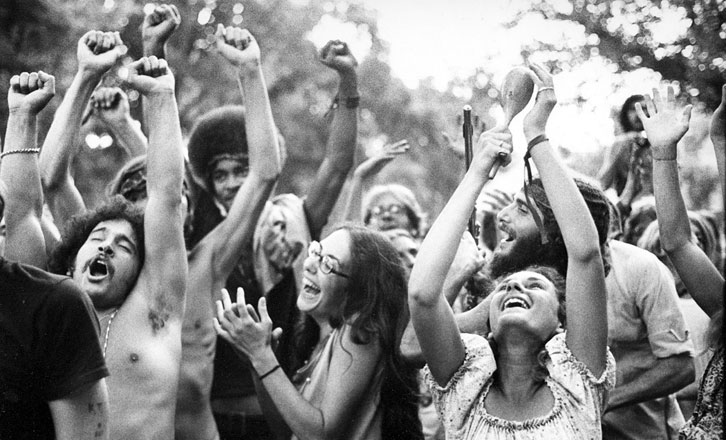
The Summer of Love refers to the 1967 convergence of young people, musicians, artists, activists, spiritual seekers, runaways, writers, and curious outsiders in San Francisco, especially around the Haight-Ashbury district and nearby Golden Gate Park. It became one of the defining images of the 1960s: long hair, handmade clothes, psychedelic posters, free concerts, antiwar feeling, communal experiments, and a belief that personal freedom could reshape society.
Although the phrase suggests one season, the movement had been building for years. Beat culture, civil rights activism, folk music, the Free Speech Movement, antiwar organizing, experiments with communal living, and the rise of psychedelic rock all fed the moment. By 1967, San Francisco had become a national symbol for a youth culture trying to live outside the expectations of postwar America.
Haight-Ashbury as a Gathering Place
Haight-Ashbury was central because it offered cheap housing, proximity to parks, a growing music scene, and a dense network of shops, crash pads, artists, activists, and informal community services. The neighborhood became a stage on which counterculture could be seen, photographed, imitated, celebrated, and criticized.
People arrived for many reasons. Some came for music and style. Some came to reject war, consumerism, racial injustice, or conventional career paths. Some came looking for spiritual experience, artistic community, or simply a place where they could be strange without immediately being alone. The result was vivid, idealistic, messy, and often overwhelmed by its own publicity.
The Music
Music carried the Summer of Love farther than any manifesto. San Francisco bands such as the Grateful Dead, Jefferson Airplane, Big Brother and the Holding Company, Quicksilver Messenger Service, Moby Grape, Country Joe and the Fish, and others turned ballrooms, parks, and festivals into meeting places for the new culture.
The sound was not one thing. It mixed folk, blues, rock, improvisation, protest music, jug-band humor, electric volume, and psychedelic experimentation. Concert posters, light shows, underground newspapers, and radio helped make the music feel like part of a complete visual and social world.
Love, Peace, and Protest
The Summer of Love is often remembered through the gentle language of peace and love, but it was also shaped by conflict. The Vietnam War, the draft, police pressure, racial inequality, poverty, and generational distrust were all present. The counterculture's optimism existed beside real social strain.
For many participants, love was not just romance or style. It meant opposition to war, suspicion of hierarchy, openness to new forms of family, interest in communal care, and a desire to treat pleasure, art, and consciousness as part of politics. The slogan was simple; the attempt to live it was not.
The Reality Behind the Image
The myth of the Summer of Love can make 1967 look effortless, but Haight-Ashbury struggled under the weight of attention. Thousands of young arrivals needed food, shelter, medical care, and help navigating drugs, exploitation, and mental distress. Groups such as the Diggers and the Haight Ashbury Free Clinic tried to meet urgent needs with free food, medical care, street theater, and mutual aid.
That tension is part of the history. The Summer of Love was both beautiful and unsustainable: a cultural opening, a media spectacle, a community experiment, and a warning about what happens when a fragile neighborhood becomes a national symbol almost overnight.
Why It Still Matters
The Summer of Love influenced music, fashion, graphic design, festival culture, organic food, alternative spirituality, environmentalism, sexual openness, independent publishing, and later ideas about community and technology. Its images have been commercialized many times, but its deeper questions remain: how should people live together, what does freedom require, and what happens when youth culture tries to become social change?
It also changed San Francisco's cultural memory. Golden Gate Park, the Haight, psychedelic poster art, free concerts, and the language of peace and love remain tied to the city's identity, even as the city itself has changed dramatically.
The 40th Anniversary Gathering
In 2007, the 40th anniversary of the Summer of Love was marked with a free gathering at Speedway Meadows in Golden Gate Park on September 2. The event brought together musicians, poets, tribal representatives, peace-movement voices, and counterculture figures to honor the principles of peace, love, and understanding associated with the 1960s generation.
Announced participants included Ray Manzarek of the Doors, Country Joe McDonald, Canned Heat, Michael McClure, New Riders of the Purple Sage, Nick Gravenites, David LaFlamme, Dan Hicks, The Charlatans, Essra Mohawk, Barry Melton, Fishbone, and others. The anniversary gathering was not the Summer of Love itself, but a later act of remembrance by people and communities still drawn to what 1967 had come to represent.