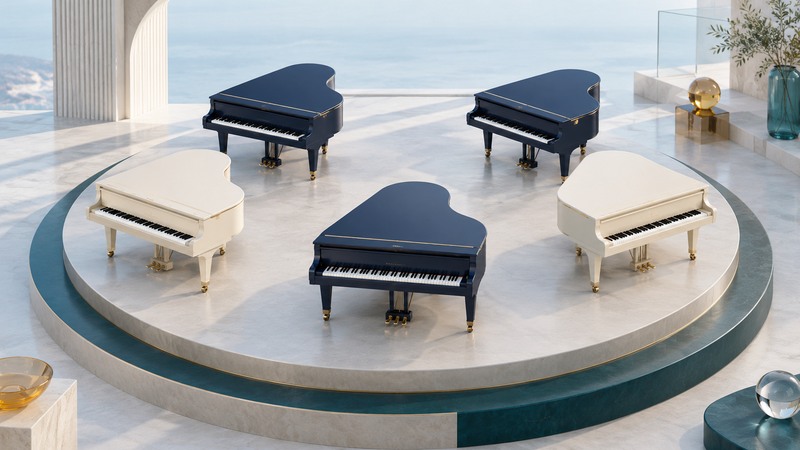
The 5 Browns’ No Boundaries is a useful introduction to piano texture: how melody, bass, rhythm, and accompanying figures fit together. Begin by checking who plays each track. The ensemble’s name does not mean all five pianists perform every selection.
Solo, duet, and multiple pianos are different things
The ensemble’s official discography describes No Boundaries as a mixture of quintet, duo, and individual performances. A solo pianist can already play several musical roles at once. A piano duet often means two people sharing one keyboard; two-piano music uses two instruments. Check the actual instrumentation rather than inferring it from how busy the recording sounds.
The licensed album credits identify Gregory Brown on Liszt’s “Hungarian Rhapsody No. 6,” Deondra and Desirae Brown on Lutosławski’s “Variations on a Theme of Paganini,” and the ensemble on “Rhapsody in Blue.” The publisher’s work record specifically identifies Lutosławski’s 1941 version as music for two pianos. Those are firmer starting points than counting apparent sound sources in headphones.
| Start here | Documented performers | Listening task |
|---|---|---|
| Hungarian Rhapsody No. 6 | Gregory Brown | Follow a melody while the same pianist supplies its support. |
| Variations on a Theme of Paganini | Deondra and Desirae Brown; two-piano work | Notice contrasts and exchanges as the theme is transformed. |
| Rhapsody in Blue | The 5 Browns ensemble | Track changes between a prominent line and fuller collective sound. |
Follow the job a sound is doing
Choose a passage short enough to replay comfortably, perhaps thirty seconds. On the first pass, follow the tune you could hum. On the second, follow the lowest recurring notes. On the third, attend to the figures between them: repeated chords, rippling patterns, or short answers. These are listening categories, not a claim that each category belongs permanently to a particular player.
A melody can move into a lower register, an accompaniment can briefly become the main event, and several players can reinforce one gesture. If you lose the line, return to its last clear entrance and listen forward. Note the change in register or rhythm that made it harder to follow. This is more useful than trying to name every note.
Make a handoff map
In the Paganini variations, choose one recognizable figure and note where it returns in a changed form. Write its timestamp, register, and character: for example, “short high gesture followed by a lower response,” if that is what you hear. Do not assign names to left and right channels without documented seating or recording information. Stereo position is a production clue, not a reliable performer credit.
What happens when orchestral music becomes piano music?
The album closes with a track labeled The Firebird (From the 1911 Version) [Excerpt]. That wording matters: it is not the whole ballet. When locating an orchestral comparison, identify the corresponding passage rather than comparing the piano excerpt’s running time with an entire score.
Listen for the same melodic gesture in each version. An orchestra can distinguish simultaneous lines through contrasting instrumental colors; a piano arrangement must make their relationship clear through register, articulation, spacing, dynamics, and the distribution of parts. Ask which line comes forward in each recording and what makes you notice it. A change in emphasis can reveal a musical detail that was less obvious before.
A satisfying first session
Hear the solo Liszt track, the two-piano Paganini variations, and one ensemble selection. For each, save one observation about melody and one about accompaniment. End with the entire track that most interested you, without stopping to take notes. The aim is to hear relationships more clearly, not to turn every replay into an identification exercise.
For another path from a selection to its larger source, see Charlotte Church’s Enchantment repertoire guide.
Keep your listening notes
Piano ensemble listening notes (plain text) includes instructions and fields for the exercise. Save a copy and fill it in with any text editor.