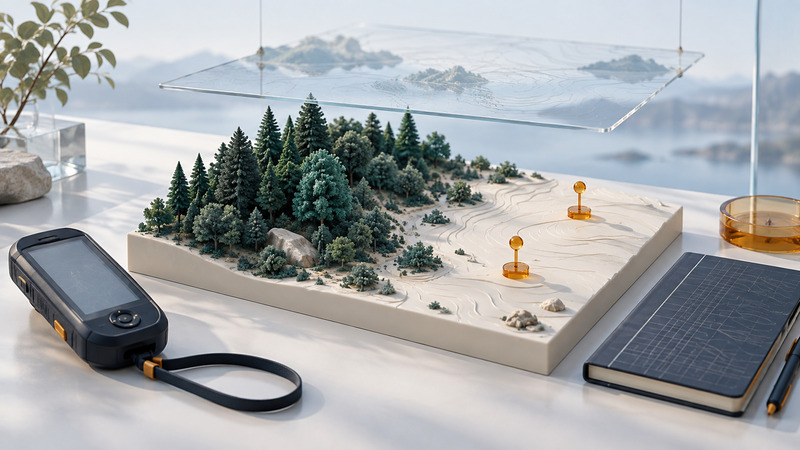
Reliable GPS field mapping means collecting locations that another person can interpret, revisit and assess. For conservation work, a useful record includes the feature's identity, observation time, coordinate reference, collection method and any uncertainty. A receiver's displayed accuracy estimate is one input to that record.
Start with the decision the map will support. Finding a broad habitat area again, relocating a small monitoring plot and establishing a legal boundary require different methods. Set the needed tolerance with the project lead before selecting equipment or accepting measurements.
Define a useful field record
| Field | What to record | Why it matters |
|---|---|---|
| Feature ID and description | Stable ID, feature type and recognizable details | Helps identify the same object on a later visit |
| Position and reference | Coordinates, units, format and reference system | Prevents interpretation based on an assumed datum or order |
| Observation time | Date/time with UTC or a stated time-zone offset | Connects the position with conditions and other records |
| Collection method | Receiver, app, provider, averaging and corrections | Explains how the coordinate was obtained |
| Quality and conditions | Reported uncertainty, fix status, canopy and obstructions | Helps reviewers flag records needing follow-up |
| Supporting evidence | Notes and appropriately handled photographs | Distinguishes a mapped feature from an unexplained point |
Decide which fields are required before deploying the form. Test one complete export in the software that will receive it. A field visible in the mobile app can still be absent from the exported file if the schema or export workflow omits it.
Prepare the map and receiver together
Download the working area and necessary reference layers. Open them offline and rehearse collecting a feature, editing its attributes, saving it and transferring it back. Use stable IDs so a failed sync or repeated observation can be recognized instead of silently becoming a duplicate feature.
In ArcGIS Field Maps, for example, mobile configuration includes required accuracy/confidence settings and GPS averaging. Its receiver preparation documentation also explains provider selection and location profiles for coordinate transformations. Configure those from the project's reference information; retain the settings with the dataset.
For a different field app, identify the equivalent controls in its documentation. If the app cannot store needed quality fields, change the schema or collection workflow before gathering data that will later be difficult to assess.
Check repeatability and agreement separately
Repeatability describes how closely repeated observations cluster. Agreement with an independently established reference addresses where that cluster is located. A stable cluster displaced from the reference can result from a systematic problem that averaging alone will preserve.
Fictional local-grid example: a known check point is at easting 1000 m, northing 2000 m. Three observations are (1003, 2004), (1004, 2004) and (1002, 2004), all in the same defined local system. Their mean is (1003, 2004). The mean is 3 m east and 4 m north of the reference, giving a horizontal displacement of √(3² + 4²) = 5 m. The readings cluster within 1 m of their mean, yet the mean remains 5 m from the reference.
That example demonstrates a distinction, not a calibration procedure or a receiver specification. The appropriateness of a check point and acceptance threshold depends on the project. For controlled survey work, use the GPS surveying guide and qualified project procedures.
Collect difficult locations honestly
Tree canopy, buildings and reflected signals can affect a position. GPS.gov's accuracy guidance identifies local reception and receiver factors as contributors. Record conditions alongside the observation so that a reviewer can distinguish a difficult site from a consistently poor setup.
When the project permits it, revisit a questionable feature at another time and compare the observations. Do not shift a point onto the nearest path or attractive-looking map location just to make it plausible. If the feature cannot be occupied safely, use a documented offset method appropriate to the required tolerance and identify the actual feature location separately from the receiver location.
Record a failed or uncertain observation as such. For a broad habitat survey, it may remain useful with a quality flag. For relocating a small plot, it may require a return visit or another measurement method. Let the project requirement determine that decision.
Review a small sample before the full survey
- Collect a few representative features, including an open-sky site and an expected difficult site.
- Export them and inspect coordinates, IDs, time zones, attributes and photographs in the receiving system.
- Check for swapped latitude/longitude, missing hemispheres, implausible jumps, duplicate IDs and empty required fields.
- Compare check observations using the project's method and tolerance. Keep reported receiver uncertainty separate from measured disagreement.
- Resolve the cause of failed checks before expanding collection; retain the original trial for traceability.
The field mapping observation checklist includes a repeat-observation record and the fictional arithmetic example. The GPS software guide helps with coordinate and file interpretation when moving data between tools.
Preserve evidence and protect sensitive locations
Keep the original observations before cleaning or conversion. Record any edits and distinguish measured coordinates from derived or generalized ones. Share only the location precision and attributes appropriate to the project; sensitive species, private property and repeated personal routes may need restricted access or generalized public maps.
Choose equipment by its ability to meet your collection and review requirements under representative conditions. A dependable workflow combines suitable observations with enough context to explain their strengths and limitations after everyone has returned from the field.