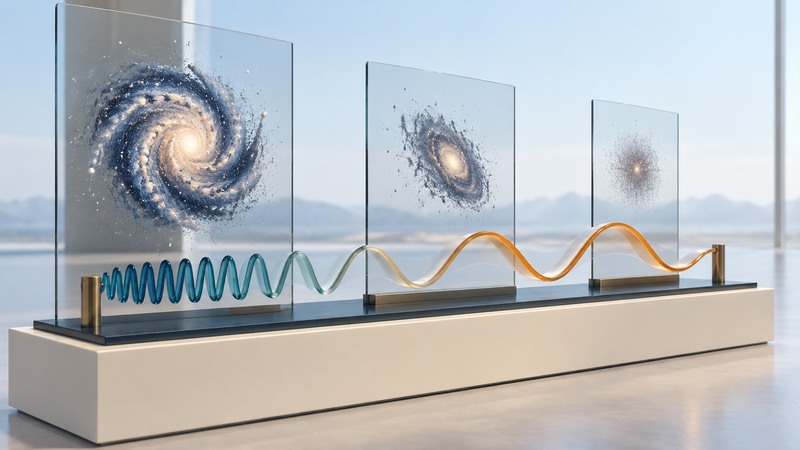
The most distant galaxies are views of the early universe preserved in arriving light. To understand a discovery, ask how its redshift was measured, which meaning of distance is being used and whether the object is a candidate or has spectroscopic confirmation. A record-holder's name can change; these questions stay useful.
Three quantities that a headline can mix together
| Quantity | Meaning | How to interpret it |
|---|---|---|
| Lookback time | The elapsed time since the light was emitted. | Describes how far into the past the observation reaches. |
| Cosmic age at emission | The universe's age when that light left. | Describes the stage of cosmic history being studied. |
| Present-day distance | A separation evaluated at the present cosmic time in a specified cosmological model. | Includes the effects of expansion while the light travelled. |
Space expanded during the journey, so multiplying lookback time by the speed of light does not give the present-day separation. Converting redshift to time or distance requires a cosmological model and its parameters. NASA's lookback-time explanation introduces the connection between finite light speed and seeing earlier epochs.
Calculate a wavelength shift
Cosmological redshift describes the stretching of light as the universe expands. If a feature's emitted wavelength is known, compare it with its observed wavelength:
1 + z = observed wavelength ÷ emitted wavelength
The wavelengths must use the same units. A redshift of 9 means a tenfold wavelength stretch. It does not mean nine billion light-years. NASA's redshift guide explains how identifiable spectral features serve as references.
Understand candidate selection and confirmation
Imaging surveys compare brightness through several filters. A sharp drop in shorter-wavelength bands can flag a high-redshift candidate because intervening hydrogen absorbs part of its spectrum. Dusty or evolved lower-redshift galaxies, blended objects and noise can sometimes imitate the colors. The candidate list is a reason for follow-up.
Spectroscopy spreads the light into finer wavelength information, testing a proposed break or identifying lines. Confidence depends on the signal quality and consistency of the features; an explicit uncertainty and an assessment of alternatives remain useful even after a spectrum is obtained. The 2024 spectroscopic study of two galaxies at redshift 14 is an example of taking imaging-selected candidates to more detailed measurements.
Distinguish a large photometric best-fit value from a secure measurement. A claim should say whether the uncertainty is broad or narrow, whether the spectrum can reject plausible lower-redshift solutions and whether other observers have checked it.
From deep fields to a dated Webb example
The Hubble Ultra Deep Field, released in 2004, used long exposures to reveal a dense collection of faint galaxies in a small area. Its importance was the population it exposed across cosmic history, not simply one distant object. NASA's deep-field history places those observations and later extensions in context.
For a dated example, NASA's January 28, 2026 account of MoM-z14 reports a NIRSpec-confirmed redshift of 14.44 and a view of the galaxy about 280 million years after the big bang. The release describes roughly 13.5 billion years of light travel. These statements refer to the same object using different quantities.
At z = 14.44, the wavelength stretch factor is 15.44. The inferred cosmic age comes from the cosmological interpretation; it is not obtained by treating 14.44 as a time. Check the publication date and supporting paper before comparing a later record claim with this example.
Assess the next “farthest galaxy” story
- Write down the object designation, source publication and date.
- Find the redshift and its uncertainty; label it photometric or spectroscopic.
- Identify the instrument and spectral evidence, including the rejected alternatives.
- Separate lookback time, cosmic age and distance. Retain the model assumptions for numerical comparisons.
- Ask what changed scientifically: the age of a population, star formation, chemistry, or a challenge to a particular model.
A galaxy brighter than a model predicted can motivate revised assumptions about stellar populations or galaxy formation. The specific discrepancy deserves more attention than a blanket claim that all cosmology has failed. For the first step in reading the underlying observation, see Webb images and spectra.