Modern Bride’s Trista Rehn cover sits at the intersection of bridal publishing and reality television in 2003. Reading the surviving cover and contemporary reporting together helps separate a magazine’s promise of wedding detail from the event and its later television presentation.
What can be established about the cover
A small cover image preserved with Yenra’s original page shows the Modern Bride masthead, a “Real Weddings” line and Trista named in the cover text. It is a partial, low-resolution image, not a complete issue. Independently, the Houston Chronicle’s October 14, 2003 news brief identifies Rehn as the cover model for Modern Bride’s December/January issue. Read the contemporary Chronicle item, “Bachelorette preps for nuptials”.
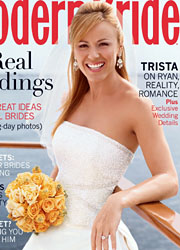
This supports a narrow identification of the feature. It does not verify the full interview, the complete issue contents, an exact on-sale day or a claim that this was the magazine’s first cover of its kind. The issue label is a publishing identifier; it should not be treated as the date the photograph was taken or the wedding occurred.
Keep publication, event and broadcast dates separate
| Date | What it dates | Evidence and limit |
|---|---|---|
| October 14, 2003 | Contemporary reporting of the cover | The Chronicle identifies the December/January issue. This is not an independently verified on-sale date. |
| December 6, 2003 | Rehn and Ryan Sutter’s wedding | ABC’s December 10 report says the event took place the preceding Saturday, separately from the television showing. |
| December 10, 2003 | Scheduled ABC wedding special, 9–11 p.m. Eastern | The contemporaneous ABC story gives that evening’s broadcast time; it is not a current viewing listing. |
ABC’s “Bachelorette Weds in Pricey TV Nuptials” is internally dated December 10, although its website timestamp displays December 9 at 7:43 p.m. The article reports that ABC paid for the event and describes preparations through interviews with the wedding coordinator and florist. It supplies broadcaster context, not independent evidence of an ordinary household wedding budget.
The dated record matters more than a later page’s surrounding headlines or automatically refreshed navigation. When citing it, save the story title and its internal dateline as well as the URL. This timeline concerns the wedding special identified by ABC; it does not reconstruct every installment of the associated television series.
Read the cover and broadcast as different editorial objects
The cover makes a promise. A cover selects a person, an image and a few phrases to attract a reader. In this surviving image, the wedding label and Rehn’s name connect the bridal magazine to a recognizable television participant. That is a reading of the cover’s visible framing, not a claim about the editors’ private intentions or the contents of every interior page.
The television report describes a produced event. Its account of a broadcaster-funded celebration gives the spectacle a production context. A reader should retain that context when encountering an isolated photograph or decoration detail elsewhere. The fact that a detail appeared in a televised wedding does not make it a typical purchase or a necessary part of another couple’s celebration.
The sources have different jobs. Use the contemporary newspaper to corroborate the cover identification, the surviving image to examine the wording that is actually visible, and the broadcaster’s report for its dated event and program information. None substitutes for reading the complete magazine issue. Keeping these roles separate lets a small archive support a useful interpretation without making it larger than it is.
For another dated example of how wedding ideas were presented, see Wedding Trends in 2005. For identifying editions and taking reading notes, see the Martha Stewart wedding books guide.
This is a 2003 media-history case study, not current celebrity coverage or a full-issue review. The new hero is conceptual and does not reproduce the magazine cover or a scene from the broadcast.