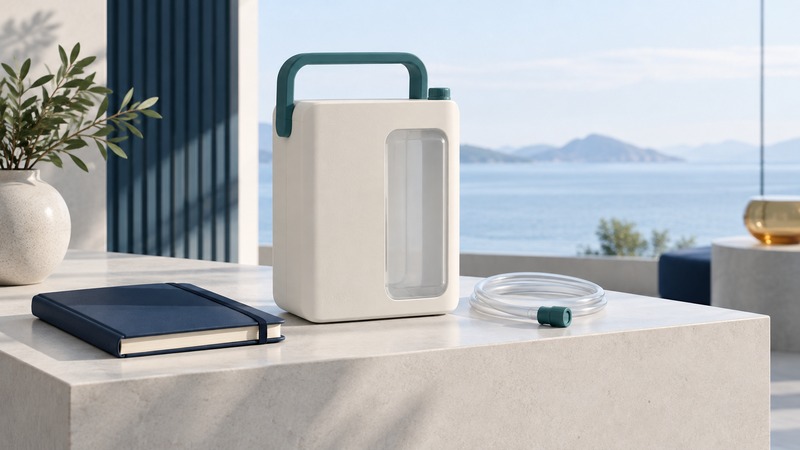
A portable chest drain can allow movement while air or fluid continues to leave the space around a lung. The useful starting point is the reason your drain is still needed and the exact system attached to it. Ask the team to show you how that system fits your recovery plan.
A chest tube enters the space between the lung and chest wall and connects to drainage equipment outside the body. Cambridge University Hospitals explains chest drainage for collections of air, fluid or pus. The reason for drainage, your symptoms and the team's assessment determine the plan.
Identify the equipment and its job
Portable systems include small collection devices with one-way valves and powered digital systems. Some support prescribed suction; others have a different arrangement. Their controls, position requirements, alarms and collection methods vary. Write down the model and keep its patient instructions with the discharge paperwork.
The Golden Jubilee hospital's Thopaz leaflet describes one powered system that permits mobility with suction and, for selected patients, use at home. Its local discharge criteria and operating instructions apply to that care pathway. Your own team must confirm which instructions apply to your device and condition.
Practice the everyday routine with a nurse
Ask the nurse to observe you getting up, walking and sitting down with the equipment. Clarify where to place it, how to support the tubing and what help you need. This turns an abstract instruction to “mobilize” into a routine you can repeat comfortably.
Cover clothing, sleeping position, washing, pain control, access to a toilet and transport. Ask whether someone should accompany you and what activity limits remain from the operation itself. If the system uses power, confirm charging, battery information and the response to a power or equipment failure.
Only carry out the handling tasks for which your team has trained you. Do not clamp, disconnect, flush or change suction settings on your own. Obtain explicit instructions about collection containers and dressings, including who will manage them. Videos for a different model can show an incompatible routine.
Make discharge a supported transition
Agree who will review the drain, how often, and where. Ask what observations to record and which changes need a call. If quantities are requested, have the team write the units, timing and meaning of the entry. The amount currently in a container and the amount collected since the last reading are different records.
A published study of a nurse-led outpatient chest-tube service describes selected patients discharged with structured review. Its practical lesson is that outpatient care includes a clinical service, not simply a smaller container. It does not establish that every patient or device is suitable for home use.
- Confirm the next appointment and transport, including how to return sooner if asked.
- Identify who supplies replacement equipment and who changes the dressing.
- Write down daytime and after-hours clinical contacts, separate from a manufacturer's technical helpline.
- Discuss any difficulty with reading the display, dexterity, language, housing or caregiver availability before leaving.
Act on symptoms and equipment problems
Sudden or worsening shortness of breath, severe chest pain, collapse or serious deterioration needs emergency help. Use your local emergency number. If the tube moves, falls out, disconnects or is damaged, contact the treating service immediately and follow its emergency instructions; do not push a tube back in. Fever, increasing pain or redness, and unexpected drainage changes also need prompt clinical advice.
Drain removal is a clinical decision based on the reason for the drain and your recovery, sometimes including imaging and drainage or air-leak information. Ask who makes that decision and what care is needed afterwards. The stitches guide can help you clarify any later stitch-removal appointment.
A resource for the conversation
Save the portable chest drain: support plan to complete with the team (editable text). Fill it in with the responsible team and keep your completed copy privately.
General patient education. Follow your clinical team's instructions for your care. Explore the medical guides.