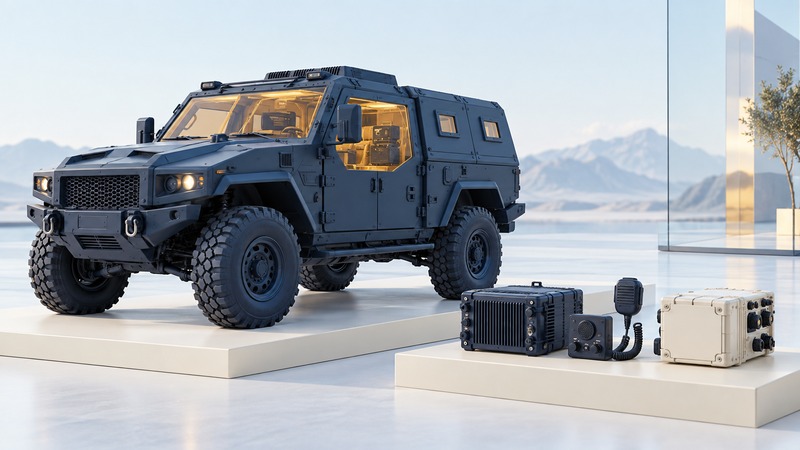
A C4I upgrade changes how a vehicle’s occupants communicate, share information, and use onboard computing. C4I stands for command, control, communications, computers, and intelligence. The engineering task is to make the equipment work together within the vehicle’s available space, power, environment, and crew workflow.
Place the MRAP milestone in context
Mine-Resistant Ambush Protected (MRAP) vehicles are a family of protected vehicle designs with different roles and configurations. In an October 19, 2017 announcement, BAE Systems reported completing C4I upgrades on the 5,000th mine-resistant tactical vehicle under work supporting the Navy's then-named SPAWAR Systems Center Atlantic. The account named communications, intercom, mobile-network, and protective-system integration across several vehicle types.
That is a dated installation milestone reported by the contractor. It establishes the scope of the announcement, while performance in a particular vehicle configuration requires its own evidence. An electronics upgrade and an armor change answer different engineering questions.
Start a useful explanation with a function: communicating within the crew, communicating beyond the vehicle, displaying information, or supporting a connected device. Then identify the equipment and dependencies involved.
Review the complete installed configuration
On a narrow screen, scroll the table horizontally. Keyboard users can focus the table region and use the arrow keys.
| Concern | What must fit together | Evidence to look for |
|---|---|---|
| Electrical power | Supply, conversion, distribution, and demand across operating states. | A reviewed power budget and results for the intended configuration. |
| Heat and environment | Equipment heat, available cooling, and the specified operating environment. | Thermal and environmental evaluation with stated conditions. |
| Space and crew access | Mounting, controls, visibility, maintenance access, and entry or exit. | Layout review and representative crew-use assessment. |
| Interfaces | Connectors, data formats, timing, software versions, and permissions. | Interface definitions and integrated function tests. |
| Coexistence | Equipment operating together in the installed vehicle. | Applicable compatibility tests, recorded issues, and accepted corrections. |
These questions help interpret an engineering report. The responsible vehicle program determines the actual installation and acceptance requirements. A bench test of a radio addresses a narrower boundary than a test of that radio installed alongside other equipment.
Understand the value of shared interfaces
Adding a separate display, receiver, and control box for each new function can consume space and make crew interaction harder. An architecture with defined shared services can reduce duplication, provided the connected systems interpret those services consistently.
The Army's March 2017 account of a VICTORY demonstration describes open interface specifications for vehicle C4ISR and electronic-warfare integration. The demonstration addressed shared position and timing, device management, and centralized access control. C4ISR extends the familiar acronym to include surveillance and reconnaissance.
The useful lesson is the integration approach: define the interface and verify the participating configurations. A shared service also creates a dependency that engineers must assess if it becomes unavailable. The demonstration account concerns its tested setup; it does not establish that every MRAP upgrade uses VICTORY or that every connected product is interchangeable.
Separate power demand from stored energy
Electrical demand is usually expressed in watts; stored or consumed energy can be expressed in watt-hours. Cooling equipment also requires power, so the full budget needs a clear boundary. The Army's March 2020 report on vehicle-integrated command-post power describes work spanning communications, mission-command equipment, and heating and cooling loads. Its planned demonstration and fielding dates are historical forecasts, not completion records.
When a report quotes endurance, ask what was powered, the operating pattern, the available energy, and how the result was measured. A component's maximum input rating and its average measured consumption describe different things.
Connect an upgrade claim to its evidence
A useful acceptance record ties a vehicle configuration to installed equipment versions, defined functions, test conditions, results, and unresolved findings. The record should make it possible to tell which combination was evaluated after a hardware or software change.
For example, a fictional upgrade report might say that an intercom was fitted and powered on. That establishes less than a documented crew assessment showing the intended users could select the correct channel, hear relevant audio, and reach the controls in the evaluated configuration. The evidence should match the promised function.
Read the milestone verb carefully: designed, installed, integrated, tested, accepted, and supported describe different stages. A count of completed installations helps describe program throughput; the supporting test and maintenance records explain the behavior of the delivered configuration.
For the underlying vehicle comparison, see military truck roles and weight terminology and the JLTV family. The wireless-security guide explains identity and access concepts in an enterprise network context.