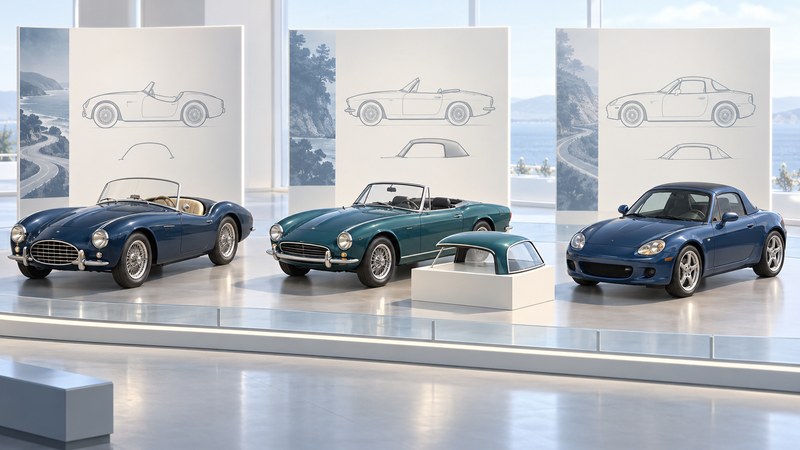
The SL's first fifty years are easier to understand as a set of model families than as a simple numbered sequence. The early 190 SL and 300 SL overlapped. Later names could recur on quite different cars, while roof designs changed the relationship between an open roadster and a closed coupe-like shape.
1952 racing origins, 1954 road-car debut
Mercedes-Benz's racing SL appeared in 1952; the production 300 SL followed in 1954, and its roadster in 1957. AMG's history with Mercedes-Benz Classic connects those events. The racing W194 and road-going W198 should therefore have separate entries in a history or identification record.
The 190 SL was presented alongside the 300 SL in 1954, but its production began in 1955. It was a parallel offering, not a replacement generation. This distinction matters when a timeline places both names under one decade: shared dates do not make them the same model family. The intervals below follow Mercedes-Benz's SL retrospective.
The families represented by the 2004 anniversary
On a narrow screen, scroll the table sideways. Keyboard users can focus the table region and use the arrow keys.
| Family / code | Production period | Body or roof distinction |
|---|---|---|
| 300 SL / W198 | Coupe 1954–1957; roadster 1957–1963 | Gullwing coupe followed by conventionally opening roadster doors. |
| 190 SL / W121 | 1955–1963 | Separate open two-seater with a removable hardtop available. |
| SL / W113 | 1963–1971 | The Pagoda family, associated with its concave removable hardtop. |
| SL / R107 | 1971–1989 | Roadster with fabric roof and removable hardtop; distinguish the fixed-roof C107 SLC. |
| SL / R129 | 1989–2001 | Fabric folding roof and removable hardtop. |
| SL / R230 | 2001 onward within this guide; continued to 2012 | Retractable rigid VarioRoof. |
The dates describe family production, not every country's model-year designation. This guide stops its narrative at 2004; the R230 did not stop then. Nor should a photograph of a roofless car automatically be assigned to one family. Several families could be driven open, and a removable roof may be stored away from the vehicle.
Work from the body to the documents
- Describe the body without naming it. Record the doors, side-window outline, rear quarter and apparent roof type. Separate a feature you can see from one hidden by the camera angle.
- Make a provisional family match. Use the table to narrow the possibilities. A roof seam can be a useful clue; the absence of a roof in a photograph is weak evidence.
- Record the badge exactly. Treat it as a claim to check. A familiar engine badge does not uniquely identify a body family, and a badge can be replaced.
- Reconcile the identification records. Match the chassis identification and data card or equivalent factory record with the physical vehicle. Keep build date, registration date and claimed model year in separate fields.
For a photograph collection, a cautious caption might read “probable W113, hardtop removed; identity not documented.” That is more useful than a confident engine designation inferred from the shape of the bonnet. For a real car, photographs start the investigation; they do not authenticate its identity or originality.
Three common sources of confusion
A reused name: in a hypothetical album, “300 SL” is written beneath an unidentified car. Keep that wording in the original-caption field and put your family assessment elsewhere. Otherwise a later correction can accidentally erase the evidence you were trying to evaluate.
A roof that changes the silhouette: ask for side and rear-quarter views, plus photographs showing the roof attached and stored if available. A detached hardtop in a garage should be documented separately until its relationship to the car is established.
A year that means registration: a title or album date may describe an administrative event or a photograph, while the table describes production. Record what each date actually measures. A disagreement should trigger a document check, not an automatic conclusion that the car or the source is wrong.
Keep the C107 SLC distinction explicit when organizing images: the fixed-roof SLC is not simply an R107 roadster photographed with its hardtop fitted. Body-family identification needs more than the presence of a roof.
Keep an evidence-based identification record
The SL family identification record has separate spaces for observed features, labels, dates and documentary confirmation. Its final field asks what remains unresolved, so the record stays useful when a better image or factory document arrives.
Use the linked manufacturer retrospective for the historical sequence and the AMG account for the connection between racing and road cars. A generation chart is a starting point for identification; specifications, parts and restoration decisions need literature for the confirmed model and market.
Explore Autos: vehicle guides, technology and design · Cars: buying, maintenance and ownership