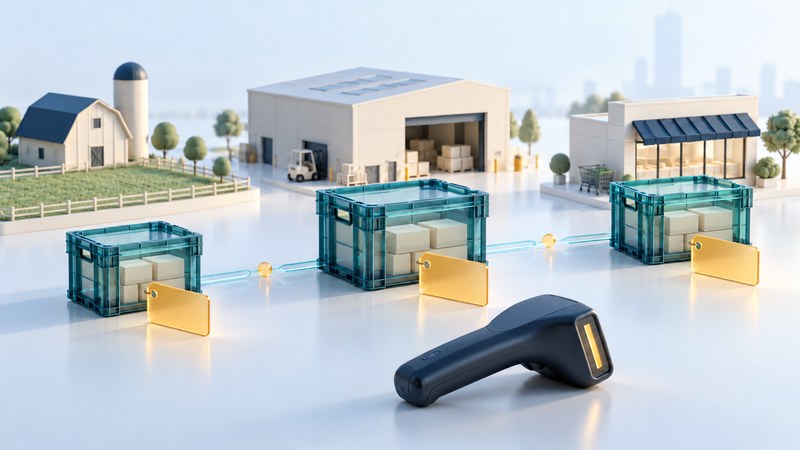
Meat traceability is the ability to connect a product with its source materials, processing history, and destinations. RFID can help capture identifiers, but a useful recall record also explains what happened to the product between scans.
This guide explains the system for readers and small food businesses. Actual recordkeeping duties depend on the product, activity, and jurisdiction; check the applicable regulator and your food-safety program before choosing a compliance workflow.
Connect identities across transformations
An animal identifier, a carcass identifier, a carton lot, and a retail package code operate at different stages. Cutting, combining, grinding, repacking, and distributing can change the unit being tracked. The record must preserve those relationships, including any carryover material, so a later question can travel backward to sources and forward to affected output.
GS1's traceability framework pairs tracking events, such as receiving and shipping, with the data describing each event. Product and location identifiers connect physical goods to records. The practical question is whether the next business can interpret and retrieve that information when needed.
Give RFID a defined job
On a narrow screen, scroll the table sideways. Keyboard users can focus the table region and use the arrow keys.
| Part | What it contributes | What still needs a record |
|---|---|---|
| Barcode or RFID identifier | Connects the object being scanned with an identity. | Which lot or serialized unit that identity represents. |
| Processing and handling event | Links inputs, outputs, time, and location. | Splits, combinations, carryover, exceptions, and corrections. |
| Data exchange | Lets authorized partners interpret the event. | Agreed meanings, access, retention, and a way to request missing information. |
GS1 EPCIS provides a common language for sharing events about products, locations, movement, and status. It can include sensor information. Choose the data relationships first, then test the capture method under the actual packaging, handling, and operating conditions. A tag's presence alone establishes neither a complete history nor a safe temperature history.
An example of a specific U.S. requirement
USDA FSIS Directive 5000.10 explains verification of raw-beef grinding records. Its background lists supplier establishment numbers, supplier lots and production dates, names of supplied materials including carryover, production dates and times, and cleaning and sanitizing dates and times. It also explains the lot definition used for that recordkeeping and specific circumstances outside the directive's verification task.
This illustrates why “we scanned the carton” may leave crucial gaps. Establishments should check the underlying current requirements and their own scope with FSIS. A food-traceability rule from another regulator or country should be evaluated separately; a technology purchase does not determine jurisdiction.
Worked example: trace backward and forward
The arithmetic reconciles: 60 + 40 = 100 kg in, and 60 + 30 + 10 = 100 kg accounted for. If records instead show only 90 kg, the missing 10 kg becomes an unresolved question. Document waste, samples, returns, or other disposition when those are the real explanation.
Test retrieval before a recall
- Choose a finished lot and retrieve its inputs, processing interval, and destinations.
- Choose one input and identify every linked output, including carryover relationships.
- Reconcile quantities and units, then explain each discrepancy.
- Confirm who can reach suppliers and customers outside normal hours.
- Record retrieval time, missing records, and corrections; repeat the failed portions.
Download the traceability exercise sheet. Protect access to partner and customer data, and agree on an outage communication method. For questions about what a test result establishes, see the biosensor evidence guide.