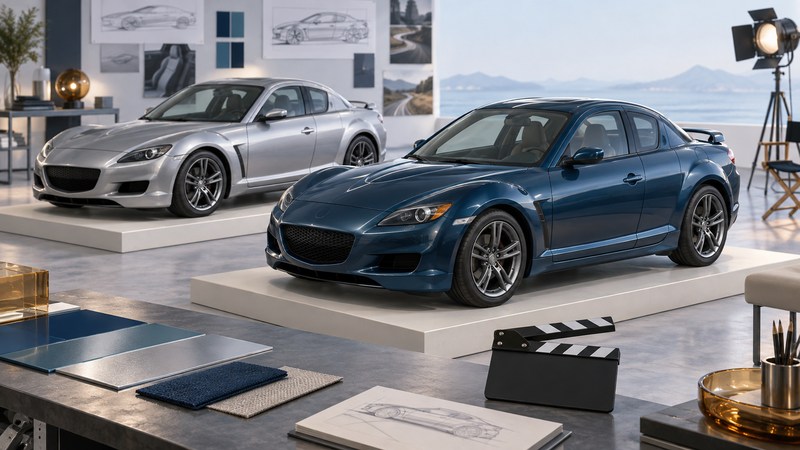
The RX-8 in X2 combined a recognizable production-car basis with a film-specific visual identity. Mazda’s period releases let you separate those layers: the underlying four-seat sports-car idea, the documented movie treatment and a different MAZDASPEED show concept. They also give you a reliable starting point for checking photographs without treating appearance as proof of a car’s history.
Place the car in its 2003 context
Three primary records anchor the chronology:
- January 10, 2003: Mazda described the RX-8 X-MEN car as based on the 2004 production model, created with 20th Century Fox for X2.
- April 9, 2003: Mazda announced the production RX-8’s Japanese launch. This is a market-specific production record, not a specification sheet for the film vehicle.
- May 2, 2003: 20th Century Studios lists the release date of X2.
The calendar year of an announcement, the model year of a car and the release date of a film describe different things. Keep all three labels when organizing a photograph or writing a caption.
What Mazda documented for the film car
The January film-car announcement identifies the following treatment. Its descriptions establish the intended appearance, not a complete build sheet or proof that every vehicle used during filming was identical.
| Area | Mazda’s film-car description | How to use the information |
|---|---|---|
| Exterior finish | Mutant Blue | A useful visual clue; lighting and later repainting make color alone weak identification evidence. |
| Exterior details | An X-shaped grille, rear spoiler and enlarged X on the nameplate | Compare each detail with dated official photographs, rather than relying on a general blue RX-8 resemblance. |
| Cabin trim | Black and silver treatment on seats, steering wheel and door trim | Check interior photographs separately; an exterior match leaves the cabin unverified. |
| Console | A communication device at the upper center console | Treat it as film-specific equipment; the announcement does not establish a usable consumer feature. |
| Powertrain basis | RENESIS rotary engine | The release supplies no film-car dynamometer result or complete modification inventory. |
These visual changes do not by themselves establish a distinct retail edition. When a listing calls a car an “X2 RX-8,” first determine whether it means documented film use, a promotional display, a replica or simply an inspired paint and trim treatment.
What belongs to the production RX-8 story
Mazda’s Japanese launch release describes a naturally aspirated, two-rotor RENESIS engine, four seats and center-opening Freestyle doors. It connects the compact, low-mounted engine to a front-midship layout. Those packaging choices explain why the base car offered a sports-coupe shape with rear-seat access.
The same production release distinguishes specifications by grade and transmission. Do not copy one Japanese-market output figure into a film-car caption merely because both vehicles are called RX-8. A car’s market, build specification and documented modifications are needed for that comparison. This page is a design-history guide; it is not a maintenance specification for a particular RX-8.
The MAZDASPEED exhibit was a different car
Mazda’s Tokyo Auto Salon announcement lists the RX-8 X-MEN car and RX-8 MAZDASPEED concept separately as reference exhibits at the January 10–12, 2003 show. It describes the MAZDASPEED concept through its own body treatment, aerodynamic components, suspension and wheels. Those details must not migrate into a film-car specification just because the exhibits shared a venue.
For a show photograph, record the display label and any associated release alongside the image. If the label is missing, describe the visible features and leave the identity provisional. The same discipline helps avoid conflating a later owner’s custom car with a period manufacturer exhibit.
A matching appearance is the start of an inquiry
Hypothetical photograph comparison
A blue RX-8 has a similar spoiler but no visible console photograph. Record the exterior resemblance and the missing interior view. Do not conclude that it was used in X2. The next useful evidence is a dated record linking that specific vehicle to production or promotion, not another unlabeled photograph.
For a screen-use claim, look for a chain of records that identifies the actual vehicle: studio or builder documentation, transfer paperwork and dated photographs whose details can be reconciled. Record who created each document and whether it refers to the same vehicle. A badge can support an appearance comparison; it cannot establish custody or film use.
The sources cited here do not establish the total number of filming or stunt cars, their individual identifiers, present owners or current locations. Leave those fields unknown until a suitable record supplies the answer. The car-photography guide can help you collect consistent views when documenting a display with permission.
Save your design notes
Download the RX-8 identification notes (plain text). Use the notes to compare photographs and keep production specifications, film styling and vehicle-history evidence separate.