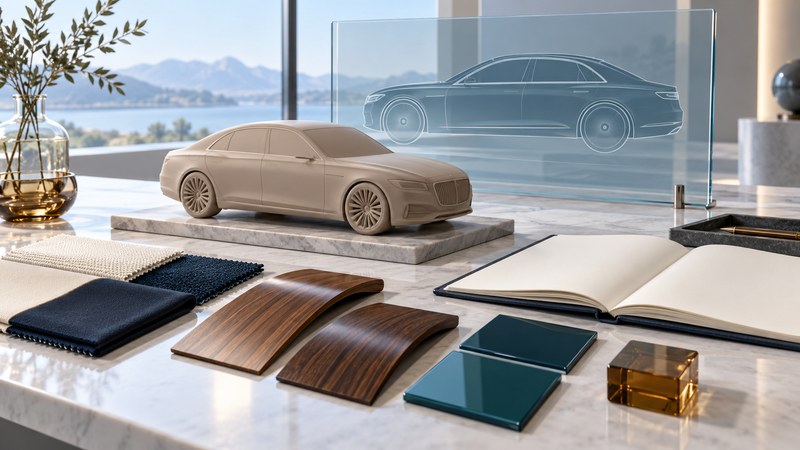
A luxury car can exist in several forms before it exists in a customer's garage: a material sample, an image on a screen, a written configuration and a completed object. The early-2000s Maybach commissioning studio brought the first two together. Understanding their different roles helps explain the historical process and makes a surviving specification file easier to read.
Physical samples alongside virtual combinations
The period DaimlerChrysler account of Maybach sales, reproduced by Automotive Intelligence, describes the Center of Excellence in Sindelfingen, Personal Liaison Managers, and a Commissioning Wall presenting paint and material samples. A Car Demonstrator combined digital images and equipment information, including presentations away from a Maybach Center.
A later Maybach 62 S manufacturer brochure, PDF page 42, also describes the wall's physical exhibits and the demonstrator's large virtual images. That later model brochure corroborates the approach; it does not establish every detail of the original 2003 American studio offering.
These are descriptions of the historical Maybach 57/62-era system. Their staffing, service and delivery promises should not be treated as a present-day ordering program. The enduring idea is more specific: use a tangible sample to examine a material, and a visualization to consider how selected materials work together across a car.
Four records, four different questions
The following evidence map is an editorial method for reading a commissioning file, not a claim that Maybach required these exact four stages or forms.
On a narrow screen, scroll the table sideways. Keyboard users can focus the table region and use the arrow keys.
| Record | Question it can help answer | What remains to be checked |
|---|---|---|
| Physical sample | What texture, grain or finish was considered? | Sample identity, lighting, date and whether it was selected. |
| Digital visualization | How did the proposed combination look as a whole? | Configuration revision; screen color is not a material specification. |
| Agreed specification | Which choices were recorded for the commission? | Approval date, amendments and correspondence resolving ambiguity. |
| Completed-car evidence | What was delivered or is present now? | Link to the same car, date, later repairs and retrimming. |
A rendering is particularly useful for relationships: whether a light seat contrasts strongly with dark surrounding trim, or whether a two-tone exterior divides the body as intended. A physical sample answers a different question about surface and feel. Neither automatically proves which material was ultimately installed.
When archiving the records, give each object a stable identifier and connect it to the next one. “Blue leather” is an impression; a dated sample reference attached to a specific configuration revision is traceable evidence. Retain the original file or photograph along with your transcription so future readers can check the interpretation.
Follow one finish choice through the file
Consider a fictional commission with two candidate wood finishes. A photograph shows the first sample beside a light upholstery swatch. A later visualization uses a darker wood, and the final written specification names the darker choice. The first photograph establishes that an option was considered; it does not establish that it was ordered.
Create a sequence with one entry per dated record. Link the final specification to any amendment, then compare it with delivery photographs or later inspection evidence. If a current photograph appears lighter, record that observation without immediately concluding that the trim was replaced. Lighting, exposure and the image itself may explain part of the difference; a replacement record would be a separate piece of evidence.
The useful result is a limited conclusion: “The dated specification identifies finish B; the present material has not been conclusively matched.” That statement is stronger than either assuming originality or declaring a mismatch from a screen image alone.
Make missing links visible
Start with the question you need to answer. For a history of the design process, an early rejected combination may be valuable. For a record of the delivered car, the same image must be marked as a proposal. File names such as “final” are not substitutes for dates and a documented approval.
If a sample has no code, photograph its labels and keep it as an unidentified sample. If two configurations conflict, retain both and look for a later amendment. If no delivery evidence survives, stop the chain at the agreed specification. An explicit gap makes the archive easier to improve without overstating what it contains.
Build a sample-to-car evidence map
The Maybach commissioning evidence map records one choice across samples, visualizations, specifications and completed-car evidence. Repeat it for each disputed material or feature. For model and equipment context, continue with the Maybach 57 and 57 S guide; for a passenger-focused examination of the larger car, use the Maybach 62 guide.
Explore Autos: vehicle guides, technology and design · Cars: buying, maintenance and ownership