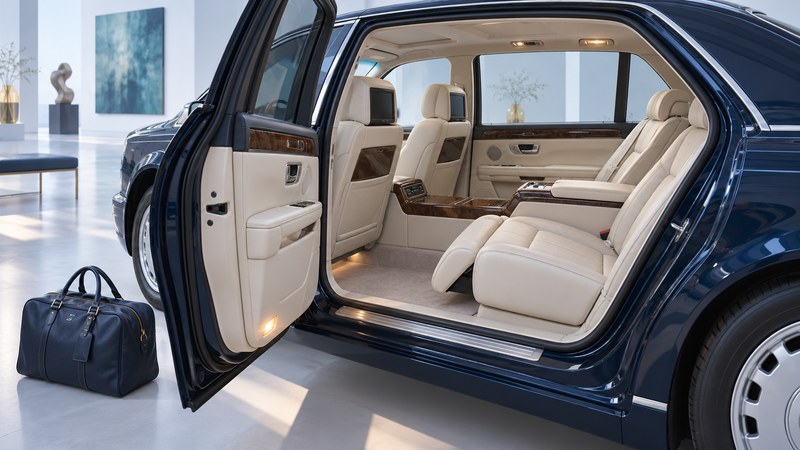
The Maybach 62 makes the most sense when the rear passenger's journey is the starting point. Evaluate how someone enters, settles into a usable seat position, controls the cabin and leaves at the destination. Then check whether the car fits the places where that journey begins and ends.
This guide concerns the original long-wheelbase Maybach 62. Its useful outcome is a rear-cabin and access record for an actual car, with each important feature marked fitted, demonstrated or unresolved.
Start with the car and the space
The Mercedes-Benz archive entry for the Maybach 62 identifies the V240 model and lists a length of 6,165 mm and wheelbase of 3,827 mm. That length is a useful first screening measurement for a garage or parking bay. Add the space needed to approach the car, open its doors and handle luggage.
Record model year, market, build details and the installed rear-cabin arrangement. A 62 S, Guard or Landaulet needs its own matching documentation. The shorter 57 has a separate Maybach identity and specialist-support guide; its dimensions are a different starting point.
Measure your actual entrance, turns and stopping position. Include mirror clearance and overhead restrictions, then assess rear-door opening space at a realistic curbside stop. A generous parking rectangle can still have an awkward approach or leave too little room for a passenger to step out comfortably.
Demonstrate the features that matter
On a narrow screen, scroll the table sideways. Keyboard users can focus the table region and use the arrow keys.
| Area | Useful demonstration | Record |
|---|---|---|
| Passenger access | Enter and leave with the front seat in its normal position; assess the step, sill and handholds. | Passenger, assistance needed and usable door clearance. |
| Seating | Have the owner demonstrate the fitted adjustments using the matching handbook. | Controls reached, useful seating position and any incomplete movement. |
| Climate and light | Check the controls and outlets used from each occupied rear seat. | Observed temperature response, shades, lamps and conditions. |
| Privacy and work | Demonstrate any installed partition, intercom, tables and roof controls while safely parked. | Present equipment, handbook reference and actual operation. |
| Media and luggage | Try the intended audio source and fit the real bags. | Supported source, storage access and remaining passenger space. |
The manufacturer 57/62 handbook's partition section, reproduced by ManualsLib, illustrates why configuration matters: partition equipment has its own controls and operating precautions. The shared handbook covers several arrangements. Match its edition and equipment to the individual car before using an operating procedure.
Keep hands and belongings clear during powered movements and let the person familiar with the car demonstrate them according to its handbook. Use the documented travel position and restraints for a journey. A comfortable stationary recline is a separate observation from a suitable occupied driving position.
Separate presence, function and support
Fitted means the hardware is present and identified. Demonstrated means a named function worked under recorded conditions. Unresolved means a question still needs a document, a repeat demonstration or specialist assessment. These statuses can coexist: a rear screen may be fitted and show a local video while its connection to another source remains unresolved.
For period telephone or entertainment equipment, describe the exact task you expect today. Ask for a demonstration with the supported source and connection. Keep current service availability, replacement components and repair support as separate questions. The original launch's communications promises describe its era.
Give a specialist the car's identity, equipment record and dated service invoices. Ask who handles the rear-seat mechanisms, cabin electronics, climate equipment and body trim, and obtain an assessment of open faults and parts availability. Keep safety and mechanical inspection findings alongside the comfort record.
Example: an airport journey
Fictional use case: two rear passengers travel with two large suitcases. One needs help entering the car, and both want quiet conversation. A viewing should reproduce the bag load, front-seat position and passenger access. Check the preferred climate settings and, if fitted, demonstrate communication through the partition.
Suppose the bags fit and both seats adjust, but the intended pickup bay leaves the rear door only partly open. The decisive next step is a different stopping arrangement or a supervised access trial in a suitable location. Extra cabin equipment adds little value until that everyday access requirement is satisfied.
Keep a rear-cabin record
Download the Maybach 62 rear-cabin record. Use one copy per car and attach measurements, equipment evidence and the specialist's findings. Finish with three lists: requirements met, work needed and questions awaiting an answer.
Explore Autos: vehicle guides, technology and design · Cars: buying, maintenance and ownership