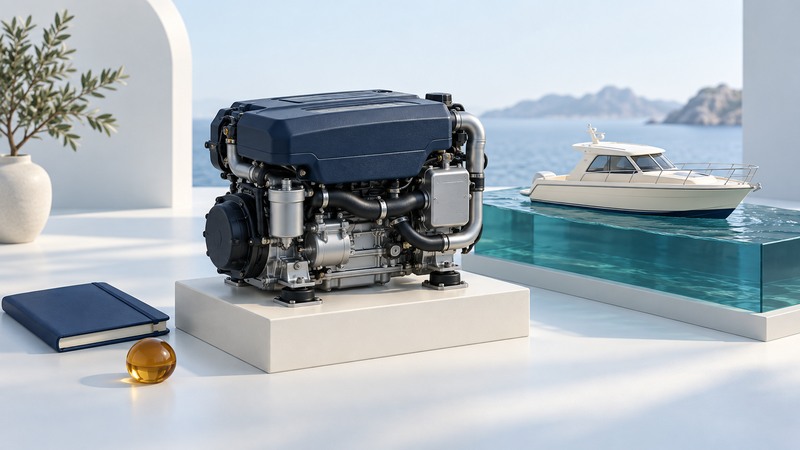
An inboard engine is part of a propulsion system. The drive arrangement determines how power reaches the water and how the boat steers, while installation, controls and maintenance shape ownership. Compare complete boats at the speeds and loading you expect to use.
For recreational cruiser buyers and owners. Volvo Penta IPS is the pod-drive example; service requirements and operating procedures depend on the exact engine, drive and control generation.
Separate the engine from the drive
A conventional inboard installation places the engine inside the hull and transfers power through a gearbox and shaft to a propeller. Rudders commonly provide steering. A pod installation places a propulsion unit below the hull; its arrangement and steering system differ from a conventional shaft setup.
Volvo Penta IPS stands for Inboard Performance System. Its propeller guide describes forward-facing, counter-rotating propellers as part of the integrated drive. Treat IPS as a specific product family rather than a name for every pod system. Other arrangements can place propellers differently and use different controls.
A sterndrive and a saildrive are additional arrangements with their own applications and service requirements. When reading a listing, record the engine model, transmission or drive model, serial numbers and controls. “Twin diesels” tells you much less than that complete identification.
On a narrow screen, scroll the table sideways. Keyboard users can focus the table and use the arrow keys.
| Question | Conventional shafts | IPS pod installation |
|---|---|---|
| Power path | Engine, gearbox, shaft and propeller | Engine and matched pod-drive system |
| Steering and controls | Rudders with the installed controls; thrusters may be fitted | Steerable drives and the installed electronic control package |
| Condition checks | Engine, mounts, shaft system, seals, propellers and rudders | Engine, drives, seals, steering, controls and matched propellers |
| Service planning | Access to the actual machinery and shaft components | Applicable engine/drive protocols, diagnostics and local support |
| Evidence for buying | Records, survey and a representative operational trial | Records, system-specific assessment and a representative operational trial |
Evaluate the controls you will actually use
Joystick control can combine several functions to help maneuver a compatible boat. Confirm which functions are installed, how they operate and what the normal and backup controls require. A product family’s available feature list may include options absent from a used boat.
Joystick operation is also available for some shaft installations. Volvo Penta’s Joystick Inboard documentation describes coordinated control of thrusters, rudders, gear and throttle. That makes “has a joystick” a control-system question, not a reliable way to identify the drive arrangement.
During a supervised trial, ask a competent operator to demonstrate the fitted controls in suitable conditions. Observe visibility, low-speed response and how the boat behaves in your expected berthing situation. Get instruction before taking control. Learn the alarm responses and fallback procedures from the applicable manuals and handover training.
Keep expectations tied to conditions and operator responsibility. Assistance can make a task easier while leaving the skipper responsible for lookout, clearance, speed and the decision to continue. Record which tasks feel manageable and which need more practice.
Compare performance with a common basis
Compare candidate boats at the cruising speeds you intend to use, with representative loading. Record hull, displacement or load, engine and propeller configuration, speed units, fuel-flow units and conditions. A manufacturer’s result for a particular installation should remain attached to that installation.
Hull form, machinery selection, loading and condition all contribute to a result. An older launch claim about a percentage improvement cannot establish the savings for your future boat. Ask for relevant trials and service history, then compare complete packages.
Noise and comfort need equally clear conditions. Listen in the spaces you will occupy and at the operating speeds you expect. Compare ventilation, vibration and access during the same demonstration rather than relying entirely on a description such as “quiet.”
Ask for the maintenance plan and local support
Collect the engine and drive service schedules by serial number and confirm the work due by time and operating hours. Volvo Penta Connect provides access to product information including manuals and service-related resources for registered products. A dealer can help identify the correct documents and outstanding work for the installation.
Request itemized quotations for the next scheduled service and any work identified by inspection. Ask which jobs require lifting the boat, which can be performed afloat and whether specialist tools or diagnostics are needed. The answer depends on the task and installation.
Inspect physical access. Can a technician reach filters, cooling components, pumps, seals and connections without dismantling unrelated furnishings? Ask the yard about lifting arrangements, berth access, parts lead times and the scope of local support for the engine and drive generation.
Keep an ownership file with hours, dates, work performed, fluid and parts specifications, diagnostic findings and invoices. Missing drive-service records deserve investigation even when the engines start cleanly. Separate recurring scheduled work from uncertain repair exposure.
Inspect the complete used installation
Choose a surveyor familiar with the boat and arrange engine/drive specialist involvement where needed. Agree the scope of the haul-out and operational checks before booking. The BoatUS survey-day guide is useful for organizing the buyer, seller and yard; the actual machinery tests should be defined by the responsible specialists.
Request inspection of accessible hull penetrations, corrosion protection, propellers, mounting and steering components, along with the engine systems. Ask whether evidence suggests grounding, impact, water ingress or deferred service. Record exclusions where components cannot be accessed or tested.
For shafts, discuss the condition and alignment of the shaft system, seals, bearings and rudders with the surveyor. For IPS, request assessment of the particular drives, seals, steering and electronic controls by someone qualified for that generation. Obtain a written repair scope and quote for material findings.
The purpose is to understand the boat in front of you. A well-maintained installation with good support can be a different ownership proposition from a superficially similar boat with uncertain history.
Make a decision file before purchase or conversion
Summarize the intended use, exact machinery, trial results, inspection findings, access and local service arrangements. Build a budget containing purchase, immediate work, scheduled care, lifting, fuel, insurance and a reserve. Mark costs that remain estimates and obtain the missing quotations before deciding.
For an existing boat, replacing a drive arrangement is a substantial engineering project. Ask the boatbuilder and a qualified naval architect or installation specialist about hull structure, machinery placement, controls and approvals. A product brochure is not a conversion plan.
At handover, obtain the complete manuals and practice normal operation with qualified instruction. Keep a baseline performance and service record. Reassess unexplained changes in fuel use, vibration, alarms or handling promptly with suitable technical help.