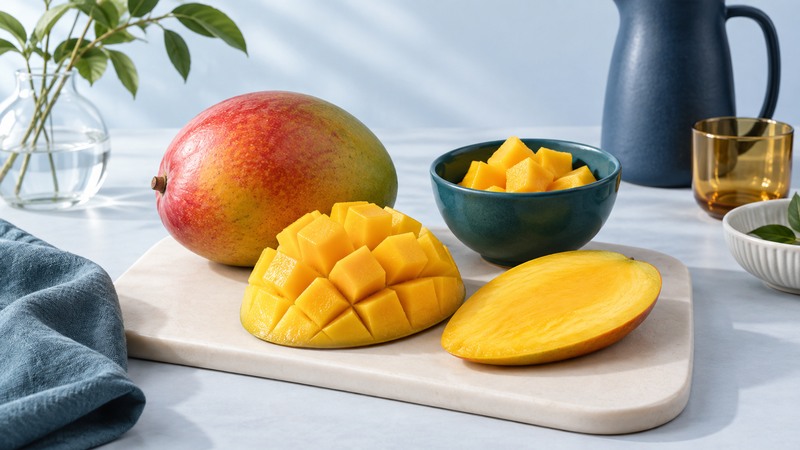
Buy a mango for when you intend to eat it. A firm fruit gives you ripening time; one that yields slightly to gentle pressure is ready for slicing or spooning. After cutting, use the texture to choose the dish: firm cubes for salsa, soft flesh for a purée, and tidy ripe pieces for breakfast.
Use feel, then check condition
Gently press the fruit with your fingers, without squeezing hard enough to bruise it. Ripe mangoes usually give a little and may smell fruity near the stem. Skin can be green, yellow, orange or red depending on variety; red blush alone does not establish ripeness. The National Mango Board’s selection guide emphasizes feel over color.
Choose fruit with sound skin. An isolated cosmetic mark differs from a leaking, moldy or deeply soft area; pass over fruit showing spoilage. If buying several, choose a mix of firm and ready fruit so they become usable on different days. Whole-fruit weight includes peel and seed, so weigh the prepared flesh when a recipe specifies an edible amount.
Let whole fruit ripen before chilling
Keep firm, unripe mangoes at room temperature. To speed ripening, place them in a paper bag and check daily. Move ripe whole fruit to the refrigerator; the Mango Board suggests up to five days. Store cut flesh in a covered container in the refrigerator for several days, or freeze for up to six months for quality. These recommendations come from its ripening and storage guide.
Make the decision before cutting: an unripe mango is easier to manage as a whole fruit. If you already cut one and it tastes tart, use a suitable cooked preparation or a tart relish; cutting does not provide the same ripening conditions as keeping the fruit whole. Discard rotten fruit. Chill purchased pre-cut mango promptly.
Cut the cheeks while keeping the fruit supported
Use a clean cutting board, a sharp kitchen knife and a large spoon. Wash the skin under running water and dry it, even though you will remove it. FDA recommends washing produce before peeling or cutting, and keeping it separate from raw meat and seafood: produce preparation guidance.
- Set the mango stem-end down on a stable board. Identify its broad, flatter sides: the flat seed runs lengthwise between them. Keep your supporting fingers clear of the cutting path.
- Slice down one broad side just outside the seed, then the other, producing two cheeks. If the knife meets the hard seed, reposition slightly outward; avoid forcing it through.
- Put a cheek skin-side down on the board. Score the flesh into strips or a grid with shallow cuts that stop before the skin.
- Scoop flesh away with the spoon. Trim usable flesh from the remaining seed section while it rests securely on the board. Discard peel and seed.
This board-supported sequence adapts the Mango Board’s slice-and-scoop method. Very soft fruit may be easier to scoop first and roughly chop afterward. Use the spoon instead of pressing fruit against a drinking-glass rim.
Choose a use for the texture
Scroll the table sideways. With a keyboard, focus the table and use the arrow keys.
| Prepared flesh | Good use | Practical adjustment |
|---|---|---|
| Firm-ripe, holds a cube | Salsa or chopped salad | Cut small, even pieces and taste before adding acid. |
| Ripe and tender | Yogurt, oatmeal or fruit bowl | Use larger pieces and fold gently. |
| Very soft, sound and sweet | Smoothie or spoonable purée | Blend first, then add liquid gradually. |
| Frozen cubes | Blended drinks or cooked sauce | Expect softer texture after thawing; follow blender limits. |
Small mango salsa: combine 1 cup diced ripe mango, ¼ cup finely diced cucumber, 1 tablespoon finely chopped red onion, 1 tablespoon chopped cilantro and 1 teaspoon lime juice. Add a small pinch of salt if desired; taste and add lime by ½ teaspoon. This illustrative combination makes roughly 1¼ cups, enough for four small toppings. It has not been kitchen-tested by Yenra. Keep chilled until serving; spoon a portion beside cooked shrimp or beans.
Freeze spare cubes in a single layer on a tray, then transfer to a labeled freezer bag once firm. Record the packed amount—such as one cup—so you can use it without thawing the entire bag.