Get the Music: Beethoven: Symphonies Nos. 5 & 7 — Carlos Kleiber, Vienna Philharmonic, Audio CD (paid link)
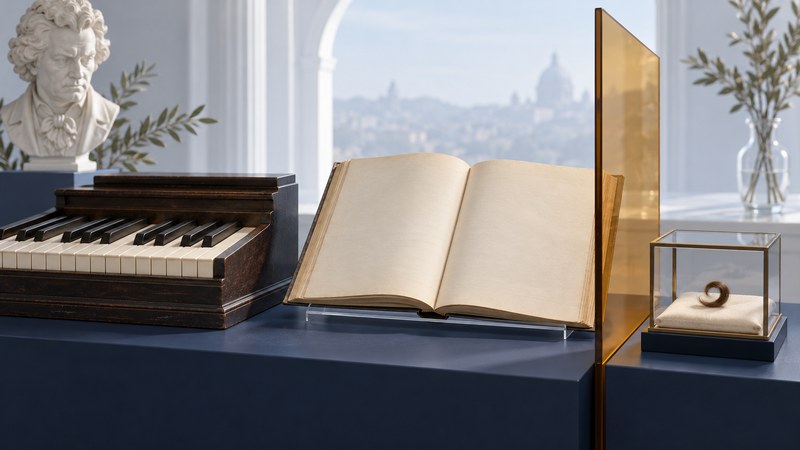
Beethoven can build a large musical argument from a very small idea. Start by following a rhythm through an orchestral movement. Then approach the story of his hearing and health through dated documents and authenticated evidence: the musical experience and the historical questions each deserve attention.
Hear an idea develop
For a manageable orchestral starting point, Carlos Kleiber and the Vienna Philharmonic’s Beethoven: Symphonies Nos. 5 & 7, Audio CD (paid link) brings two contrasting symphonies together. A symphony has several movements; start with the following two, then hear each complete work when you have more time.
Symphony No. 5 in C minor, Op. 67: first movement
Remember the opening short-short-short-long rhythm. Follow its shape as it passes between instruments, appears under other material, or becomes quieter. The point is to hear how much can change while a recognizable rhythm persists. The opening pauses also matter: notice how each restart changes your sense of momentum.
On a second pass, listen for the more singing material and then for the return of the opening drama. You can experience tension, interruption, and return without assigning the passage a story. In the complete symphony, keep the third and fourth movements together so you can hear the transition into the finale.
Symphony No. 7 in A major, Op. 92: second movement, Allegretto
Follow the repeated rhythmic tread as the texture grows. A line that begins with a restrained character becomes part of a larger web of voices. Try concentrating on the recurring pulse once and on the melodic line above it another time. The movement shows how repetition can create changing weight and color.
A useful comparison
After these two movements, write one sentence about what keeps each moving. In the Fifth, a short motif can interrupt and redirect the music. In the Seventh's Allegretto, a recurring pattern can support accumulating layers. These are listening prompts, not a required interpretation.
Place the orchestra beside the piano and string quartet
Beethoven also wrote on much smaller scales. In the Piano Sonata in C-sharp minor, Op. 27 No. 2, commonly called “Moonlight,” the sustained opening and turbulent finale belong to the same three-movement work. A familiar slow excerpt represents only its beginning. The String Quartet in A minor, Op. 132 includes a slow movement marked as a recovered person's song of thanksgiving, alternating with livelier passages. Its four instrumental parts create an intimate setting for changes of pace and character. The Beethoven-Haus archive and work resources provide documents, scores, and context for exploring the repertoire.
Hearing loss belongs in a dated life
Ludwig van Beethoven lived from 1770 to 1827. His hearing deteriorated over years. The Beethoven-Haus account of the Heiligenstadt Testament places his distress in a document written in October 1802. Addressed to his brothers, it describes the social isolation and difficulty of acknowledging his condition.
Letters, manuscripts, and later conversation books help reconstruct how he worked and communicated. Distinguish the date of a document from the date of a composition. “Written while losing his hearing” covers a changing experience, and a retrospective diagnosis is a separate claim. Beethoven's craft, revision, professional relationships, and knowledge of instruments also belong in the account of how his music took shape.
What changed in the story of Beethoven’s hair
Russell Martin's Beethoven’s Hair, published in 2000, brought wide attention to a lock associated with Ferdinand Hiller and the possibility of recovering medical history from it. Subsequent authentication changed that story. The 2023 genomic study by Begg and colleagues found that the Hiller lock came from a woman. Results from that lock therefore cannot establish Beethoven's exposure or diagnosis.
On a small screen, scroll sideways to read the table.
| Evidence | Finding | What it establishes |
|---|---|---|
| Hiller lock, tested in the 2023 genomic study | Its DNA came from a woman. | This lock cannot be used as a biological sample of Beethoven. |
| Five matching locks in the 2023 study | The researchers judged them almost certainly authentic and reconstructed a genome. | A basis for studying genetic risk and evidence of infection; the study found no genetic explanation for the hearing disorder. |
| Authenticated hair examined for metals in 2024 | Two independent locks contained high lead concentrations. | Evidence of substantial exposure in those samples, with medical interpretation still requiring care. |
The 2023 study found a genetic predisposition to liver disease and evidence of hepatitis B infection in his final months. The authors considered these alongside his documented alcohol consumption as plausible contributors to his severe liver disease. The hearing disorder and gastrointestinal problems remained genetically unexplained.
The 2024 report by Rifai and colleagues examined the authenticated Bermann and Halm-Thayer locks. It offers a separate line of evidence about lead exposure. Its published correction clarifies the source of a formula used to estimate blood lead from hair measurements. Those blood values were estimates, not measurements of Beethoven's blood. The results do not settle a single cause for all his symptoms or death.
Read the sample before the headline
When a new Beethoven claim appears, ask three questions: Which object was tested? How was it authenticated? What was actually measured? A matching DNA profile, a metal concentration, and a historical symptom report provide different evidence. An exposure can be relevant without explaining the entire clinical history.
Keep the study date and any correction with the claim. For biography, compare the scientific account with the dated letters and documents; for listening, return to the actual musical choices. Neither a relic nor a diagnosis supplies a complete explanation of a composition.
Explore Mozart through listening, letters, and research, or return to artist guides and musicians’ rights.
Researched and updated October 4, 2026. Listening prompts are editorial suggestions; primary sources are linked beside historical and research claims.