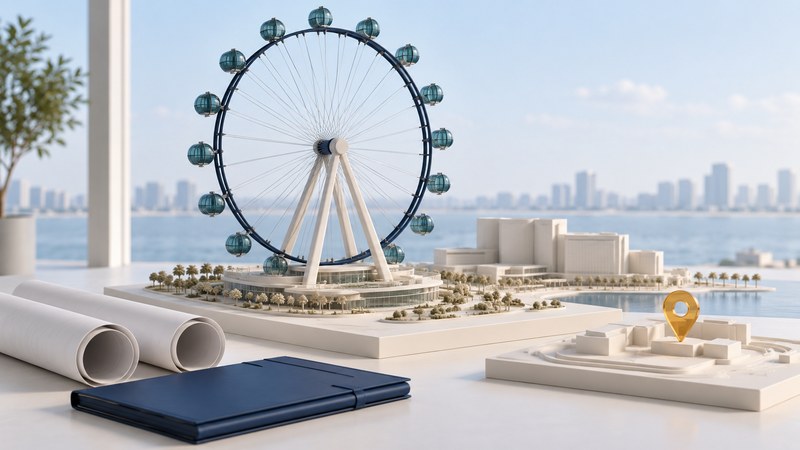
The Las Vegas “Orbitor” story concerns Voyager Entertainment International’s proposed observation wheel, including a September 2005 plan for the Westward Ho site on the north Strip. The documented history follows an announced resort project, a later transfer of the site and another Voyager land agreement elsewhere in Las Vegas. It provides no verified opening of a Voyager attraction at Westward Ho.
“Orbitor” and “Voyager” describe different parts of the idea. Voyager was the developer’s name; its later company filings call the proposed passenger vehicles Orbitors. Keeping the company, vehicle, site and date together makes the project easier to trace.
Begin with the September 2005 Westward Ho proposal
Voyager’s 2005 annual report, filed in April 2006, records the September 27, 2005 announcement: the observation wheel was to occupy the Westward Ho Hotel and Casino site and form part of a larger planned resort. The report still described dependence on raising money to support the company’s operations.
A contemporaneous Las Vegas Sun report attributes the location and development announcement to Voyager. It identifies Centex Destination Properties as the intended managing partner of the company buying the land. This establishes what was announced and by whom. It leaves construction, completed financing and opening as separate milestones requiring their own records.
For this phase, the useful identifying details are Voyager Entertainment International, Westward Ho, the north Las Vegas Strip and September 2005. A later mention of a “Las Vegas Voyager” could describe a different site or version. Carry those four details into the comparison before combining accounts.
The site entered a different land transaction
The next strong evidence concerns the property itself. The September 2006 Boyd–Harrah’s exchange agreement (PDF) explicitly defines the Westward Ho site as approximately 15.22 acres and names its three assessor parcels. It sets out an exchange involving that site and the neighboring Ribbon property for the Barbary Coast property.
In its June 2007 quarterly report (PDF), Boyd records completion of the exchange on February 27, 2007. Boyd received roughly 24 acres adjoining its Echelon development and described an expanded 87-acre holding.
These records explain why the wheel’s proposed footprint and the surrounding development must be kept separate. The 15.22-acre former hotel site, the approximately 24-acre exchange and the larger Echelon holding refer to different areas. None is a documented measurement of a completed Voyager wheel installation.
The exchange gives a concrete later chapter in the Westward Ho land history. It does not itself specify when or how Voyager’s earlier arrangement ended. A land transaction and a project-termination agreement answer different historical questions.
Read each date as a specific milestone
Swipe sideways, or focus the table and use the arrow keys.
| Date | Documented event | What it establishes |
|---|---|---|
| September 27, 2005 | Voyager announced a wheel at Westward Ho within a proposed resort. | The identity and intended site of that version. |
| September 2006 | The Boyd–Harrah’s agreement named the Westward Ho and Ribbon properties. | A later planned transfer of the land. |
| February 27, 2007 | Boyd completed the Barbary Coast exchange for approximately 24 acres. | The reported completion of that property transaction. |
| April 2011 | Voyager disclosed a purchase agreement for land on Dean Martin Drive. | A later Las Vegas location, distinct from Westward Ho. |
| September 2011 reporting period | Voyager still made production dependent on obtaining sufficient capital. | A development-stage proposal with unresolved funding needs. |
| August 7, 2015 | An SEC order made revocation of Voyager’s securities registrations effective. | A reporting-enforcement outcome, with its own limited scope. |
The first three entries are supported by the announcement, annual report and land records above. The later company filing and SEC order are linked below. A chronology becomes useful when each date retains the event it actually records.
A later Voyager scheme used another Las Vegas location
Voyager’s April 2011 land-agreement disclosure (PDF) describes approximately 4.89 acres on Dean Martin Drive between Flamingo and Harmon, north of Panorama Towers. That location distinguishes the later scheme from the 2005 north-Strip announcement.
The report for the quarter ended September 30, 2011 uses the name Orbitors for 30 proposed passenger vehicles and describes a wheel approximately 600 feet high with a 27-minute rotation. These are specifications of that dated proposal. The same report says production would await sufficient capital and describes engineering and construction as work to be undertaken after funding.
That combination is the key to reading the filing: detailed design language coexists with explicit conditions on delivery. Cabin descriptions and an intended visitor experience can explain the ambition without establishing that the attraction entered service.
The SEC’s August 7, 2015 notice and attached decision (PDF) concern failures to file required periodic reports and the resulting revocation of registered securities. This supplies a later corporate-record endpoint. It supplies neither a construction ruling nor a precise cancellation date for the Westward Ho proposal.
Keep the Texas Voyager and High Roller separate
Voyager in Euless, Texas
The Dallas–Fort Worth Voyager history follows the proposal associated with Euless and Bennett Realty. It has its own land arrangement and dated design figures. The same developer’s involvement creates a connection in corporate history, while the municipality, partner and site distinguish the projects.
High Roller at the LINQ
Arup’s engineering retrospective (PDF) documents the 550-foot High Roller as a Caesars Entertainment project at the LINQ that opened in 2014. Its client and completed-project record establish a separate identity. A similar attraction type and the same city do not establish that Voyager became High Roller.
Use the project name with its developer, site and date when searching. This avoids importing Texas cabin counts into a Las Vegas design or treating a successful wheel by another team as proof that an earlier proposal was delivered.
What the record supports, and what remains open
The Westward Ho scheme belongs in the history of unrealized Las Vegas proposals. The evidence here establishes its announcement, the later land exchange, Voyager’s pursuit of another site and continuing funding conditions. No operating Voyager wheel at Westward Ho has been verified in this account.
The exact termination date of the Centex-era wheel arrangement, the complete disposition of any related rights and the full permit history remain unresolved. Stronger answers would require the particular development agreement and amendments, plus land-use and permit records matched to the original parcels. A company’s later reporting failure cannot fill those gaps.
A compact project-history note
For any attraction proposal, record the company, exact site, dated source, milestone and conditions still outstanding. Add a new line when the site or partner changes. Keep “announced,” “land agreement signed,” “funded,” “construction begun” and “opened” as separate entries, supported by separate evidence.
That approach preserves the interest of the idea while making its outcome intelligible. For activities to plan on a present-day trip, use the Las Vegas planning hub; for a built district to explore, see CityCenter’s architecture and art.