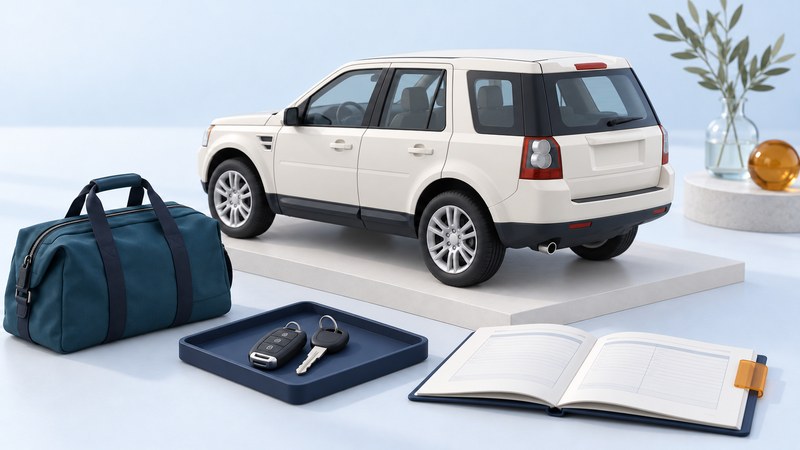
An early Land Rover LR2 should earn its place on a shortlist through usable space, documented maintenance and a shop prepared to support it. Begin with the exact year, market and trim. Then connect each service claim to an identifiable component and an invoice.
Use LR2 specifications for the actual car
The 2008 US LR2 HSE brochure describes a five-seat vehicle with a 3.2-liter inline-six rated at 230 hp, a six-speed automatic, coil-spring suspension and electronically controlled Haldex all-wheel drive. Its Terrain Response system offers General, Grass/Gravel/Snow, Mud/Ruts and Sand settings. The brochure's HSE wheel specification should not be assumed for every LR2 trim or year.
Write down the VIN, model year, original market, trim and current wheel and tire sizes. Compare the car's equipment with matching documents. Use Land Rover's owner-information portal to find the appropriate handbook or its guidance for older models. Instructions for a different Land Rover are not a substitute.
On a narrow screen, scroll the table sideways. Keyboard users can focus the table region and use the arrow keys.
| Configuration or claim | What to establish | Useful evidence |
|---|---|---|
| People and luggage | Will the regular load fit with the required seats in use? | Parked passenger and luggage trial with the front seats set normally. |
| AWD and Terrain Response | Does the fitted system operate as specified, without unresolved warnings? | Correct handbook, specialist assessment and a written diagnostic report if needed. |
| Service claims | Which component was serviced, using what procedure and materials? | Itemized invoices with date, mileage and identifiable work. |
| Future support | Can a suitable shop diagnose and repair the actual car? | Shop confirmation plus availability and estimates for identified parts. |
Try the tasks that a brochure cannot settle
Bring regular passengers and the bags, mobility equipment or other bulky items the LR2 must carry. Set the front seats first, then assess rear legroom, entry and exit. Load through the actual tailgate opening; a quoted volume does not tell you whether an awkward object will pass through it.
Record the arrangement with the rear seats occupied and again with permitted seats folded. Do not combine the luggage capacity of one arrangement with the passenger count of another. If lifting height or reach is important, have the person who will load the vehicle perform the ordinary task.
Check parking visibility and maneuvering on a suitable ordinary route. Ask for a demonstration of the controls using the correct handbook. There is no need to stage an off-road challenge to decide whether the cabin and controls suit you. Any warning or abnormal behavior belongs in the inspection brief.
Turn “drivetrain serviced” into a useful record
An invoice saying “differential service” should identify what was actually serviced. Ask the shop or seller to clarify the component, procedure, materials, mileage and date. Keep automatic-transmission work, coupling work and rear final-drive work distinct in your notes; one vague line should not become evidence that every assembly received attention.
Compare the available invoices with the matching maintenance schedule and the vehicle's use. Ask for explanations of missing periods, replacement assemblies, leaks, recurring warnings and previous diagnostic visits. Record an unresolved item as unknown rather than declaring either a failure or a pass.
Choose an independent inspector familiar with this LR2 configuration. Request a written assessment of the drivetrain, steering, suspension, brakes, tires, underside and visible repairs. If a system warning is present, ask for diagnosis before assigning a replacement part or price. Confirm that your intended service shop has the necessary capability and can quote the actual work identified.
Example: an invoice does not explain a warning
Fictional inspection: the LR2 fits your family and bags, but a drivetrain warning appears during the demonstration. The seller points to an old invoice labeled “rear axle service.” Keep the successful space trial as one finding. Record the warning and request the invoice detail plus a current diagnostic assessment as another.
Do not conclude that the old service fixes the present warning, or guess that a particular assembly must be replaced. Compare the asking price and confirmed work only after the report explains what is known and what still requires investigation.
Take the fit and service record to a specialist
Download the LR2 fit and service record. Use it with the vehicle inspection guide. Check NHTSA recalls by VIN and ask Land Rover about older or completed campaigns that may not appear in the online search.
Explore Autos: vehicle guides, technology and design · Cars: buying, maintenance and ownership