Kwanzaa is observed each year from December 26 through January 1. Its seven days bring African heritage, family, and community into focus through seven principles, shared reflection, and cultural expression. Begin with those meanings when learning about the celebration or accepting an invitation.
Origins and purpose
Maulana Karenga created Kwanzaa in 1966. The Smithsonian’s history of Kwanzaa describes it as an African American and Pan-African cultural holiday rooted in African first-fruits celebrations. Its name draws on the Swahili phrase matunda ya kwanza, meaning first fruits. The contemporary observance connects that harvest imagery with remembering history and strengthening community.
Kwanzaa’s cultural purpose allows people of different religious commitments to observe it. Families may also celebrate religious holidays. Keep its African American and African diaspora context clear when explaining it: a particular family’s observance is one expression of a wider living tradition.
The dates stay the same each year, crossing from December into January. A museum or community organization may hold its public program on just one of those days. Confirm that organizer’s date, admission arrangements, accessibility information, and intended audience before going.
Seven days and principles
The Nguzo Saba, or seven principles, give each day its focus. The Smithsonian’s introduction to the principles is a useful companion to the reference below. The questions in the final column are optional discussion prompts written for this guide, rather than prescribed ceremonial language.
| Date | Principle and usual English rendering | Optional reflection |
|---|---|---|
| December 26 | Umoja — Unity | Where did people support one another this year? |
| December 27 | Kujichagulia — Self-Determination | Who gets to tell our community’s story? |
| December 28 | Ujima — Collective Work and Responsibility | Which shared problem could we help address together? |
| December 29 | Ujamaa — Cooperative Economics | How can our choices help sustain community enterprises? |
| December 30 | Nia — Purpose | What contribution do we want to carry into the coming year? |
| December 31 | Kuumba — Creativity | What could we make or improve for others? |
| January 1 | Imani — Faith | Which people, values, and possibilities deserve our continuing commitment? |
Give a conversation room to develop beyond the English label. For example, a discussion of collective responsibility can move from naming a problem to agreeing who will help, what is feasible, and when to check progress. A specific commitment makes reflection easier to carry into everyday life.
Read the symbols as a connected set
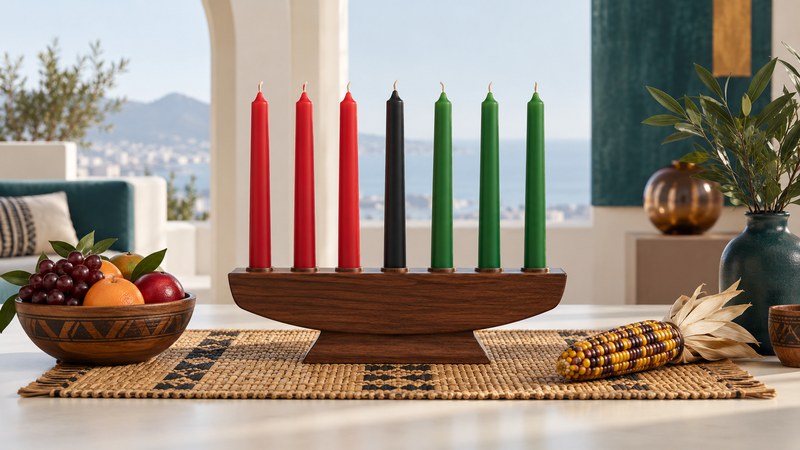
The founder’s explanation of Kwanzaa symbols connects the mkeka, or mat, with the foundation of tradition and history; the kinara, or candleholder, with continental African roots; crops with harvest and collective labor; and corn with children and the future. The unity cup expresses unity, the seven candles represent the principles, and gifts connect parental love and labor with children’s commitments.
These meanings help explain why the arrangement belongs to a celebration of relationships and responsibilities. When looking at a display, ask what each object represents and how the objects work together. A photograph alone may leave those connections invisible.
The official celebration guidance specifies one black candle in the center, three red candles to its left, and three green candles to its right. Black represents the people, red the struggle, and green the future and hope arising from that struggle. The central black candle is lit first. For the complete ceremonial guidance, consult that source and follow the host’s explanation at a gathering.
Participate thoughtfully
As a guest, ask what you can contribute, when to arrive, and whether there are parts of the program where visitors should listen. Obtain permission before photographing people or recording a reading. Let the host explain the household or organization’s practice rather than expecting every gathering to follow an identical schedule.
Food, storytelling, music, and creative work can support the observance. The Smithsonian identifies December 31 with the Karamu feast and offers family learning resources. A host can choose food with personal or cultural significance and explain that connection; guests can help with preparation, serving, and cleanup.
For teaching, distinguish learning about Kwanzaa from asking children to perform an observance. Use named cultural sources and make space for different family experiences. Explore more context and celebration guides in Holidays.