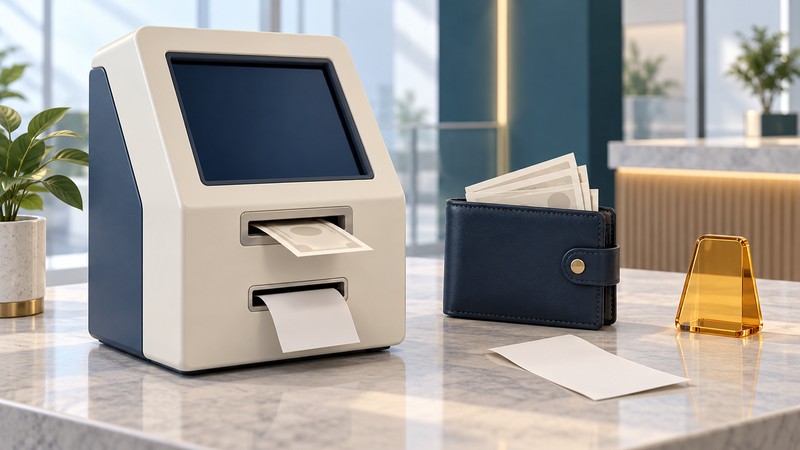
A successful cash bill payment ends with the biller crediting the correct account. Before using a kiosk, establish who operates it, whether your biller accepts payments through it, what you will pay in fees, and when the payment will count.
This guide is for U.S. household bill payments. A kiosk, a staffed retail payment counter, and a biller's own office can have different terms. Start with the payment instructions on a recent bill or the biller's official website.
Confirm the location before taking cash
Find the exact location through the biller's payment directory. Match the address and operator, then confirm that it accepts your type of bill. A machine displaying a familiar payment-network name may support only selected billers. Check opening hours, accessibility, supported denominations and whether it gives change.
For a concrete example, PG&E's authorized payment-center directory describes accepted payment methods, receipts and a cutoff for same-day posting. That is evidence for those locations and that biller. Use your own biller's instructions for your transaction.
Bring the current bill or the account identifier the biller specifies. Confirm the service address or other identifying information shown before paying. If the kiosk finds a different customer or cannot confirm the intended biller, stop and contact the biller through a number you independently obtain.
Separate the bill amount, fee and posting deadline
Read the final confirmation screen before inserting cash. Ask whether the service fee is added to the bill amount or deducted from the money inserted. A receipt showing money accepted is evidence of the kiosk transaction; the biller's account record establishes how that money was credited.
Scroll sideways for all columns. Keyboard users can focus the table and use the arrow keys.
| Check | What to establish | Why it matters |
|---|---|---|
| Amount | Bill credit, service fee and total cash required. | A fee deducted from the cash can leave part of the bill unpaid. |
| Time | Cutoff, time zone, business-day rules and expected posting date. | A payment made today may be credited later. |
| Deadline | What the biller requires for a due date or disconnection notice. | A general processing estimate may not resolve an urgent account problem. |
| Receipt | Transaction reference, location, date, fee and masked account details. | These connect the payment to an investigation. |
Fictional example: the cash total matters
You owe $120 and the kiosk charges a $3 fee on top. The total is $123: $120 for the bill and $3 for the service. If a different service deducts its $3 fee from $120 tendered, only $117 reaches the bill. Verify which arrangement the screen describes before proceeding.
A $3 fee for each of twelve monthly payments costs $36 a year. Compare that with a biller-authorized alternative, allowing for travel, opening hours and posting speed. These are invented fees, not quotes from a provider.
If the due date is close or service may be disconnected, contact the biller first. Ask which payment channel it recognizes in time and whether an arrangement or assistance program is available. Keep the reference number for that conversation.
Keep a receipt and confirm the account credit
- Review the biller, account and amount on the screen before confirmation.
- Follow the machine's cash-feeding instructions and check the amount recognized.
- Save the printed or electronic receipt. Photograph a paper receipt before it fades.
- After the stated posting interval, check the biller's authenticated account page or ask its customer service team to confirm the credit.
- Record the credited amount and date alongside the transaction reference.
For provider-specific help, PayNearMe directs consumers to their biller for payment support. The appropriate first contact depends on the arrangement. Keep both the biller's contact details and the operator's receipt information.
Download the cash bill-payment record to keep the fee, promised posting time, reference and follow-up notes together. Store full account details privately; a shared troubleshooting note usually needs only the last few characters.
Resolve a missing payment without losing the evidence
If cash was accepted but the machine failed, record its location, machine identifier, date, time and amount. Contact the operator using the posted support information, and notify the biller. If a receipt exists but the credit is missing, ask the biller to trace the transaction reference and ask the operator whether it was completed, rejected or reversed. Obtain a case number and the next expected response date.
Before paying a second time, establish what happened to the first payment and ask the biller how to handle any urgent deadline. Keep a written record of any duplicate-payment or refund arrangement. The relevant dispute procedure depends on the service, funding method and jurisdiction; a cash kiosk receipt alone does not establish a universal refund right.
Verify unexpected payment demands independently. The FTC's utility-scam guidance explains threats of immediate shutoff and demands for gift cards, cryptocurrency or other hard-to-recover payments. Call the number on your bill, rather than one supplied by an unexpected caller.
For related choices, see banking channels and ATM errors and budgeting around expenses and payment timing.