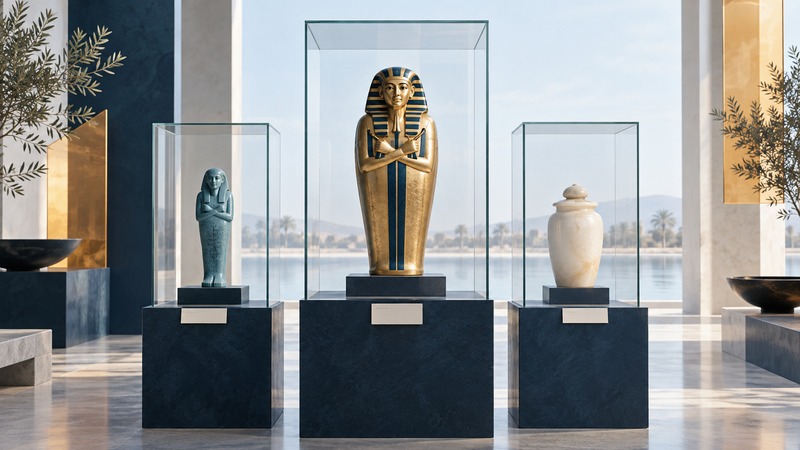
Tutankhamun’s tomb objects become more understandable when you ask what each was made to do. A coffin, a protective figure, a chair and a container all belong to the burial, but they reveal different relationships between royal identity, daily life, ritual and the hoped-for afterlife.
This guide helps museum visitors and learners read object labels, connect an object to its excavation record, and establish what a present-day exhibition actually contains. Keep the artifact, its archaeological documentation and its modern presentation distinct as you explore.
Check the present exhibition before planning around an object
In September 2026, the Grand Egyptian Museum’s official ticketing website lists access to the Tutankhamun Galleries as part of a museum visit. Check that site for the selected date, gallery access and current visitor rules. A named gallery does not by itself guarantee that every individual object will be on display during your visit.
For a touring or local exhibition elsewhere, read the organizer’s description and object list. Establish whether it presents ancient originals, modern replicas, digital reconstructions or a combination. Each can serve an educational purpose; the label determines what kind of evidence you are viewing.
Write down the specific object you hope to see and its identifying number if available. Ask the museum about that item when it is central to your trip. Old tour pages and undated photographs are useful historical records but cannot confirm a current display.
Read the objects through their functions
On a narrow screen, swipe the table sideways or focus it and use the arrow keys.
| Object group | What to investigate | What to look for |
|---|---|---|
| Coffins, mask and shrines | How the body and royal identity were enclosed and represented | Nesting, scale, materials and protective imagery |
| Canopic equipment | How embalmed organs were contained and protected | Relationships between outer shrine, chest and smaller containers |
| Divine and protective figures | Which beings or powers the label identifies | Pose, attributes, inscriptions and original placement |
| Furniture and clothing | Connections between bodily scale, craftsmanship and royal life | Construction, materials, wear and decoration |
| Chariots, vessels and containers | How practical forms entered the burial assemblage | Assembly, contents, fit and excavation context |
The Griffith Institute’s scientific-note categories organize records around subjects including canopic equipment, chariots, coffins, materials and shrines. Use those categories as routes into documentation, then read the individual record for the object in front of you.
A gold-colored surface may involve different materials and construction methods. Read whether a label says solid gold, gilded wood, inlay or another combination. Ask how the maker joined, shaped or decorated those materials. This directs attention to workmanship as well as visual richness.
Use five fields on the museum label
- Identity: the object name and any inventory or catalog number.
- Date and cultural context: the period or reign assigned by the museum, including uncertainty where given.
- Material and technique: what the object is made from and how its surface was produced.
- Function and meaning: the museum’s interpretation and the evidence supporting it.
- Location and provenance: where it was found and which collection is responsible for it now.
Record the label’s distinction between an observation and an interpretation. “Wood with a gilded surface” describes material; a proposed ritual role adds an explanation. Both can be well supported, but they may depend on different evidence.
For a reproduction, also record what was reconstructed. A replica can convey scale or assembly; an excavation photograph records a particular view at a particular moment. Compare the display’s description with the associated archive record before attributing reconstructed details to the ancient object.
Follow an object into the excavation archive
The Tutankhamun Spatial Archive brings together the records of Howard Carter and his team, including photographs, cards, journals, drawings and scientific notes. Begin with its object records, which group related documents by object, or its object cards.
Excavation records capture what was observed and recorded during the investigation. Modern conservation and scholarship can add or revise interpretations. Preserve dates and authors when comparing accounts. An archival term and a current museum label may differ; record the difference before deciding whether they describe separate objects.
Make a manageable looking plan
Choose three objects with different functions: one associated with the body, one with a protective or divine role, and one with furniture, clothing or equipment. Spend a few minutes on each. Describe its form before reading the full interpretation, then compare what the label adds.
Look for a detail that scale reproductions often hide: an edge, fastening, seam, inlay or small repeated mark. Respect the gallery’s distance and photography rules. The Grand Egyptian Museum’s current visitor information includes specific photography restrictions in designated parts of the Tutankhamun Galleries, so check signs as well as the online guidance.
After the visit, select one question to research in the archive. Keep the object number and source alongside the question. The art-record guide provides a broader method for connecting an object with its documentation; the close-looking guide offers another exercise in separating observation from interpretation.
The most rewarding route through the treasures joins visual attention with context. A small container can reveal as much as a spectacular gold surface when you understand its place within the burial and the records that preserve its history.