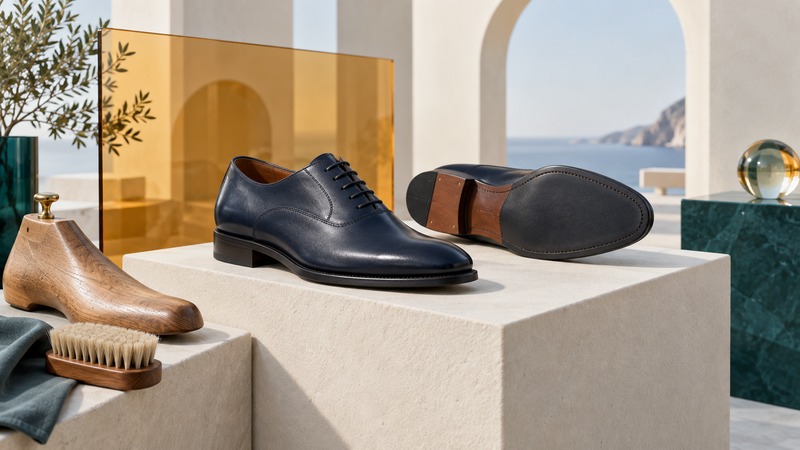
Italian shoes span many forms, materials and construction methods. A useful comparison starts with the job—daily walking, office wear, a formal event or a design collection—then checks the actual pair for fit, material details, care and repair options.
Ask how the sole is attached
Construction influences how a shoe can be serviced and how its components work together. A named technique is useful information, but details vary by model. Ask for the specification and repair service for the pair you are considering.
| Term | Basic relationship | Question for the maker or repairer |
|---|---|---|
| Blake stitching | Stitching joins the sole through the shoe bottom to the upper/insole assembly | Can this exact pair be resoled locally, and with which equipment? |
| Welted construction | A welt provides the attachment between the upper assembly and outsole | Which components can the maker replace, and what condition must they be in? |
| Cemented construction | Adhesive bonds the sole to the upper assembly | Is a compatible replacement sole and repair service available? |
The manufacturer Carlos Santos explains Blake and Goodyear construction as general shoemaking techniques. For an Italian product example, Santoni specifies Goodyear Light construction for this Derby model. The product-specific description matters more than assuming that all Italian footwear uses one method.
Ask a repairer about the actual worn shoe before assuming a stitched pair is economically repairable or a bonded pair must be discarded. Upper condition, sole availability, labor and access to appropriate equipment all affect the answer.
Use size conversions as a starting point
Read the manufacturer's chart and determine whether it gives foot measurements, shoe measurements or a conversion between size systems. Record the units. An EU size conversion helps choose a pair to try; it does not describe width, instep volume or toe shape.
Try both shoes with the intended socks. Walk, turn and sit, following the retailer's try-on conditions. Check for toe pressure, heel movement, instep discomfort and a flex point that feels misplaced. A different last or width may solve a problem that adding length does not.
For a formal event, test the full outfit and a realistic period of indoor wear well before the date. For a travel shoe, use a gradual ordinary-wear trial after deciding to keep it. Persistent discomfort is a reason to reassess, not a reason to promise yourself that every problem will disappear with wear.
Separate origin, materials and performance
Record the stated country of manufacture separately from the brand's headquarters or design language. If an origin claim matters to your purchase, ask the seller for the model-specific marking and supporting explanation. Claims such as Italian style describe something different from a stated place of manufacture.
For footwear sold in the EU, Your Europe's footwear-label guidance explains material information for three parts: the upper, lining and insole, and outer sole. Check all three. A leather upper does not tell you what the lining or sole contains.
Also check the intended conditions. A leather appearance, stitched sole or luxury price does not itself establish wet-surface grip or waterproofness. If you require a tested property, request the relevant product documentation and its limits.
Choose care by the actual surface
Identify smooth leather, suede, nubuck, coated leather, textile and any mixed panels before choosing a product. Follow the shoe maker's care directions, including color suitability and any patch-test instruction. Use tools and treatments intended for that surface; a cream meant for one finish can change another.
Remove loose dirt using the recommended method, allow damp shoes to dry as directed away from direct heat, and store them in a way that preserves their shape. Consult the maker before adding protectors or aftermarket insoles that could change fit or appearance.
Examine heel wear, separating edges and lining damage periodically. Seeking repair before wear reaches a structural layer can give the repairer more options. Ask for a written scope and estimate, including the replacement sole material and any expected change in feel.
Read design history through a specific object
The Ferragamo Museum exhibition archive identifies the 1938 Rainbow sandal made for Judy Garland, using kidskin and a cork platform covered in suede. Its combination of color, shape and materials is a concrete way to explore footwear design.
A museum object can answer questions about a designer's experimentation and a period's aesthetics. A daily shoe purchase adds another set of questions about fit, durability and service. Keeping those purposes distinct lets you appreciate an expressive design while choosing suitable footwear for your own use.