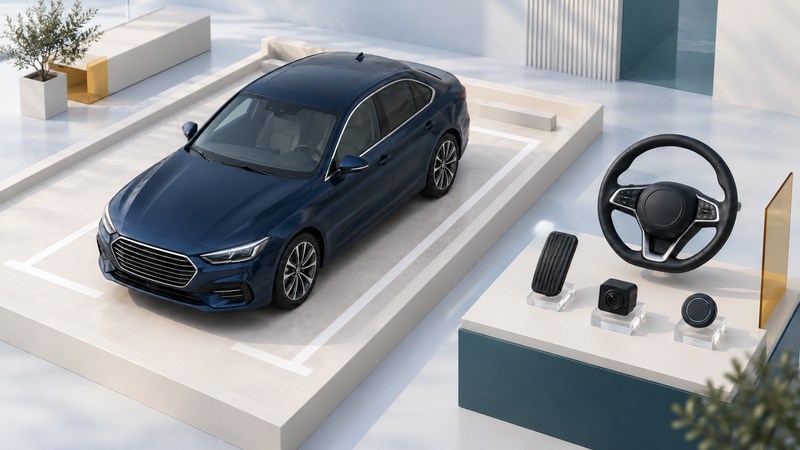
Before using parking assistance, answer four questions: who steers, who controls speed, who changes direction, and how do you stop or cancel? Find those answers for the exact vehicle and installed option in its owner manual.
Use this guide when considering a used car or learning a feature you already own. A sales listing, dashboard button or feature name is a starting clue. Build a short record that connects the equipment to the instructions you will actually use.
Separate information from vehicle control
On a narrow screen, scroll the table sideways. Keyboard users can focus the table region and use the arrow keys.
| Function | Typical contribution | Question for the exact manual |
|---|---|---|
| Parking sensors | Proximity information through sound or a display. | Which areas and objects can be detected, and what does each alert mean? |
| Rear or surround camera | A displayed view to support observation. | Which views are available, and what lies outside them? |
| Steering assistance | Steering during specified parking maneuvers. | Which pedals and gear changes remain with the driver? |
| Assistance with several controls | May combine steering, acceleration, braking and shifting. | What must the driver hold, supervise or do when the system pauses? |
Treat the rows as functions that may coexist. Check each separately; a camera-equipped car may have no automated steering, and a parking maneuver may use a different feature from a reversing warning. Record the manufacturer's names beside the plain-language functions.
Similar names can assign different jobs
The 2010 Ford Escape Hybrid owner guide describes Active Park Assist with automated steering while the driver controls the other required inputs. By comparison, the 2023 Ford Explorer's Active Park Assist instructions describe a system that can steer, accelerate, brake and shift, while requiring the driver to remain in the vehicle and supervise.
These are examples of why the model year, market and fitted equipment matter. Use the manual supplied for your vehicle as the primary instruction source; Ford also flags possible differences between its online material and the original vehicle manual. A demonstration in another model is useful only after you identify those differences.
Prepare the instructions while safely parked
- Identify the car. Record model year, market, trim, VIN and installed feature. Ask a dealer to resolve an uncertain equipment record.
- Read the complete section. Include warnings, conditions, cancellation, troubleshooting and any connected camera or sensor instructions.
- Write the control assignment. Put steering, accelerator, brake and gear selection on separate lines. Record what changes between searching, maneuvering, pausing and completion.
- Locate the controls. With the vehicle safely parked, identify buttons and display messages without initiating a maneuver. Find the documented stop/cancel instructions before considering operation.
- Arrange suitable familiarization. If the instructions or controls remain unclear, ask a qualified instructor or the dealer to explain them for this vehicle. Choose conditions permitted by its manual.
Keep people clear of the vehicle's path. Do not use a person, animal or valuable object to test detection. A parked checklist prepares you to follow the manufacturer procedure; it supplies no universal button or pedal sequence.
Resolve missing information before relying on a feature
The Explorer instructions identify sensor obstruction, certain accessories, repairs and tire differences as factors that can affect the system. Read your own vehicle's limits for weather, space geometry and attachments. A space offered on a display still requires observation and the driver's judgment.
If a feature becomes unavailable, follow the displayed and manual instructions, stop safely as needed, and record the exact message afterward. Note weather, visible obstruction and recent repairs or equipment changes. Persistent faults belong with a qualified service provider. Avoid repeated experiments in a confined space.
For related distinctions, see lane-warning and steering assistance. For a used-car purchase, include unresolved parking-system behavior in the independent inspection brief.
Save your parking-assistance record
Download the parking-assist feature record. Complete it from the correct manual, mark unknowns, and take the unanswered questions to the dealer or instructor.
Explore Autos: vehicle guides, technology and design · Cars: buying, maintenance and ownership