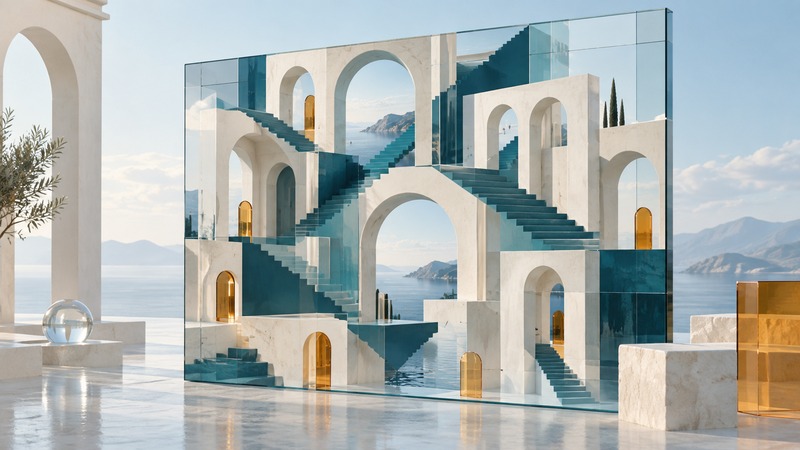
A hyperphoto invites two kinds of looking: the whole composition offers an architectural or landscape world, while close inspection reveals a dense field of details. Jean-François Rauzier builds these worlds from photographs, using arrangement and repetition as artistic materials. The useful question is how the parts change your experience of the whole.
Understand the artist’s use of the term
Rauzier’s gallery, Modern Fine Art, dates his first Hyperphotos to 2002 and provides an overview of his practice with access to works. The term here refers to that artistic approach. It is not a standard camera setting or a fixed resolution threshold.
In Rauzier’s own technical account, published in French in 2006, he discusses photographic assembly, retouching, and digital painting as parts of his process. Read it as the artist’s account of his method at that time. The artistic aim matters as much as the number of component images.
A detailed image can make a space feel convincing while its arrangement becomes increasingly improbable. Repeated windows, transformed scale, and a viewpoint assembled from multiple observations encourage the viewer to alternate between recognizing a place and questioning its construction. These are useful things to look for, rather than a checklist that every work must satisfy.
Compare three reasons for joining photographs
On a narrow screen, scroll the table sideways. Keyboard users can focus the table region and use the arrow keys.
| Approach | Typical aim | Question for the viewer |
|---|---|---|
| Conventional panorama | Extend the field of view of a scene | How does the projection represent the space? |
| Detailed stitched view | Retain fine detail across a large subject | What can I inspect when I zoom in? |
| Constructed hyperphoto | Reorganize photographic material into an imagined world | How do scale, repetition, and arrangement change what the place means? |
These approaches can share tools. Stitching describes an operation; it does not determine the image’s purpose. A panorama can contain creative interventions, and a constructed artwork can retain highly precise local detail. Assess the stated intention and the visible evidence together.
Look in three passes
- At whole-image scale, describe the dominant shape, rhythm, or direction. Decide where your eye first enters and whether the space feels open, enclosed, endless, or unstable.
- Move closer or use the gallery’s available detail views. Pick one small area and inspect objects, repeated elements, transitions, and changes of scale. Record what you actually see.
- Return to the whole. Ask whether the detail supports your first reading or changes it. A tiny recognizable object can alter the apparent scale of an immense architectural arrangement.
Use the gallery’s work listings to identify a title, date, medium, and dimensions where available. A small web preview cannot convey every detail or the physical scale of a large print. When detail views are unavailable, state that limit in your notes instead of inventing what a closer view might reveal.
For exhibition visits, check the venue’s current dates and location directly. An artist biography or past exhibition announcement establishes a history of showing work; it does not establish that a particular work is on view today.
Build an interpretation from specific evidence
Separate observations from associations. A repeated arch is visible; a feeling of memory, confinement, abundance, or fantasy is your response to it. Strong criticism connects the response to a specific feature and allows another viewer to test the connection. Read the artist’s explanation after your first pass, then note what it adds or changes.
A club discussion can compare two viewers’ routes through the same work. Ask each person to identify the first detail noticed, the point where the space became uncertain, and the feature that brought the whole composition together.
Try a small construction study of your own
Use your own photographs of a permitted subject, such as a bookshelf or a building detail you may photograph. Make a small series with consistent light and overlapping details. Begin with a straightforward assembly, then make a separate version in which one element is deliberately repeated or rescaled.
Keep the source files and layered construction. Inspect seams, mismatched light, and perspective, then decide which inconsistencies are deliberate and which merely distract. Label the result as a composite when sharing it. The goal of this exercise is to understand how assembly changes space and meaning, not to reproduce another artist’s work.
Compare the conventional and constructed versions side by side. Write one sentence about what the intervention adds. If the answer is only “more detail,” reconsider the arrangement until the construction contributes an idea.