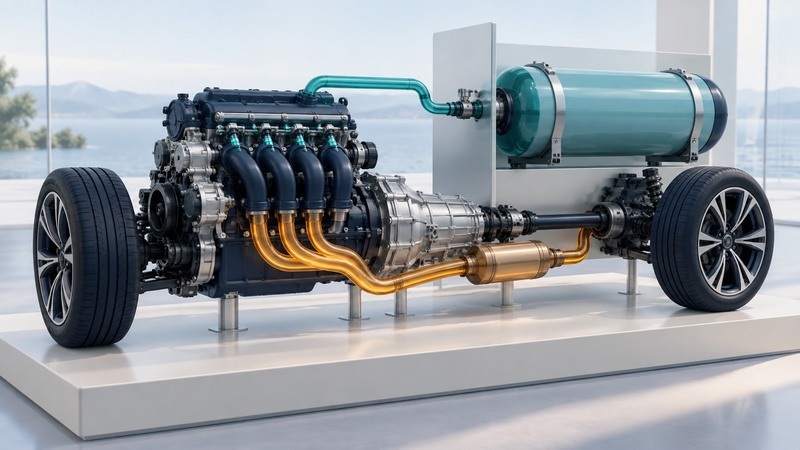
A hydrogen combustion vehicle burns hydrogen in an engine to produce mechanical power. A hydrogen fuel-cell vehicle uses an electrochemical system to supply an electric motor. Both carry hydrogen, but their conversion equipment, emissions behavior and operating requirements differ.
To assess either pathway, begin with the same transport task: payload, route, speed, stops, weather and required availability. Then compare fuel consumed, useful service delivered, storage and refueling needs, and measured emissions within matching boundaries.
Identify the propulsion pathway
On a narrow screen, scroll the table sideways. Keyboard users can focus the table region and use the arrow keys.
| Pathway | Onboard energy conversion | Evidence needed for comparison |
|---|---|---|
| Hydrogen combustion | Hydrogen engine drives the powertrain; hybrid storage may also be present | Fuel consumption over the duty cycle, emissions and aftertreatment behavior |
| Hydrogen fuel cell | Fuel cell supplies electricity to a motor, commonly with a battery | System fuel consumption, battery energy balance and operating limits |
| Battery electric | Stored electrical energy supplies the motor | Vehicle energy use, charging losses and charging/service requirements |
Hybridization adds another accounting step. Compare trips that start and finish at comparable battery state of charge, or apply a documented correction. Otherwise, part of the apparent fuel saving can come from borrowed battery energy.
DOE's 2023 overview of hydrogen combustion engines provides technical context. Use identified vehicle tests for performance claims, and distinguish an engine bench result from a complete vehicle route trial.
Separate tailpipe pollutants from the fuel supply
Hydrogen contains no carbon. Combustion in air can still form nitrogen oxides, and engine lubrication can contribute other emissions. Ask for measured pollutant results at representative load and temperature, including cold operation and the applicable aftertreatment configuration.
DOE's hydrogen and air-pollutant explanation distinguishes combustion from fuel-cell use and discusses NOx control. A low-carbon fuel description and a local air-quality result answer different questions.
For climate impact, include hydrogen production, processing and delivery. Record the production pathway and the electricity or feedstock assumptions. The broader hydrogen energy-chain guide helps organize this upstream boundary. A vehicle's fuel label alone leaves the supply-chain footprint unresolved.
Compare like-for-like fuel use
Fictional route comparison
Two hypothetical vehicles complete the same 200 km service with the same payload and equivalent battery energy at the start and finish. Vehicle A uses 12 kg hydrogen and vehicle B uses 10 kg. Consumption is 6 and 5 kg per 100 km, respectively.
B uses 16.7% less hydrogen than A on that trial. That result alone gives neither engine efficiency nor annual operating cost. Repeat representative conditions, record uncertainty, and include refueling and maintenance requirements before estimating fleet service.
When a source reports efficiency, identify the useful output: engine shaft work, system DC electricity or energy delivered to the wheels. Check whether hydrogen energy uses lower or higher heating value. Compare values calculated at the same boundary and duty, with auxiliaries included consistently.
A peak-efficiency operating point helps describe a machine. A route-average result helps describe a transport task. Ask for both when they influence the decision.
Evaluate the complete storage and refueling arrangement
Record usable hydrogen, storage-system mass and volume, supply pressure or material requirements, withdrawal capability and reserve policy. Compare the full installed assembly, including containment, thermal management and controls. The mass of hydrogen alone understates the vehicle burden.
Metal-hydride systems bind hydrogen within a material and require attention to heat transfer during uptake and release. DOE's metal-hydride research overview identifies capacity, reaction kinetics, cycle life and thermodynamics as important properties. A material measurement needs further engineering evidence before it becomes an onboard-system rating.
For a fleet assessment, verify that the proposed fuel supply can serve the actual vehicles at the required frequency, with qualified maintenance and a contingency during outages. Use the exact vehicle and fueling-system requirements. Engine conversion and pressure-system assembly belong to approved designs and qualified specialists.
Close the comparison with four evidence sets: representative service results, emissions measurements, complete storage/refueling capability and availability/support records. Label prototypes, demonstrations and commercially supported vehicles according to the evidence actually available.