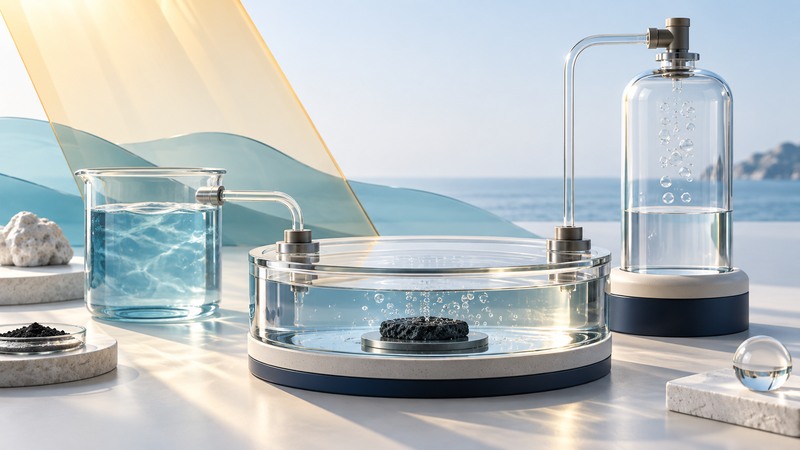
Research on hydrogen from seawater and sunlight combines several challenges: capturing light, producing hydrogen selectively, managing salts and impurities, separating gases and sustaining operation. To interpret a claim, identify the experiment's energy and material inputs before comparing its output with another process.
A catalyst experiment, a complete water-splitting device and an integrated hydrogen plant represent different levels of evidence. This guide helps readers record what was demonstrated and what remains to be established.
Identify how light and electricity enter
Photocatalytic and photoelectrochemical systems use light-responsive materials to drive reactions. Another route uses photovoltaic electricity to power an electrolyzer, with water treatment as required by that equipment. Draw the boundary around the arrangement actually tested.
DOE's photoelectrochemical water-splitting explanation identifies efficiency, durability and cost as development needs. An electrically assisted experiment should report the applied electrical input as well as illumination. If a chemical reagent is consumed to support hydrogen evolution, include it in the material and energy account.
Guo and colleagues' MoS₂/TiO₂ photocatalyst paper was first published online in September 2017 and appeared in the 2018 journal volume. It reports a light-harvesting heterostructure for hydrogen evolution. A material-level improvement needs additional system evidence before supporting a plant-level cost or efficiency conclusion.
Read the experimental conditions
On a narrow screen, scroll the table sideways. Keyboard users can focus the table region and use the arrow keys.
| Topic | Record | Why it matters |
|---|---|---|
| Light | Spectrum, intensity, illuminated area and exposure time | Lamp power alone does not define incident energy at the sample |
| Water and reagents | Natural or simulated seawater, pretreatment, pH and additives | Different electrolytes represent different tasks |
| Other inputs | Electrical bias, heating, pumping and consumed chemicals | The system boundary determines the performance measure |
| Gas measurement | Hydrogen amount, purity, calibration and collection method | Bubbles alone provide insufficient production evidence |
| Reaction balance | Other products and the companion oxidation reaction | Hydrogen evolution alone leaves overall water splitting unresolved |
| Durability | Duration, operating conditions, degradation and interventions | A short test and sustained operation establish different things |
For an electrochemical result, also record current density and electrode area. Check whether efficiency uses lower or higher heating value and whether it describes the stack, device or complete installation. Compare values only after aligning these definitions.
Check a simple solar-energy calculation
Fictional boundary check
Assume 1.0 kWh of sunlight reaches the defined aperture during a test and the collected hydrogen contains 0.08 kWh on a stated heating-value basis. With sunlight as the sole counted energy input, the ratio is 8%.
If the experiment also receives 0.10 kWh electricity, total supplied energy becomes 1.10 kWh and the corresponding ratio is 7.27%. Report the sunlight and electrical inputs separately and name the metric. Consumed reagents or external heat would require further accounting.
These invented values illustrate how a boundary changes interpretation. They are not performance figures from the cited experiments.
A rate per gram of catalyst is useful for comparing material activity under controlled conditions. Converting that rate into plant output requires illumination area, reactor behavior, duty cycle, losses and balance-of-plant data. Preserve the original metric until those inputs are available.
Keep seawater tests and device tests distinct
Salts and other constituents can affect selectivity, corrosion, precipitation and long-term operation. Record the actual water composition and any treatment or replenishment. Natural seawater and a laboratory salt solution establish different exposure conditions.
A 2024 Nature Communications study provides a useful example of careful scope: it reports a catalyst test in natural seawater and a separate flow-electrolyzer test in simulated seawater at 60°C. Those conditions should travel with the respective results. The work concerns electrically driven electrolysis; it does not by itself establish sunlight-only performance.
When comparing direct seawater research with treatment plus electrolysis, include treatment energy, water recovery, consumables, maintenance, gas handling and the electrolyzer's specified feedwater requirements. Avoid giving either pathway free inputs or excluding a difficult process step.
Write a conclusion proportional to the evidence
Use a short evidence statement: “Under these conditions, this material or device produced this measured result for this duration.” Follow it with the unresolved requirements for the intended application, such as full reaction balance, long-duration stability, gas purity or a complete system energy balance.
Independent reproduction, realistic exposure and sustained integrated operation strengthen a scale-up claim. Cost needs a separate model with equipment life, replacement, capacity utilization and operating inputs. Record those assumptions before describing a laboratory improvement as cheaper hydrogen.
The hydrogen energy-chain guide covers what happens after production, including the further steps needed to deliver useful hydrogen service.
Solar-hydrogen evidence worksheet
Solar-hydrogen evidence worksheet — plain-text download. Save a copy and fill it in with your own information. The file includes instructions, assumptions and references so it can be used independently.