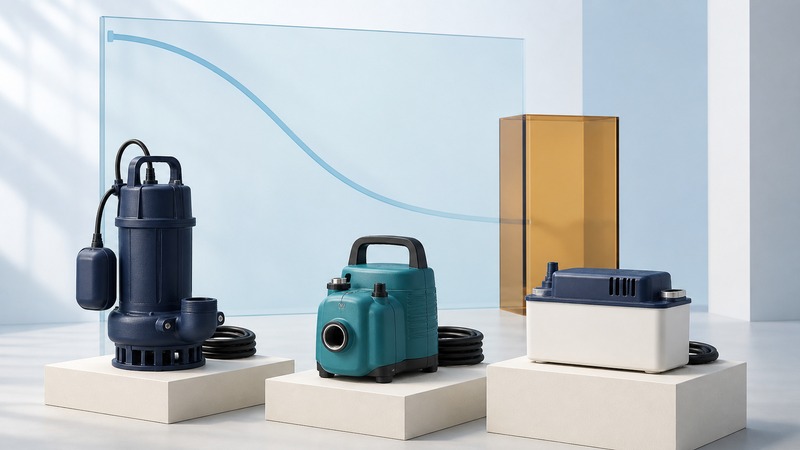
Start a pump purchase with a description of the water and where it needs to go. The useful specification is how much that pump can deliver through your proposed discharge system. Match the application, performance curve, controls, and maintenance access as one system.
Choose the application first
Swipe horizontally to read the table, or focus it and use the arrow keys.
| Type | Typical purpose | Selection questions |
|---|---|---|
| Sump pump | Move collected groundwater from a sump basin | Required flow at head, basin fit, float clearance, discharge route, backup |
| Utility or transfer pump | Move suitable water for a temporary task | Permitted liquids, solids size, suction or submersion needs, start and stop water levels |
| Condensate pump | Collect and lift drainage from HVAC equipment | Equipment compatibility, liquid temperature, lift, reservoir, overflow switch |
For sewage, corrosive liquids, or water with substantial debris, ask a qualified supplier to specify equipment rated for that liquid and service. Describe the material present and the likely temperature. Give the installer the actual model number and intended use of the connected equipment.
Condensate products vary by application and model suffix. Little Giant’s VCMA-15 specifications distinguish versions with and without a safety switch. Ask the HVAC technician to confirm compatibility with the appliance and how overflow protection will operate. Include any required condensate treatment and the approved discharge destination in the scope.
Read flow at the required head
Flow describes the amount of water moved per unit of time, commonly gallons per minute (gpm) or gallons per hour (gph). Head describes the energy the pump must supply, expressed as a height of liquid. Total dynamic head includes the vertical lift and the resistance of the discharge piping at the intended flow. Pipe length, diameter, fittings, and valves affect that resistance.
Use the performance curve for the exact pump to find its flow at the calculated total dynamic head. The maximum-head figure marks the shutoff end of a typical centrifugal-pump curve, where useful delivery approaches zero. Zoeller’s sizing resources identify head, flow, and solids handling as central selection factors. Have the supplier check the operating point and application limits.
Give the supplier a sketch with the basin, outlet elevation, pipe sizes, approximate lengths, fittings, and destination. Ask the supplier to document the head calculation and mark the proposed operating point on the model’s curve. This makes two pump quotations easier to compare.
Plan controls, discharge, and backup
Allow room for the float or level sensor to operate freely, and provide service access to the pump and controls. Have the installer select the check-valve arrangement and assess cycling behavior. Zoeller’s product-support guidance explains how basin dimensions and the on/off pumping range influence short cycling.
Agree on a lawful discharge location with the installer and local authority. Review where the discharged water travels, seasonal freezing exposure, and how the system will be checked for blockage. Include this work in the quote alongside electrical supply and any required permits.
For a critical sump, discuss a high-water alarm and a backup that matches the outage scenario. A separate battery-powered pump needs capacity at the required head, a suitable battery, charging, and periodic testing. Ask how long it can operate under your expected inflow, what happens if the main pump fails, and how an alert reaches you when you are away.
Handle flooding and power safely
During flooding, follow local emergency instructions and establish that entry and electrical conditions are safe before operating equipment. Never enter standing water to reach a switch or plug. CDC’s flooded-home guidance calls for an electrician when reaching the main switch would require entering water, and for electrical assessment before restoring power.
Keep gasoline-powered pumps outdoors, at least 20 feet from windows, doors, and vents, with exhaust directed away from the home. Never operate them inside a home, basement, garage, or enclosed space. CDC’s power-outage safety guidance explains the carbon-monoxide precautions for gasoline-powered engines. Arrange a suitable professional response for contaminated water and structurally damaged spaces.
Make the service plan part of the purchase
Before handover, have the installer demonstrate normal startup and shutdown, the approved test procedure, alarm behavior, and the response to loss of power. Save the exact pump, switch, controller, and battery model numbers. Ask which observations you can safely make and which tasks require a technician.
Use the manual’s inspection interval and procedure. Record test dates, alarm results, battery checks, discharge observations, and service work. A change in sound, repeated cycling, or rising water deserves a timely investigation. Give the technician the observation record and the original system sketch so the diagnosis starts with the whole installation.