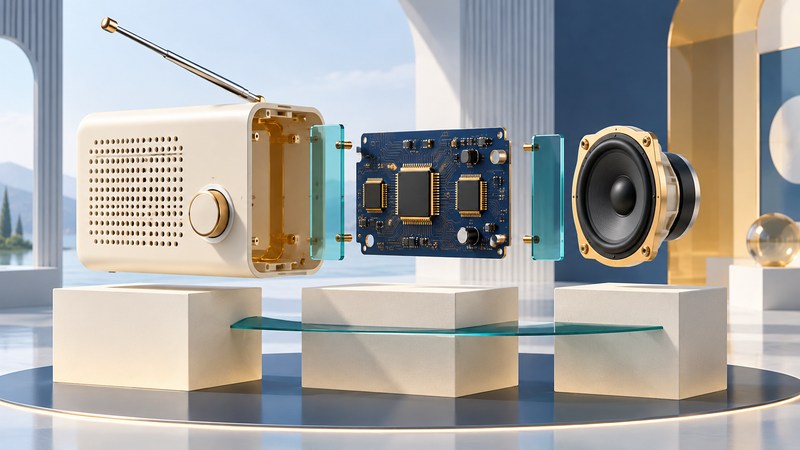
An HD Radio processor recovers digital broadcast information and helps turn it into audio and data. It operates within a receiver that also needs an antenna, RF circuitry, clocks, software, audio electronics and controls. A processor’s feature list becomes a listening feature only when the complete product implements it.
On a narrow screen, swipe tables sideways or focus them and use the arrow keys.
Trace the signal from antenna to listener
- Antenna and RF front end: admit the wanted broadcast
- Tuning, filtering and conversion: produce a usable signal for digital processing
- Synchronization, demodulation and error correction: recover digital information
- Audio decoding and data handling: produce sound and program information
- Audio output and user interface: drive the listening system and display
These are functional stages, not a required count of chips. Integration can put several stages into one device, and the location of analog-to-digital conversion varies by architecture. A radio may also maintain an analog reception path. Reading the block diagram is more informative than counting packages on a board.
The NXP SAF3560 short datasheet, revision 5 (2013, PDF) provides a concrete receiver diagram including tuners, IF processing, digital-radio processing, audio and data rendering. Its part-specific functions and interfaces illustrate how a digital processor fits into a larger design.
Separate four kinds of processing
| Function | Reader-friendly meaning | Question for a product design |
|---|---|---|
| Demodulation | Recover information carried by the digital radio signal | Which broadcast modes and input interfaces are supported? |
| Error correction and decoding | Use the transmitted coding to recover useful data | Under what reception conditions can the receiver sustain decoding? |
| Audio handling | Turn coded audio into samples and route or process them | Which outputs, mixing, volume and audio-processing functions are implemented? |
| Metadata and controls | Deliver program information and accept user commands | What does the host software display, select and store? |
Song information on a screen requires both broadcast data and receiver software that handles it. A second digital audio service requires a suitable broadcast plus receiver support. Recording adds storage and product behavior beyond the presence of a radio processor. Evaluate the finished product’s manual alongside a chip datasheet.
Understand the move toward integrated radios
Early digital-radio designs often added a dedicated processor to an existing receiver chain. The engineering opportunity was to reuse tuning and audio work while adding digital reception. Integration can later reduce board area and external connections, but it also shifts work into firmware, clocks, interfaces, power and validation.
NXP’s SAF4000 product description illustrates a later software-defined platform spanning multiple analog and digital broadcast standards. Read that as a platform capability: a particular vehicle or tabletop radio still needs the corresponding implementation and product support. A platform’s broad scope is not a firmware-upgrade promise for an arbitrary older receiver.
For a component evaluation, record the supported software package, reference design, host interface, audio interface, memory needs, clocks and supplies. Then identify which functions your team must supply. The most integrated part can still require substantial system engineering.
Use reception behavior to locate the next question
The HD Radio FAQ explains that digital reception requires an HD Radio receiver. For a hybrid station’s main program, an analog path can provide fallback when digital reception is lost. Digital-only additional programs depend on continued digital reception; check the specific receiver’s behavior.
Compare reception in a stationary, repeatable location; record the selected service, antenna arrangement and observable digital indicator. Keep audio routing separate: successful tuning with silence at an external amplifier can be an output or connection issue. Your product manual supplies the relevant controls and indicators.
Read a receiver specification in three passes
- Broadcast: identify the desired local services and their formats.
- Receiver: verify exact model support, antenna connections, user controls and audio outputs.
- Components: use block diagrams and datasheets to understand how a documented design implements those features.
For ordinary listening, the receiver manual and a reception test answer the practical question. For engineering study, trace one audio service and one metadata item through the block diagram, identifying what each stage accepts and produces. That exercise connects the chip’s specifications to something the listener can observe.