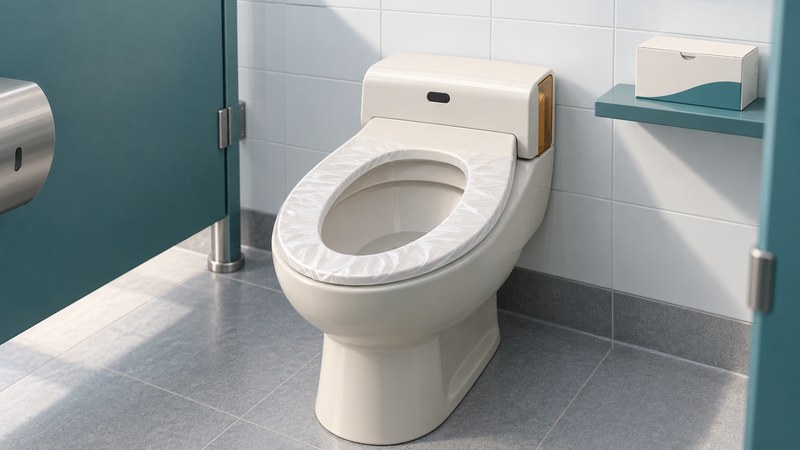
An automatic toilet-seat cover advances a disposable sleeve around the seat for the next user. For an office or other public facility, the buying decision involves the complete service routine: bowl fit, access, power, replacement rolls, cleaning and staff response when the mechanism stops. Ask a supplier to demonstrate those tasks on the proposed model before ordering a building-wide installation.
SaniSeat is one example of this equipment category. Its manufacturer FAQ describes a sleeve that travels around the ring and collects in a separate used-roll compartment. Treat descriptions of the mechanism as product information; claims about disease prevention require separate evidence.
Check the actual toilet and room
Record the toilet manufacturer and model, bowl shape, mounting-hole arrangement, clearance behind the seat, and space around the fixture. Give photographs and measurements to the supplier and obtain confirmation for that combination. A broad “standard toilet” claim leaves too much unspecified for a purchase or retrofit.
| Check | Information to obtain | Why it matters |
|---|---|---|
| Bowl and mounting | Exact compatible seat version, mounting hardware and installation drawing | The seat must be supported and secured as designed. |
| Rear clearance | Housing dimensions and opening space for servicing | A unit can fit when closed yet be difficult to reload. |
| Power and sensor | Battery or wired configuration, charging routine and sensor position | Installation work and daily responsibilities vary by configuration. |
| Access | Finished seat height, approach, transfer space and reachable controls | The completed installation must suit its users and applicable requirements. |
| Consumables | Correct roll code, usable advances, storage and supply lead time | A dispenser depends on compatible refills being available. |
The SaniSeat installation and service manual illustrates several power and sensor arrangements as well as mounting and roll-loading procedures. Obtain the current instructions for the exact equipment being quoted; a different version can require different parts or installation work.
For US facilities, the US Access Board's toilet-room guide explains the applicable ADA layout and equipment provisions. For adult water closets covered by its seat-height provision, the top of the seat is 17–19 inches above the finished floor. Exceptions and children's provisions exist. Have the responsible designer review the complete retrofit, including grab bars and controls, rather than treating a sensor or one dimension as proof of accessibility.
Assign the work behind each fresh cover
Ask the maintenance team to watch a roll change, cleaning demonstration and fault recovery. Identify who checks the remaining supply, where compatible rolls and keys are kept, and who covers absences. Include evenings and weekends if the building stays open.
- At routine inspections: look for visible soil, damaged or bunched sleeve material, loose components, low-supply indications and faults. Follow the model's documented check procedure.
- At reloading: use the correct consumable and the manufacturer's loading path. Confirm that the ring is ready for reloading and that a complete advance finishes correctly.
- At a fault: record the displayed indication and observed behavior, then use the approved service procedure. Staff should know when to take the fixture out of service and how to direct users elsewhere.
Service work can expose moving parts or an internal cutting blade. Keep users away from an opened housing; have trained personnel follow the manual's precautions. Ask the supplier about parts availability, repair turnaround and the approved fallback when supplies or power are unavailable.
Separate a cover change from the cleaning program
A cover changes the contact surface presented to a user. Evaluate that function alongside cleaning of the ring, housing, sensor, flush controls and surrounding restroom. The CDC's community-facility guidance calls for regular cleaning of frequently touched surfaces and cleaning before disinfection. Follow the disinfectant label, including surface compatibility and wet contact time, together with the equipment maker's instructions. Healthcare and other regulated settings need their own applicable procedures.
When a supplier offers a health claim, ask what was measured, on which model and material, under what conditions, and whether the result concerns a laboratory surface or illness in real users. A percentage without that context gives a facilities manager little basis for comparison. Maintain handwashing facilities and the existing restroom inspection program when introducing a dispenser.
Estimate refills from advances, not just visitors
Request a delivered price for compatible rolls and the stated number of advances per roll. Include installation, power or batteries, staff time, spare parts and waste collection in the operating comparison. Ask the local waste contractor how used material should be handled; recycling depends on the material and accepted collection route.
Use a trial to decide whether the system fits
Trial a representative location with an agreed inspection schedule. Record successful advances, failed cycles, reload frequency, cleaning and service time, user requests for help, and any access problems. Compare those observations with the existing arrangement using the same measures.
Agree in advance what would justify expansion: reliable operation, workable supply replenishment, staff able to service it, and access reviewed for the completed installation. A good trial provides an operating plan as well as a purchase decision. Explore the rest of the Office Supplies library for other workplace equipment guides.