
A photograph records a view from a particular place and moment. To understand Haiti through images, pair close looking with the photographer’s record, the historical setting and Haitian voices. Poverty is one subject to investigate; a country’s people and history also encompass work, culture, institutions and political choices.
Start with a photograph and its record
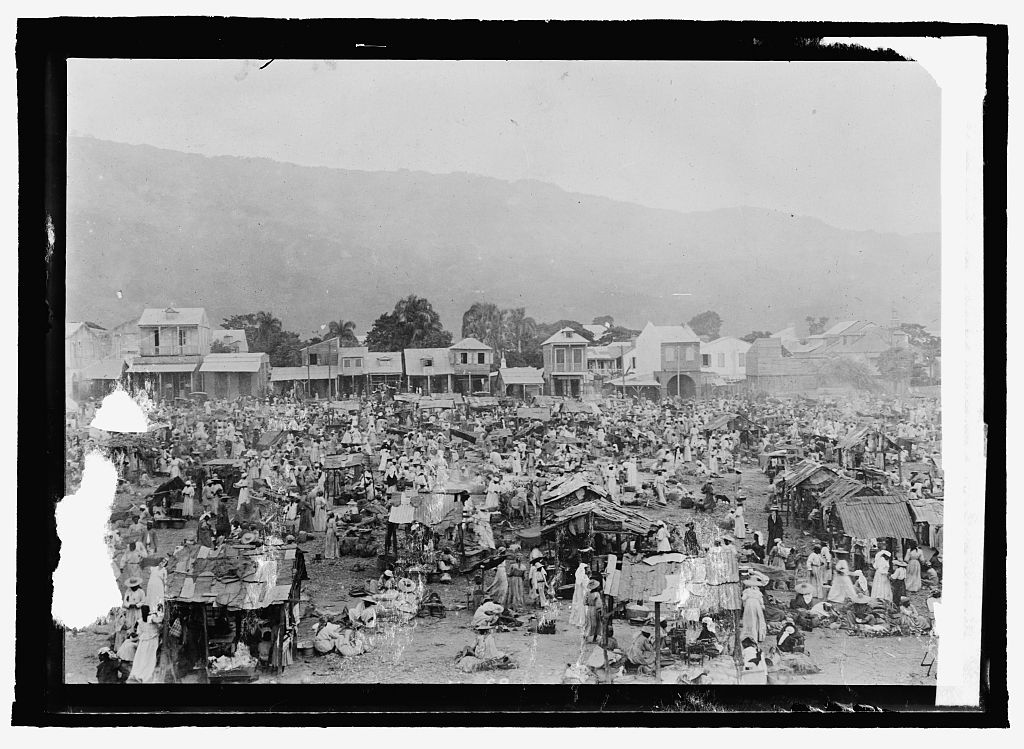
The catalog assigns a date range from neighboring negatives. It also says the title came from unverified company information on the negative or sleeve. Preserve those qualifications when writing a caption; replacing the range with a single year would create false precision.
The record identifies a glass negative and notes possible deterioration. Its rights advisory states that there are no known publication restrictions. The image above retains its visible border and damage.
Separate what you see from what you infer
In the photograph, look first at the dense gathering, temporary-looking stalls, low buildings and hills in the background. These are visible features. The city identification and approximate date come from the catalog. Household incomes, the prices of goods, people’s health and the reasons they are present require other evidence.
| Layer | Example | Next check |
|---|---|---|
| Visible observation | Many people and stalls occupy the pictured space. | Inspect the full image and record what is actually visible. |
| Catalog attribution | The record identifies a market square in Port-au-Prince. | Read the catalog’s source and uncertainty notes. |
| Historical interpretation | A claim about livelihoods or poverty at that time. | Find dated economic records, testimony or historical research. |
Try writing a two-sentence caption: one sentence for the documented identification and one for a visible detail. Then put your interpretation in a separate paragraph with its own sources. This keeps a compelling image from carrying an argument it cannot establish alone.
For comparison, choose another record with a known date and purpose. Check whether the pictures show the same place, season and kind of activity before treating their differences as evidence of change. The image-reading notes provide a reusable record.
Read period books with their dates and viewpoints
Two early-2000s titles offer different starting points. Bibliographic descriptions establish their identity and broad scope; a close review of their arguments requires reading the books themselves.
Eyes of the Heart: Seeking a Path for the Poor in the Age of Globalization
The WorldCat record lists Jean-Bertrand Aristide and Laura Flynn and identifies Common Courage Press’s 2000 publication. Its subject is an argument about poverty and globalization. Approach it as a situated viewpoint: identify the author’s claims, their supporting examples and the historical period they address.
Haiti in Focus: A Guide to the People, Politics and Culture
Practical Action Publishing’s record identifies Charles Arthur and a 2002 publication. It describes a guide spanning people, politics and culture. Use it to orient historical reading, then check later evidence for anything presented as current conditions or travel information.
A useful reading note records the edition, page, claim and cited evidence. An endorsement expresses a reader’s opinion; a publisher’s description describes a book’s intended scope. Neither substitutes for evidence supporting a historical assertion.
Include Haitian cultural institutions and creators
Le Centre d’Art’s institutional history describes its founding in 1944, its role in Haitian artistic creation, and the preservation of works, photographs and archives. Its account also describes the disruption of the 2010 earthquake and the resumption of public activities in 2014.
Use an institution’s account to locate artists, collections and documents, then examine individual records. Record who made an image, why it was commissioned and who supplied its caption. A Haitian artist’s work, a foreign press photograph and an aid organization’s publicity image can frame the same society differently.
Choose sources that let named people and institutions describe their work. Keep the question specific: a market history, an artist’s practice, a local institution or a particular policy. This produces a fuller account than treating every image as an illustration of deprivation.
Add data when making a claim about poverty
A claim about the share of Haitians living in poverty needs a defined measure, observation year, population and source. A photograph can enrich an account of people’s surroundings; a survey or statistical series supplies a different kind of evidence. The poverty-measures guide explains the comparison checks.
For assistance programs, distinguish a plan’s intended beneficiaries from documented delivery and measured results. A document describing a past funding period remains evidence about that period. To discuss subsequent outcomes, seek the project’s evaluation and the relevant later data.
Before sharing a picture, preserve its source link, attribution and date range, and check the intended use against the item’s rights information. Write alt text describing the image, while keeping interpretation and uncertainty in the caption or accompanying prose.
Sources and related reading
Reviewed October 7, 2026. Historical documents retain their own reporting dates; follow the linked official collections for newer releases.
Use the linked catalog, publisher records and Haitian institutional history as starting points for further investigation. Food insecurity and hunger provides another example of connecting images and stories with clearly defined measures.