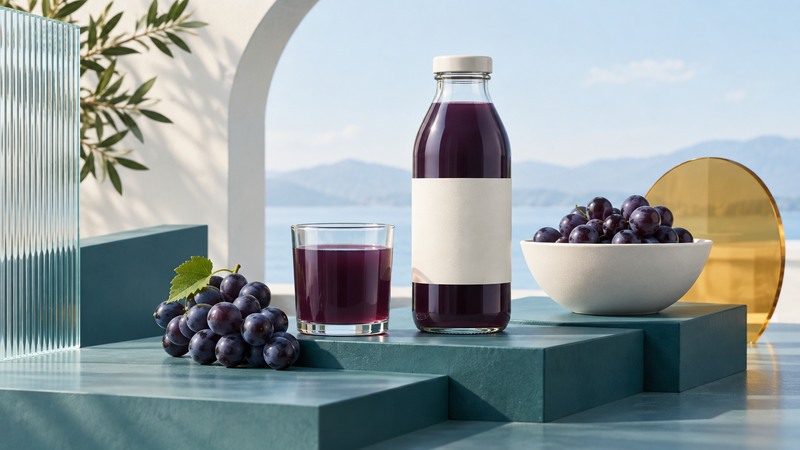
Compare Concord grape juice through its product name, ingredient list and Nutrition Facts panel. Then assess any health claim separately. The amount of a plant compound in a sample and the effect of drinking a particular juice in a human study answer different questions.
Read the front and back of the bottle together
Find the stated juice percentage and identify whether the product is grape juice alone, a blend or a juice drink. Read the ingredients to see which juices, water, sweeteners or other components it contains. A prominent grape image is an invitation to examine the label, not a complete description of the contents.
Record the label serving volume, calories, total sugars, added sugars and any nutrients relevant to your comparison. Keep total and added sugars separate: added sugars form part of total sugars. A zero-added-sugar line can accompany naturally occurring sugars. The FDA's Nutrition Facts guide explains how these fields relate.
If your goal is to compare two bottles, use the same volume. If your goal is to understand lunch, use the amount you will pour. Those can be two different calculations.
Work through a portion example
The values below are fictional labels, chosen to show the method. They are not current nutrition figures for a brand.
On narrow screens, scroll the table sideways. Keyboard: focus the table and use the arrow keys.
| Label or calculation | Juice A | Juice drink B |
|---|---|---|
| Label serving | 240 mL | 300 mL |
| Calories per label serving | 150 kcal | 120 kcal |
| Total sugars per label serving | 36 g | 27 g |
| Added sugars per label serving | 0 g | 15 g |
| Calories per 120 mL | 75 kcal | 48 kcal |
| Total sugars per 120 mL | 18 g | 10.8 g |
| Added sugars per 120 mL | 0 g | 6 g |
For Juice A, a 120 mL portion is half its label serving. For Juice Drink B, 120 ÷ 300 = 0.4 of a serving. Multiply each label value by that fraction. The example shows why “juice” or “added sugar” alone does not settle every nutrition comparison.
If you mix 120 mL of Juice A with 120 mL of plain water, the resulting 240 mL glass still contains 75 kcal and 18 g total sugars from the juice. Dilution changes concentration and taste; drinking the entire glass still delivers the original juice portion. The beverage comparison sheet can help record your own labels.
Put antioxidant rankings on a common basis
Grape polyphenols are an active research topic. A ranking becomes interpretable only when its units, preparation and serving basis are clear. Milligrams per 100 mL, milligrams per customary serving and laboratory antioxidant activity are distinct measures. Rankings using different beverage portions can change when converted to an equal volume.
For a fictional composition example, 90 mg in 150 mL equals 60 mg per 100 mL. Another sample containing 120 mg in 240 mL equals 50 mg per 100 mL. The second serving contains more total compound, while the first sample has the greater concentration. Neither calculation establishes a clinical benefit.
For any real claim, ask what compound was measured, which samples were tested and whether the finding concerns people. Avoid translating “higher in a test” into “better for treating disease.”
What one controlled study can tell you
A 2010 randomized crossover trial enrolled 64 people with modestly elevated blood pressure and compared Concord grape juice with a matched placebo beverage. Participants consumed each beverage for eight weeks. The study found no effect on its primary measure of 24-hour mean systolic blood pressure; some secondary findings warranted further investigation.
This example matters because an attractive secondary finding can receive more attention than the primary result. Read the outcome named in advance, the between-treatment comparison and the population before drawing a conclusion. A trial of a specified drink also supplies limited information about a different brand, a smaller casual portion or a concentrated extract.
Make a useful food choice
Decide whether you want juice for taste, a recipe, a mixer or a convenient drink. Choose the portion, compare the actual labels and follow the bottle's refrigeration and use-after-opening instructions. If you are comparing juice with whole grapes, compare their own nutrition information, including fiber, rather than assuming they are interchangeable by volume.
People following an individualized carbohydrate or fluid plan should use their own plan when selecting portions. For questions about concentrated plant products and clinical claims, continue with POMx and pomegranate evidence. For distinguishing juice blends and cocktails, see cranberry labels.